October 5, 2026 | by Carezone Healthcare
Last Medical & Regulatory Review: 5 October 2026
India Regulatory Context: CDSCO / Ministry of Health & Family Welfare
Primary Audience: Adults, caregivers, pharmacists, pharma distributors, PCD partners and people checking cold-medicine ingredients
Medical Note: This article explains medicine ingredients and current regulatory information. It does not recommend a specific medicine, brand, dose or treatment for an individual patient.
A typical “cold tablet” may contain more than one active ingredient because a common cold can produce several symptoms at the same time—fever, headache, blocked nose, sneezing or a runny nose.
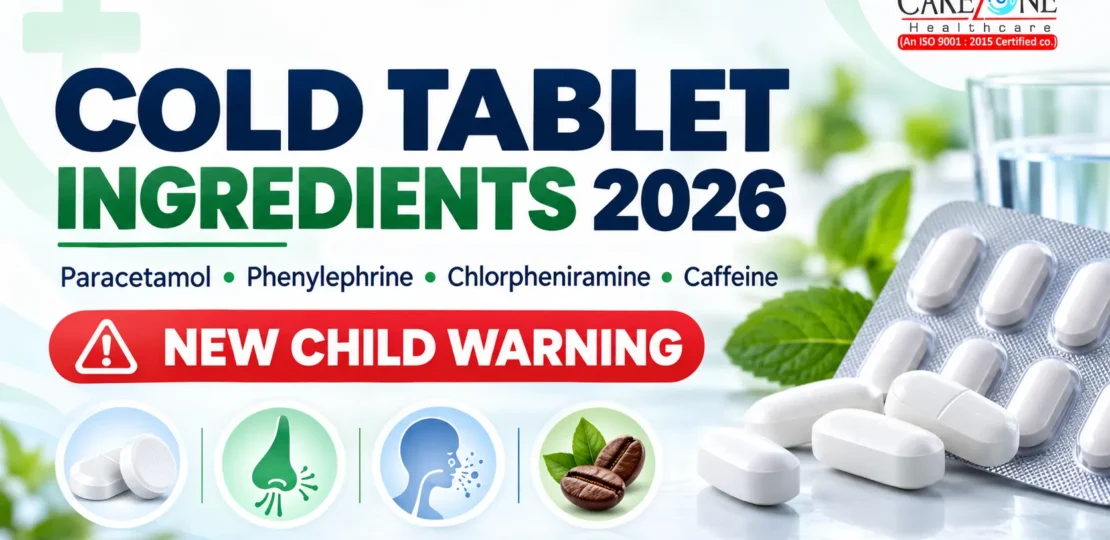
Four names frequently encountered across cold-and-flu formulations are paracetamol, phenylephrine, chlorpheniramine and caffeine.
But these ingredients do not do the same job.
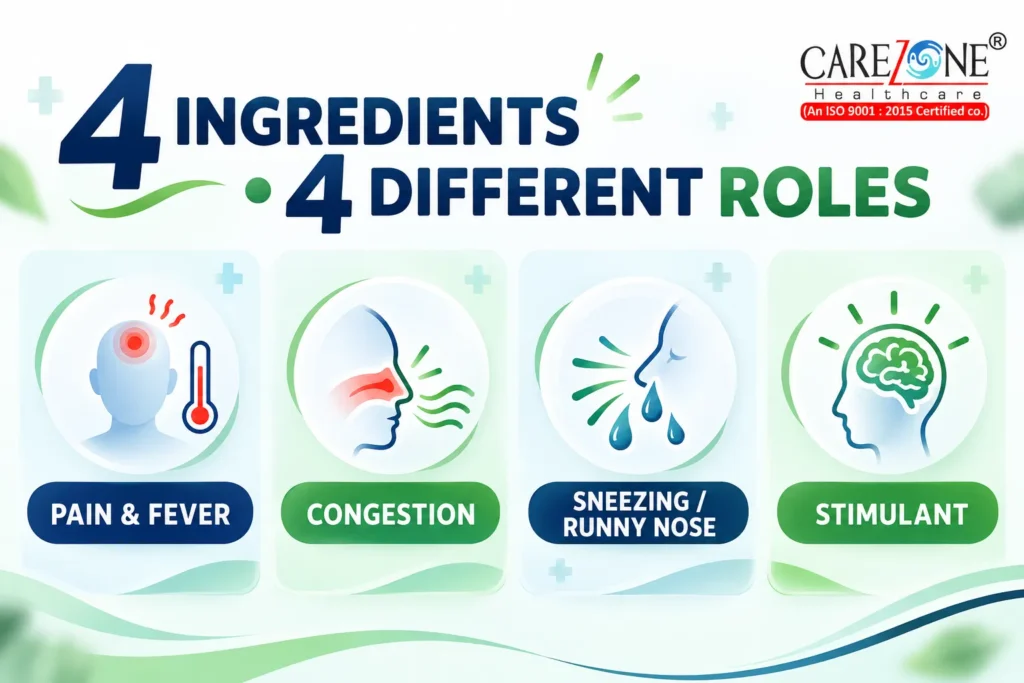
Paracetamol is primarily used for pain and fever. Phenylephrine is intended as a decongestant. Chlorpheniramine is a sedating antihistamine used for allergy-type symptoms such as sneezing and runny nose. Caffeine is a stimulant and is included in some combination medicines.
Understanding those differences matters because taking a multi-ingredient cold medicine without checking its composition can expose someone to ingredients they may not actually need—or duplicate ingredients already present in another medicine.
There is also an important 2026 India child-safety development.
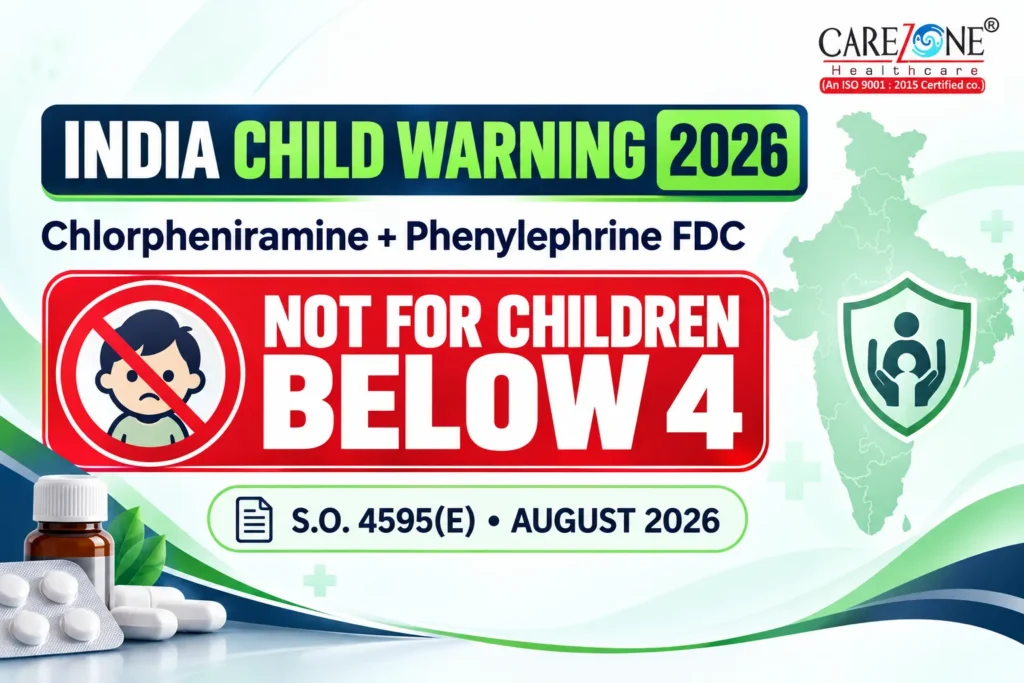
In August 2026, the Government of India extended restrictions to applicable fixed-dose combinations containing Chlorpheniramine Maleate + Phenylephrine Hydrochloride and required the warning that the affected combination shall not be used in children below four years of age.
This guide explains what the four ingredients do, their major safety considerations, what India’s new child warning actually covers, and why the words “cold tablet” alone are not enough to decide whether a medicine is appropriate.
There is no single universal formula called a “cold tablet.”
Different products can contain different active ingredients and different strengths.
A combination may be designed to address several symptoms, but consumers should never assume that all cold tablets contain the same medicines.
Here is the basic role of the four ingredients discussed in this guide:
| Ingredient | Drug Type | Main Intended Role |
|---|---|---|
| Paracetamol | Analgesic / antipyretic | Pain and fever relief |
| Phenylephrine | Decongestant | Intended to reduce nasal congestion |
| Chlorpheniramine | First-generation antihistamine | Sneezing, runny nose and allergy-type symptoms |
| Caffeine | Central nervous system stimulant | Included in some combination medicines; stimulant effect |
Paracetamol, phenylephrine, chlorpheniramine and caffeine target different symptoms or effects. Their presence together does not mean that every person with a cold needs every ingredient.
That distinction is important.
A person mainly experiencing fever and body aches has a different symptom pattern from someone who mainly has sneezing and watery nasal discharge.
Likewise, somebody with a blocked nose but no fever may not have the same medication needs as somebody with several simultaneous symptoms.
More active ingredients do not automatically mean better treatment.
Paracetamol—also known internationally as acetaminophen—is commonly used to relieve pain and fever.
During a viral respiratory illness, it may therefore be included to help with symptoms such as:
It does not kill the cold virus.
It does not directly unblock the nose.
It does not function as an antibiotic.
The NHS describes paracetamol as a medicine used for pain and high temperature and specifically warns against taking it alongside another medicine that also contains paracetamol because accidental excessive intake can be dangerous.
External source:
https://www.nhs.uk/medicines/paracetamol-for-adults/
This is one of the most important consumer-safety issues with combination cold medicines.
Imagine someone takes:
Cold/flu combination tablet
and later takes:
another paracetamol tablet
without checking whether the first product already contained paracetamol.
They may unknowingly be consuming the same active ingredient twice.
The same problem can occur when using two different cold/flu brands at the same time.
Check the label for:
If the ingredients or total exposure are unclear, ask a pharmacist or doctor rather than estimating.
Excessive paracetamol exposure can seriously damage the liver.
Someone who believes they have taken more paracetamol than directed should seek appropriate medical advice even if they initially feel well.
Phenylephrine is used in many cold and allergy preparations as a nasal decongestant.
Its intended role is to reduce congestion by affecting blood vessels within nasal tissues.
MedlinePlus describes phenylephrine as being used for nasal discomfort, sinus congestion and pressure associated with conditions such as colds and allergies.
External source:
https://medlineplus.gov/druginfo/meds/a606008.html
No.
Even when used for symptom relief, phenylephrine does not eliminate the virus responsible for an ordinary viral cold.
Its intended role is symptom management.
Consumers may have seen international headlines claiming phenylephrine “does not work.”
The accurate version requires more context.
In November 2024, the U.S. FDA proposed removing oral phenylephrine from the U.S. OTC monograph for nasal congestion after reviewing evidence and concluding that available data did not support its effectiveness as an oral nasal decongestant at the permitted doses.
The FDA has continued to explain that this action concerns oral phenylephrine, not phenylephrine nasal sprays, and that its proposed action was based on efficacy rather than a newly identified safety problem.
External source:
https://www.fda.gov/drugs/understanding-over-counter-medicines/key-information-about-nonprescription-over-counter-otc-oral-phenylephrine
No.
U.S. FDA regulatory action and Indian CDSCO regulation are separate systems.
The FDA assessment is useful scientific context, but Indian products must be evaluated according to Indian approvals, notifications and labelling requirements.
That distinction is important when discussing medicine regulations online.
People with certain conditions or those taking interacting medicines should not assume that a decongestant is appropriate simply because it appears in a familiar cold product.
The label, prescription and advice of an appropriately qualified healthcare professional remain important.
Chlorpheniramine Maleate—also commonly written as chlorphenamine in some countries—is a first-generation antihistamine.
Histamine contributes to symptoms such as:
Chlorpheniramine works by blocking the action of histamine.
MedlinePlus describes its use for allergy symptoms including sneezing, runny nose and itching, while the NHS classifies chlorphenamine as a sedating antihistamine.
External sources:
https://medlineplus.gov/druginfo/meds/a682543.html
https://www.nhs.uk/medicines/chlorphenamine-including-piriton/about-chlorphenamine/
Older first-generation antihistamines can enter the central nervous system more readily than many newer antihistamines.
As a result, chlorpheniramine may cause:
The NHS specifically advises against driving or cycling if chlorphenamine causes sleepiness, dizziness or blurred vision.
Alcohol can increase sedating effects.
Someone taking a chlorpheniramine-containing medicine should therefore pay attention to the medicine’s alcohol and driving warnings rather than treating it like an ordinary non-sedating tablet.
Medical advice may be especially relevant for people with conditions such as:
MedlinePlus lists several of these conditions among the precautions for chlorpheniramine.
Caffeine is a central nervous system stimulant.
Most people associate caffeine with:
However, caffeine is also included in some medicines.
MedlinePlus notes that synthetic caffeine may be present in some pain relievers and cold medicines.
External source:
https://medlineplus.gov/caffeine.html
Caffeine should not be interpreted as an antiviral ingredient.
Its role in combination medicines is different from that of:
Someone taking a caffeine-containing medicine may also consume caffeine through:
Therefore the tablet is not necessarily the person’s only caffeine exposure.
Higher caffeine intake may contribute to symptoms such as:
The U.S. FDA states that for most healthy adults, around 400 mg of caffeine per day is generally not associated with negative effects, while emphasizing that individual sensitivity, medicines, body weight and medical conditions can change how caffeine affects a person.
External source:
https://www.fda.gov/consumers/consumer-updates/spilling-beans-how-much-caffeine-too-much
That figure should not be interpreted as a target intake or as personalised medical advice.
The easiest way to understand a combination cold tablet is to separate each component by purpose.
| Symptom / Effect | Paracetamol | Phenylephrine | Chlorpheniramine | Caffeine |
|---|---|---|---|---|
| Fever | ✓ Main role | — | — | — |
| Headache/body pain | ✓ Main role | — | — | Not primary role |
| Nasal congestion | — | Intended role | Limited indirect role | — |
| Sneezing | — | — | ✓ | — |
| Runny nose | — | — | ✓ | — |
| Allergy-type symptoms | — | — | ✓ | — |
| Sedating potential | Usually no | Usually no | Yes | Usually stimulating |
| Stimulant effect | — | May have sympathomimetic effects | — | Yes |
A multi-symptom tablet is not automatically appropriate simply because someone says:
“I have a cold.”
The actual symptoms, age, medical conditions, other medicines and product-specific instructions matter.
Combination products have an obvious advantage:
Several symptoms may be addressed with one formulation.
But there is also an equally important limitation:
For example, someone may mainly have:
fever + body ache
but little or no:
sneezing or nasal congestion.
A multi-ingredient product could therefore expose that person to additional active medicines that are not relevant to the symptoms they are trying to manage.
MedlinePlus advises consumers to inspect cough-and-cold labels carefully before using two or more products because different medicines can contain the same active ingredient.
This principle is particularly important with paracetamol.
Two products with similar “cold and flu” branding can have different:
Always read the active ingredient section.
This is the most important regulatory update in this article.
On 18 August 2026, the Government of India issued S.O. 4595(E) concerning applicable fixed-dose combinations containing:
Chlorpheniramine Maleate + Phenylephrine Hydrochloride
CDSCO’s official Gazette Notifications register describes the notification as concerning all formulations of these FDCs in children below four years.
Official CDSCO source:
https://www.cdsco.gov.in/opencms/opencms/en/Notifications/Gazette-Notifications/
The Government’s official explanation states that manufacturers must display the warning:
“Fixed Dose Combination shall not be used in children below four years of age.”
on the label, package insert or promotional literature associated with the affected formulation.
Government source:
https://www.pib.gov.in/newsite/erelcontent.aspx?lang=2®=48&relid=293805
If an applicable fixed-dose combination contains both Chlorpheniramine Maleate and Phenylephrine Hydrochloride, India’s 2026 restriction requires the under-four warning specified by the Government.
No.
One important reason the August 2026 development matters is that the official Government explanation describes the extension as covering all applicable formulations containing the two ingredients together, rather than only one paediatric liquid formulation.
Carezone Healthcare has already published a detailed regulatory analysis addressing the implementation and existing-stock issue:
Internal Link:
Cough & Cold FDC Warning 2026
No.
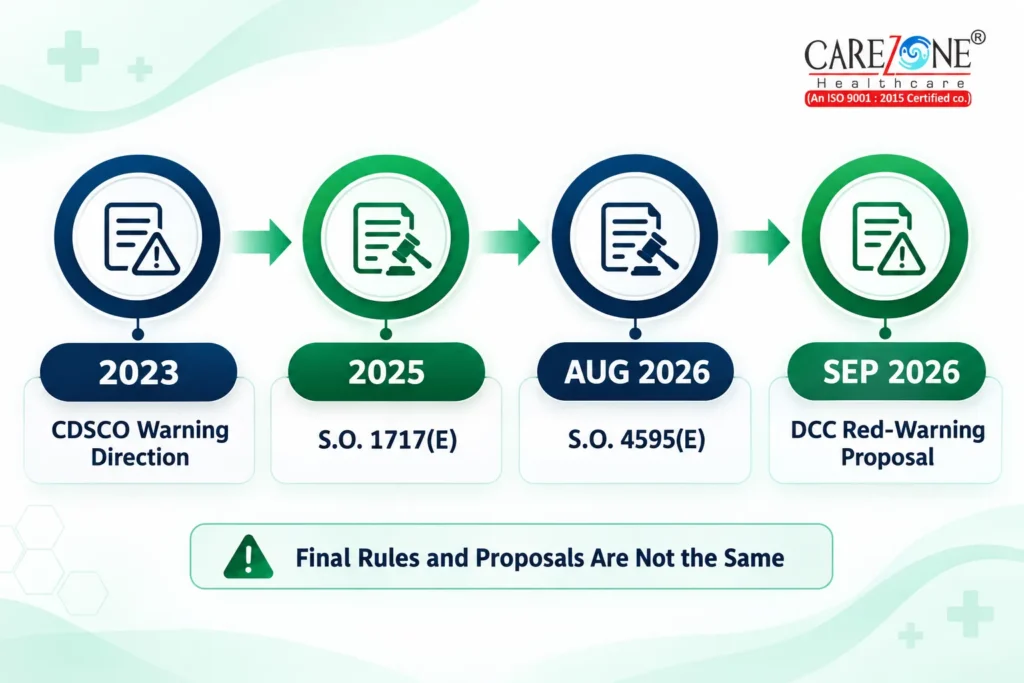
The regulatory history goes back further.
CDSCO directed State and UT Drugs Controllers regarding the specific FDC:
Chlorpheniramine Maleate IP 2 mg + Phenylephrine HCl IP 5 mg drops/ml
and requested an under-four warning after concerns regarding its use and promotion for infants.
Official source:
https://cdsco.gov.in/opencms/resources/UploadCDSCOWeb/2018/UploadPublic_NoticesFiles/FDCpublic18dec23.pdf
The Government issued S.O. 1717(E), restricting the Chlorpheniramine Maleate + Phenylephrine Hydrochloride FDC subject to the same under-four warning.
Official source:
https://cdsco.gov.in/opencms/resources/UploadCDSCOWeb/2018/UploadGazette_NotificationsFiles/S.O.%201717%28E%29%20dt%2015.04.2025.pdf
The Government expanded the requirement through S.O. 4595(E) to applicable FDC formulations containing the two ingredients.
Then came a separate development concerning cough syrups more broadly.
That distinction deserves its own explanation.
Not yet on the basis of the September DCC recommendation alone.
On 18 September 2026, India’s Drugs Consultative Committee discussed concerns regarding cough-syrup prescribing to infants.
The committee agreed in principle that cough-syrup labels should prominently carry a red warning stating that cough syrup should not be used in children below four years.
It also recommended that:
CDSCO published the meeting minutes on 30 September 2026.
Official CDSCO source:
https://cdsco.gov.in/opencms/resources/UploadCDSCOWeb/2018/UploadCommitteeFiles/Minutes%20of%2070th%20DCC%20MEETING%2018.09.2026-1.pdf
There are two related but different developments:
| Development | Status |
|---|---|
| Under-4 warning for applicable Chlorpheniramine + Phenylephrine FDCs under S.O. 4595(E) | Final / operative notification |
| Broader red warning proposed for cough-syrup labels following September DCC meeting | Agreed in principle; rule amendment action to be initiated |
Publishing them as though they are identical would be misleading.
Carezone’s content should maintain that distinction because accurate regulatory interpretation strengthens trust with:
No—not for every person and every context.
The 2026 Government notification should not be simplified into:
“Phenylephrine banned in India.”
or
“Chlorpheniramine banned in India.”
Those statements would be too broad.
The relevant 2026 action concerns fixed-dose combinations containing both Chlorpheniramine Maleate and Phenylephrine Hydrochloride, with the specified restriction regarding children below four and the required warning.
The individual ingredients also appear in other pharmaceutical contexts.
Another important point for pharma businesses:
Discussing four ingredients in one educational article does not establish that every possible four-ingredient FDC, strength or formulation is legally approved for manufacture or sale.
India has issued restrictions and prohibitions affecting numerous specific FDCs over the years.
Manufacturers, marketers and third-party brand owners should therefore verify:
before commercialising any combination.
The fact that a restriction says “below four years” does not mean that every child aged four or older should automatically receive the medicine.
Age is only one factor.
Paediatric medicine decisions may also depend on:
Parents should therefore not interpret “4+” as a universal permission to self-medicate.
For a child with cough, fever, congestion or breathing symptoms, medicine selection should be discussed with a paediatrician, doctor or appropriately qualified healthcare professional.
A product’s label and patient-specific advice take priority, but extra caution may be appropriate for people with:
Because different ingredients raise different considerations.
Paracetamol: duplication and liver toxicity when excessive amounts are taken.
Phenylephrine: decongestant/sympathomimetic considerations and potential interactions.
Chlorpheniramine: drowsiness, dry mouth, impaired concentration and anticholinergic effects.
Caffeine: restlessness, sleep disruption, palpitations or jitteriness in sensitive individuals.
This is why medicine selection should be symptom- and patient-specific, rather than based only on a product’s “cold & flu” branding.
Only after confirming whether the cold medicine already contains paracetamol.
This is an important featured-snippet answer.
Many combination cold medicines already contain a pain and fever ingredient.
Taking another medicine containing the same ingredient can unintentionally increase total exposure.
The NHS specifically warns against taking paracetamol simultaneously with other medicines that contain paracetamol, including some cold-and-flu remedies.
Before combining medicines, compare the active ingredients, not merely the brand names.
If you cannot determine whether the medicines overlap, ask a pharmacist or doctor.
That depends on its ingredients and how they affect you.
A cold tablet containing chlorpheniramine may cause:
The NHS advises people not to drive or cycle if chlorphenamine makes them sleepy, dizzy or causes blurred vision.
Therefore, do not assume that caffeine in the same or another product will “cancel out” sedating effects and make driving safe.
The patient’s actual response and product warnings matter.
It should not be treated as a safety strategy.
Caffeine is a stimulant and chlorpheniramine is a sedating antihistamine, but taking them together does not guarantee normal:
If a medicine causes sleepiness or dizziness, follow the product warning.
Do not rely on coffee, caffeine or an energy drink to make driving safe.
No.
Most common colds are caused by viruses.
Cold medicines primarily aim to manage symptoms.
Depending on the formulation, they may target:
They do not necessarily shorten or eliminate the underlying viral infection.
This is also why antibiotics should not automatically be started for an ordinary viral cold.
Carezone recently explained how cold, influenza and allergy symptoms can overlap:
Internal Link:
Coughless Cold in India 2026 — Cold vs Flu vs Allergy
For the latest influenza context:
Internal Link:
H1N1 in India 2026 — Symptoms, Surveillance & Warning Signs
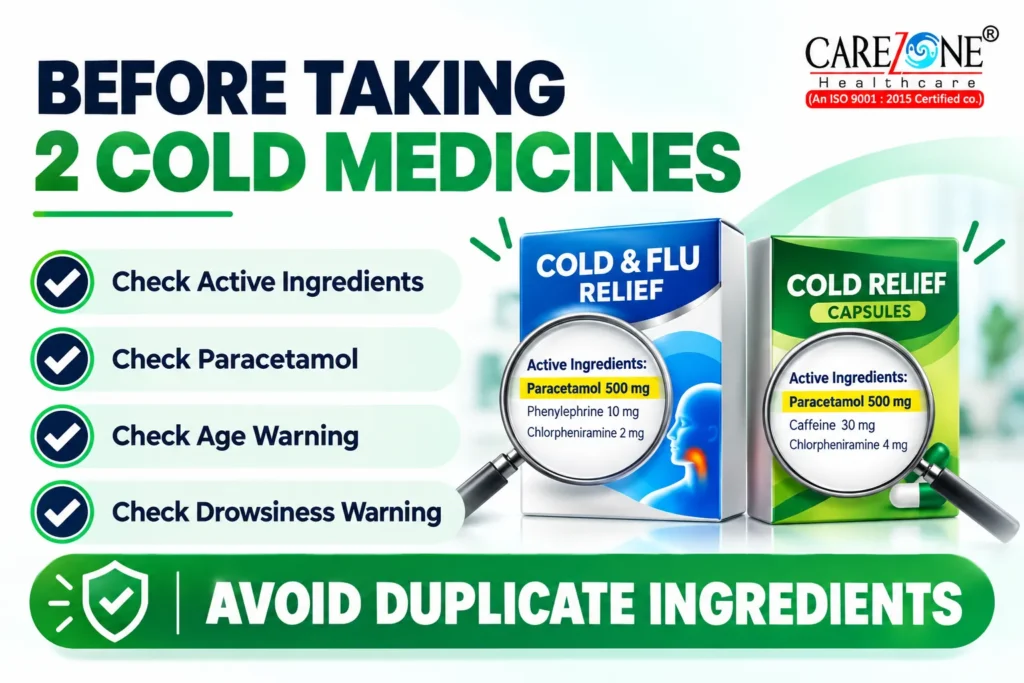
Before using a multi-ingredient cold product, check five things.
What drugs are actually inside?
What amount of each active ingredient is present?
Does the product carry an age restriction?
Are you already taking another product containing:
Check whether the label mentions:
If the label does not answer your question, a pharmacist or doctor is a better source than guessing based on another product with a similar name.
The August 2026 development is not relevant only to parents.
It also carries practical implications for India’s pharmaceutical supply chain.
Affected manufacturers and marketing businesses need to pay close attention to:
For an affected Chlorpheniramine Maleate + Phenylephrine Hydrochloride FDC, promotional artwork should not contradict the mandatory safety warning.
The September DCC recommendation also shows the regulatory direction toward more visible paediatric warnings and less child-oriented imagery on cough-syrup labels, although the broader proposal still requires the applicable rule-making process.
A third-party brand owner should never focus only on:
composition + rate + MOQ.
Regulatory suitability matters equally.
Questions worth checking include:
Carezone Healthcare supports pharmaceutical, nutraceutical and cosmetic third-party manufacturing enquiries, including product, packaging and documentation discussions subject to product feasibility and applicable regulatory requirements.
Internal Link:
Explore Carezone Healthcare Third-Party Manufacturing
PCD partners and distributors sit closer to:
That makes accurate product communication important.
When regulations change, a distributor should avoid making assumptions based on old:
Instead, confirm updated information with the manufacturer or marketing company.
Carezone Healthcare supports territory-based PCD franchise discussions across its product portfolio and provides business buyers with product and catalogue information subject to availability and applicable commercial/regulatory requirements.
Internal Link:
Explore Carezone Healthcare PCD Franchise Opportunities
Businesses evaluating available formulations can also review:
Internal Link:
Carezone Healthcare Product Catalogue & Product Enquiries
A formulation acceptable in one country should not automatically be assumed to satisfy the rules of another.
International buyers may face different requirements concerning:
Carezone Healthcare accepts selected international business enquiries, including product-category and documentation discussions for applicable markets.
Internal Link:
Explore Carezone Healthcare International Export Enquiries
Final export feasibility depends on the destination country’s regulatory and import requirements.
Many mild respiratory illnesses improve with supportive care, but medical assessment becomes more important when symptoms are severe, persistent or unusual.
Seek prompt medical attention for concerning symptoms such as:
People at higher risk of complications—including some older adults, very young children, pregnant people and patients with chronic diseases—may require earlier assessment.
Online information cannot determine the cause of an individual person’s symptoms.
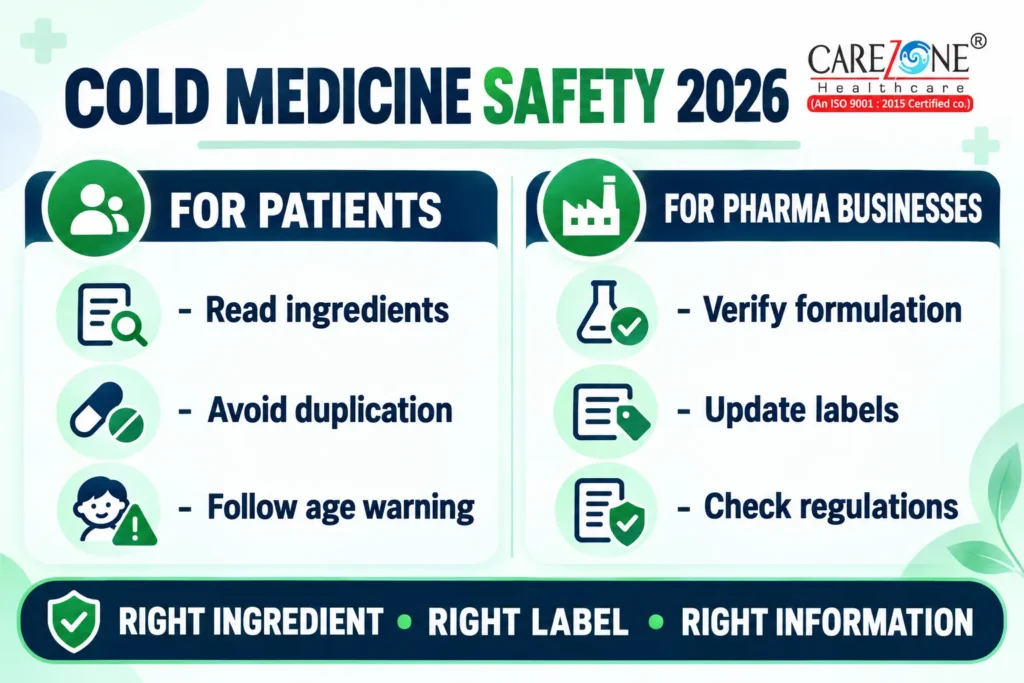
Paracetamol, phenylephrine, chlorpheniramine and caffeine serve different purposes and carry different safety considerations.
Paracetamol is mainly for fever and pain.
Phenylephrine is intended as a decongestant, although evidence regarding the effectiveness of oral phenylephrine for nasal congestion has been questioned internationally.
Chlorpheniramine is a sedating antihistamine that may help runny nose and sneezing but can impair alertness.
Caffeine is a stimulant that may also add to a person’s total daily caffeine exposure.
The most important 2026 India regulatory point is that applicable fixed-dose combinations containing Chlorpheniramine Maleate + Phenylephrine Hydrochloride must carry the prescribed warning and should not be used in children below four years of age under S.O. 4595(E).
A separate September 2026 DCC recommendation proposes a more prominent red under-four warning across cough-syrup labels, but that broader development should currently be described as an in-principle recommendation moving toward rule amendment, rather than as an already-final blanket rule.
For consumers, the practical message is simple:
Read the ingredients, avoid duplicate medicines, take child warnings seriously and seek professional advice when the appropriate medicine is unclear.
Cold-tablet formulations vary. Common ingredients across different products can include paracetamol for pain and fever, phenylephrine as a decongestant, chlorpheniramine for allergy-type symptoms such as sneezing and runny nose, and caffeine as a stimulant. Not every product contains all four ingredients.
Paracetamol is mainly used to reduce fever and relieve headache, body aches and other pain associated with cold or flu symptoms. It does not cure the underlying virus.
Phenylephrine is intended to temporarily relieve nasal congestion. However, the U.S. FDA has proposed removing oral phenylephrine from its OTC nasal-decongestant monograph after concluding that evidence did not support its effectiveness at approved OTC oral doses. This U.S. position does not automatically determine Indian regulatory status.
Chlorpheniramine is an antihistamine that may help symptoms such as sneezing and runny nose. Because it is a sedating antihistamine, it can cause drowsiness and affect concentration.
Caffeine is a stimulant included in some combination medicines. People should remember that coffee, tea, cola, energy drinks and other medicines can also contribute to total caffeine intake.
India’s S.O. 4595(E), dated 18 August 2026, applies to relevant fixed-dose combinations containing Chlorpheniramine Maleate and Phenylephrine Hydrochloride and requires a warning that the affected FDC shall not be used in children below four years of age.
No. The 2026 restriction should not be described as a universal ban on the individual ingredients. It addresses affected FDCs containing both ingredients and specifically prohibits their use in children below four while imposing the specified warning requirement.
Not on the basis of the September 2026 DCC recommendation. DCC agreed in principle that cough-syrup labels should prominently carry a red under-four warning and said necessary action for amendment of the Drugs Rules may be initiated. The recommendation therefore represents an important regulatory direction, but it should not yet be misreported as the final amended rule for every cough syrup.
Check the cold tablet’s ingredients first. Many combination cold medicines already contain paracetamol. Taking another paracetamol-containing product can unintentionally duplicate the ingredient.
Yes. Chlorpheniramine is a sedating antihistamine and may cause drowsiness, dizziness or reduced concentration. Do not drive if the medicine affects your alertness.
No. Caffeine should not be relied upon to reverse medicine-related impairment. If a product causes drowsiness or dizziness, follow the medicine warning and avoid driving or operating machinery.
No. Cold medicines usually provide symptom relief. They do not eliminate the viruses responsible for an ordinary common cold.
Understanding a formulation involves more than knowing its ingredient names.
For pharmaceutical businesses, current regulations, appropriate labelling, product documentation, packaging and market suitability are equally important.
Carezone Healthcare, Ambala, supports business enquiries across pharmaceutical, nutraceutical and selected healthcare categories, including:
With a portfolio spanning multiple dosage forms and product categories, Carezone works with pharma entrepreneurs, distributors and business buyers seeking structured product and partnership discussions.
Internal Links:
Contact Carezone Healthcare for a Business Enquiry
Business enquiries should always be subject to product availability, documentation, applicable licences, regulatory feasibility and final commercial discussion.
This article is provided for general educational and pharmaceutical-regulatory awareness only.
It should not be used to:
Medicine compositions, approvals, indications and warnings vary by product and jurisdiction.
For treatment decisions, consult an appropriately qualified doctor, paediatrician or pharmacist.
For pharmaceutical regulatory decisions, manufacturers and businesses should verify the latest CDSCO/Government notifications and their applicable State Licensing Authority requirements.
View all