September 28, 2026 | by Carezone Healthcare
Last Medical & Regulatory Review: 28 September 2026
Current India Context: Seasonal respiratory illnesses and influenza remain under surveillance
Primary Audience: Adults, caregivers, healthcare readers, pharmacists and people searching for cold/flu symptom information
Medical Note: “Coughless cold” is a descriptive phrase appearing in recent reporting, not an officially recognised new virus name or standalone diagnosis
The phrase Coughless Cold in India 2026 has begun attracting attention after recent reports described people experiencing a blocked or runny nose, watery eyes and other cold-like symptoms without the usual cough or chest congestion.
A recent Kolkata report used the term “coughless cold” for this symptom pattern and quoted doctors who suggested that symptoms may sometimes remain concentrated in the nose and upper airways rather than significantly involving the lower respiratory tract.
That does not mean India has officially identified a new virus called “coughless cold.”
In fact, the Union Ministry of Health and Family Welfare stated on 25 August 2026 that seasonal influenza trends were being monitored nationally and that available surveillance had not detected a new or unusual influenza strain. ICMR said the H1N1 viruses then circulating showed expected seasonal changes rather than evidence of a new influenza threat.
So what does a “coughless cold” actually mean?
Can a viral cold happen without coughing?
Could the symptoms instead be allergy, influenza or another respiratory illness?
And when is it reasonable to monitor symptoms at home versus seeking medical advice?
This Carezone Healthcare guide explains the current evidence without turning a news phrase into a medical diagnosis.
The term Coughless Cold in India 2026 is currently best understood as a descriptive phrase for a symptom pattern, rather than the formal name of a recognised disease.
A recent report from Kolkata described people experiencing:
without significant:
Doctors quoted in that report suggested that one possible explanation is infection or irritation remaining concentrated in the nasal passages and upper airway instead of strongly involving the lower respiratory tract.
A “coughless cold” generally describes cold-like nasal symptoms occurring without much cough. It is not currently an official new-virus diagnosis.
That is an important distinction.
A search trend or newspaper phrase should not automatically be converted into a new medical disease name.
There is currently no official evidence reviewed for this article that identifies a new virus called “coughless cold.”
The strongest national public-health context available comes from the Ministry of Health and ICMR.
On 25 August 2026, the Government stated that:
Government of India: Seasonal influenza surveillance update
That Government statement was issued on 25 August 2026.
The “coughless cold” report appeared later in September.
Therefore, the responsible conclusion is:
No official health authority cited in this review has named “coughless cold” as a new virus.
That is different from saying:
“No respiratory virus could possibly change in the future.”
Respiratory surveillance continues precisely because viruses and circulation patterns can change over time.
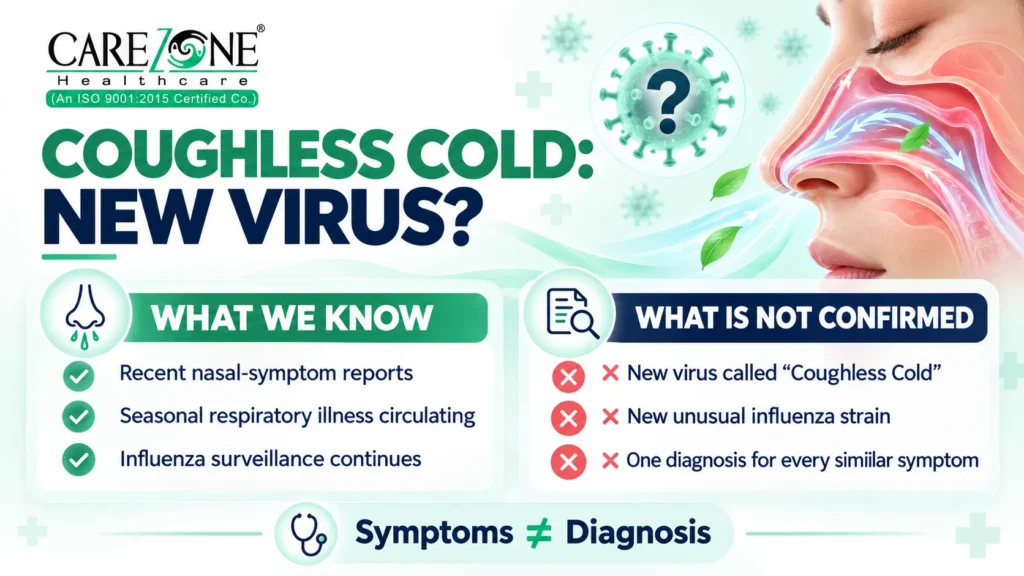
India has experienced increased attention around respiratory symptoms during the 2026 monsoon/post-monsoon period.
The Health Ministry reviewed H1N1 preparedness in August and emphasised continued surveillance of:
Separately, physicians interviewed in September noted that changing weather, influenza circulation and allergy triggers can make it difficult for people to distinguish a cold from allergy or flu by symptoms alone.
This creates a search behaviour problem:
Someone with a runny nose may search:
“cold”
someone with watery eyes may search:
“allergy”
and someone with fatigue may search:
“flu.”
But symptom overlap is substantial.
The recent “coughless cold” reports primarily describe upper-airway symptoms without prominent coughing.
Possible symptoms may include:
However, these symptoms are not specific to one disease.
They can overlap with:
Watery or itchy eyes and repeated sneezing may suggest an allergic component more strongly than an ordinary viral cold—but symptoms alone still do not prove the diagnosis.
Yes, it is possible to experience a cold without every textbook symptom appearing.
The CDC describes the common cold as an upper-respiratory viral infection whose symptoms can include:
The phrase “can include” is important.
It does not mean every person must develop every symptom.
A cough is common with colds, but the absence of cough does not by itself rule out an upper-respiratory viral infection.
Likewise, having no cough does not prove the illness is a cold.
Respiratory illnesses do not always affect every part of the respiratory tract equally.
The common cold is fundamentally an upper respiratory tract infection.
Symptoms concentrated in the nasal passages may therefore involve:
without prominent lower-airway symptoms.
Recent physicians quoted in Kolkata similarly suggested that the so-called coughless pattern could reflect irritation or infection largely confined to the nasal area.
Allergic rhinitis commonly causes:
So a person should not conclude:
“No cough = definitely viral.”
A typical common cold often develops gradually.
Common features include:
A “coughless cold” description mainly differs in one obvious way:
the cough is absent or minimal.
Otherwise, much of the nasal symptom pattern may overlap with an ordinary upper-respiratory infection.
Common Cold: cough may occur.
“Coughless Cold”: nasal symptoms dominate with little or no cough.
This distinction is descriptive—not diagnostic.
Flu and common colds are caused by different viruses.
CDC notes that influenza is generally more severe than the common cold, while WHO describes influenza as often beginning suddenly with symptoms including:
Symptoms are:
However:
Flu cannot always be reliably diagnosed from symptoms alone.
Special testing may sometimes be needed, particularly when treatment decisions matter.
WHO India: Influenza information
Allergy can look remarkably similar to a cold.
An Indian expert consensus on allergic rhinitis describes common features including:
CDC also notes that pollen-related allergic rhinitis can cause:
while allergic conjunctivitis can cause:
Allergy becomes more plausible when symptoms involve:
An infection may be more likely when there is:
These are clues, not diagnostic rules.
| Feature | Common Cold | Influenza | Allergy |
|---|---|---|---|
| Cause | Respiratory viruses | Influenza virus | Allergic reaction |
| Onset | Usually gradual | Often sudden | Often linked to exposure |
| Runny nose | Common | Can occur | Common |
| Blocked nose | Common | Sometimes | Common |
| Sneezing | Common | Less prominent | Often prominent |
| Itchy nose/eyes | Less typical | Less typical | Common |
| Watery eyes | Can occur | Less characteristic | Common |
| Cough | Common but not universal | Common | Can occur but not defining |
| High fever | Less typical in adults | More common | No |
| Strong body aches | Usually mild | More common | No |
| Marked fatigue | Usually mild | Often prominent | Variable |
Important: This table helps with understanding patterns; it cannot diagnose an individual illness.
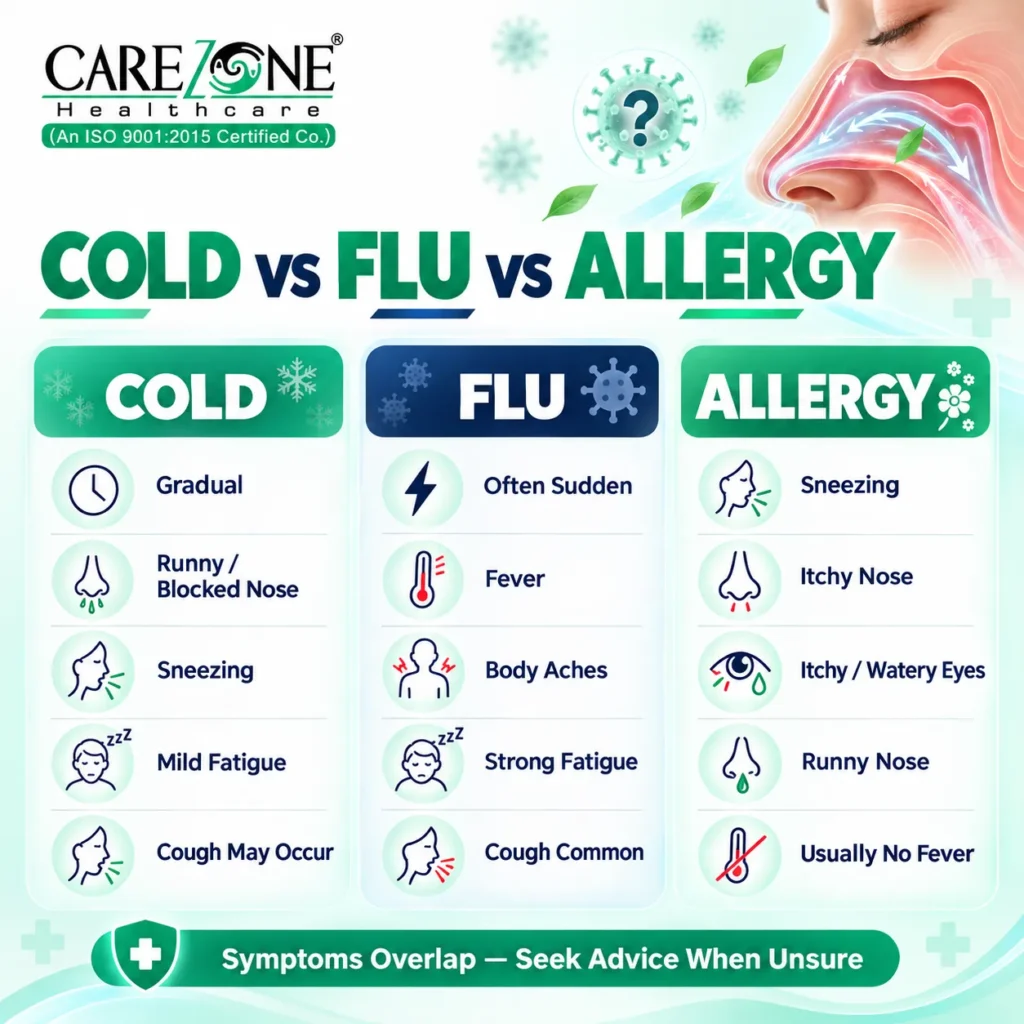
Not always.
Cold, influenza, allergy, COVID-19 and other respiratory conditions can overlap.
CDC specifically notes that cold and flu can be difficult to distinguish based only on symptoms.
People at increased risk from influenza or another respiratory infection may need professional assessment or testing even when symptoms initially seem mild.
This is particularly important for:
No cold tablet cures the viral infection that causes an ordinary cold.
Most cold medicines are intended to reduce symptoms, not eliminate the underlying virus.
CDC states that most colds improve on their own and that there is currently no cure for the common cold.
This distinction matters because people often search:
when what they actually need to understand is:
Which symptom is being treated, and is that ingredient appropriate for that person?
Carezone already has an established educational article covering anti-cold tablet brands and cold-medicine searches:
Top 10 Anti-Cold Tablet Brands in India — Carezone Healthcare
That article should be used as general product-category information rather than as a personalised prescription guide.
Combination cold medicines may contain ingredients from different symptom-relief categories.
Common categories can include:
These may help manage:
Paracetamol/acetaminophen is commonly present in many multi-symptom products.
These may help certain symptoms such as:
depending on the ingredient and context.
These are intended to reduce nasal congestion.
These ingredients do not all serve the same purpose.
A person with:
runny nose only
may not need the same medicine combination as someone with:
fever + headache + nasal congestion.
Medication selection should therefore not be based only on the words “cold tablet” on a search page.
This is one of the most practical medicine-safety points.
Some cold and flu products already contain a pain/fever medicine such as paracetamol.
If someone then takes:
a cold combination + a separate paracetamol product
they may unintentionally take the same active ingredient more than once.
MedlinePlus specifically warns that combination cough/cold products may contain pain relievers and that taking another product with the same ingredient can result in an unsafe amount.
Check:
When uncertain, ask a doctor or pharmacist.
No. Antibiotics do not treat ordinary viral colds.
CDC states clearly that antibiotics do not work against viruses and therefore do not help a viral common cold.
They also do not treat influenza viruses.
Unnecessary antibiotic use can:
A person who initially has a viral respiratory illness can occasionally develop a secondary bacterial infection.
That situation should be clinically assessed.
It is not a reason to self-start antibiotics “just in case.”
Carezone has also covered the latest Indian regulatory emphasis on responsible antibiotic and painkiller use:
CDSCO Painkiller & Antibiotic Advisory 2026 — Carezone Healthcare
Extra caution is required with cough/cold medicines in young children.
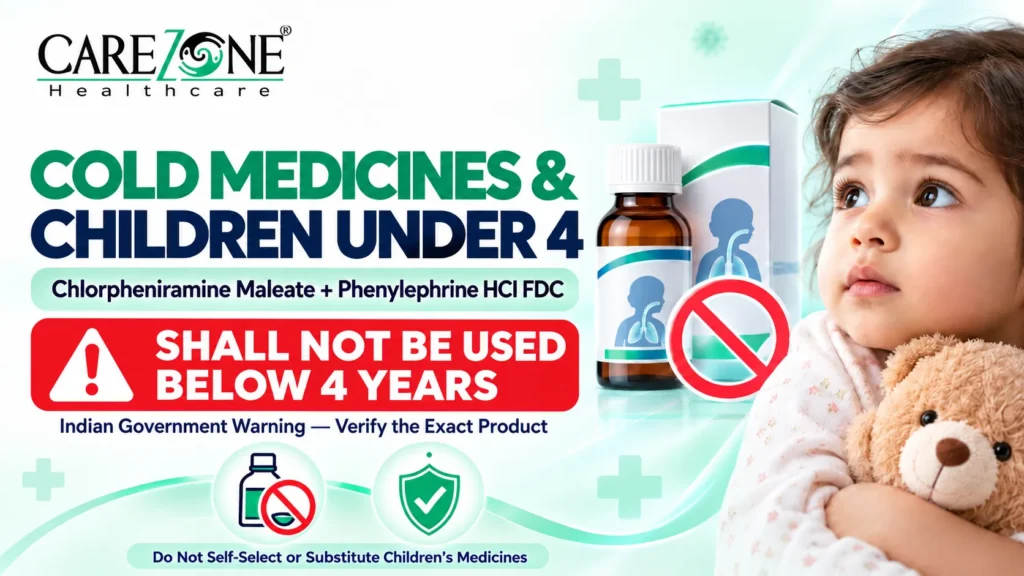
In India, the Government issued S.O. 4595(E) in August 2026 concerning fixed-dose combinations containing:
Chlorpheniramine Maleate + Phenylephrine Hydrochloride
The Government requires the warning that the affected fixed-dose combination shall not be used in children below four years of age.
Government of India: 2026 restriction on Chlorpheniramine + Phenylephrine FDCs
It means the affected fixed-dose combinations are subject to the specific Government restriction.
Cough & Cold FDC Warning 2026 — Carezone Healthcare
Parents and caregivers should not use online articles to calculate doses or choose alternative cold medicines for young children.
[IMAGE 5 — CHILD COLD MEDICINE SAFETY 2026]
For many uncomplicated viral colds, symptoms improve on their own.
CDC and MedlinePlus recommend supportive measures such as:
More medicines do not automatically mean faster recovery.
Treatment should be based on:
Most mild cold-like illnesses improve without major intervention.
However, medical advice becomes more important if symptoms are severe, persistent or changing.
CDC advises seeking medical care for warning patterns including:
No online checklist can capture every emergency or clinical scenario.
People with increased risk of complications from influenza and other respiratory infections should have a lower threshold for contacting a healthcare professional.
Higher-risk groups can include:
If influenza or another treatable respiratory infection is suspected, early assessment may matter because certain antiviral treatments work best when started promptly.
No official authority cited here has identified a new virus called “coughless cold.”
Upper-respiratory infections can present differently.
Allergic rhinitis may also produce watery or itchy eyes.
Many infections can cause fever.
Antibiotics do not treat ordinary viral colds.
Combination ingredients, age, other medicines and health conditions matter.
Paediatric medicine safety is age- and product-specific.
The Government’s August national assessment specifically said that circulating influenza remained consistent with expected seasonal behaviour and there was no cause for panic.
Carezone Healthcare’s search data shows strong public interest around terms such as:
That search behaviour is understandable.
People want quick answers when they are uncomfortable.
But responsible healthcare information should move the reader from:
“Which tablet?”
to:
“What symptoms do I actually have, what might be causing them, and do I need professional advice?”
A medicine is not automatically appropriate merely because:
Carezone Healthcare’s website currently provides a B2B product catalogue across tablets, syrups, suspensions, dry syrups, drops and other categories. The catalogue itself states that product information is for business/product discussion and is not a substitute for medical diagnosis or treatment.
Explore Carezone Healthcare Product Categories
For patient-facing health information, the priority should remain:
Correct symptom understanding → safe medicine use → appropriate professional advice when needed.
Coughless Cold in India 2026 is a phrase being used in recent reporting for people experiencing cold-like nasal symptoms, such as a blocked/runny nose or watery eyes, without prominent coughing. It is currently a descriptive term rather than the formal medical name of a newly recognised disease.
There is currently no official evidence cited in this article identifying a new virus called “coughless cold.” In its latest national influenza update available for this review, the Government said no new or unusual influenza strain had been detected.
Yes. A common cold can cause several upper-respiratory symptoms, and not every person develops every symptom. Runny nose, congestion, sneezing and sore throat may occur even when cough is mild or absent.
Allergies are more likely to involve repeated sneezing, nasal itching and itchy/watery eyes, while viral colds may include sore throat and a general feeling of illness. However, symptom overlap is common, so symptoms alone may not confirm the cause.
Influenza often begins more suddenly and is more likely to cause significant fever, body aches, headache and marked fatigue. Common cold symptoms tend to be milder and more concentrated in the nose and throat.
If the symptoms are caused by a viral common cold, antibiotics will not treat the virus. Antibiotics should only be used when appropriately prescribed for a bacterial infection.
No. Cold tablets are generally intended to manage symptoms such as fever, nasal congestion or sneezing. They do not eliminate the viruses responsible for ordinary colds.
Do not assume this is safe. Combination products may contain overlapping active ingredients, including paracetamol/acetaminophen. Always check labels and ask a pharmacist or doctor if you are unsure.
Product-specific rules matter. India currently prohibits use in children below four of affected FDC formulations containing Chlorpheniramine Maleate + Phenylephrine Hydrochloride and requires the prescribed warning. Parents should seek professional guidance rather than substituting another medicine on their own.
Seek medical advice for trouble breathing, dehydration, prolonged fever, symptoms lasting more than about 10 days without improvement, symptoms that improve then worsen, or deterioration of an existing medical condition.
The Coughless Cold in India 2026 trend is worth understanding—but not sensationalising.
Current evidence supports four practical conclusions:
1. “Coughless cold” is a description, not an officially identified new virus.
2. A viral upper-respiratory infection can occur without every classic symptom, including cough.
3. Cold, influenza and allergy symptoms overlap, so self-diagnosis from one symptom can be misleading.
4. Medicines should treat an actual symptom or diagnosed condition—not a trending search phrase.
The Government continues to monitor influenza in India, and its latest nationwide public statement available for this review did not identify a new or unusual influenza strain.
For mild symptoms, rest, hydration and appropriate supportive measures are often sufficient.
For severe, persistent or worsening symptoms—or for people at higher risk of complications—medical evaluation becomes more important.
The most useful approach is:
Understand the Symptoms → Avoid Unnecessary Medicines → Check Active Ingredients → Watch for Warning Signs → Seek Medical Advice When Needed

Carezone Healthcare is an Ambala, Haryana-based healthcare business supporting B2B enquiries across pharmaceutical, nutraceutical and selected cosmetic categories.
Its current website offers dedicated enquiry pathways for:
Explore Carezone Healthcare PCD Pharma Franchise
Discuss Third-Party Manufacturing With Carezone Healthcare
Browse Carezone Healthcare Products
Call / WhatsApp: +91 7488834800
Email: info@carezonehealthcare.com
Important: Carezone’s product catalogue is intended for B2B/product-information discussion and should not be used as a substitute for medical advice or as a self-medication guide.
This article provides general health education only.
It does not diagnose:
The phrase “coughless cold” is being used descriptively in current reporting and should not be treated as a formal diagnosis.
Do not use this article to:
Seek appropriate professional medical advice if symptoms are severe, persistent, worsening or concerning.
Medical and regulatory content last reviewed: 28 September 2026.
View all

October 1, 2026 | by Carezone Healthcare