October 1, 2026 | by Carezone Healthcare
Last Medical Review: 1 October 2026
Current Surveillance Context: WHO influenza surveillance data reported for 1–14 September 2026
Primary Audience: People searching for H1N1 symptoms, seasonal flu, cold-vs-flu differences, testing, treatment and warning signs in India
Medical Note: This article provides general health education and does not diagnose influenza or recommend a personalised medicine regimen.
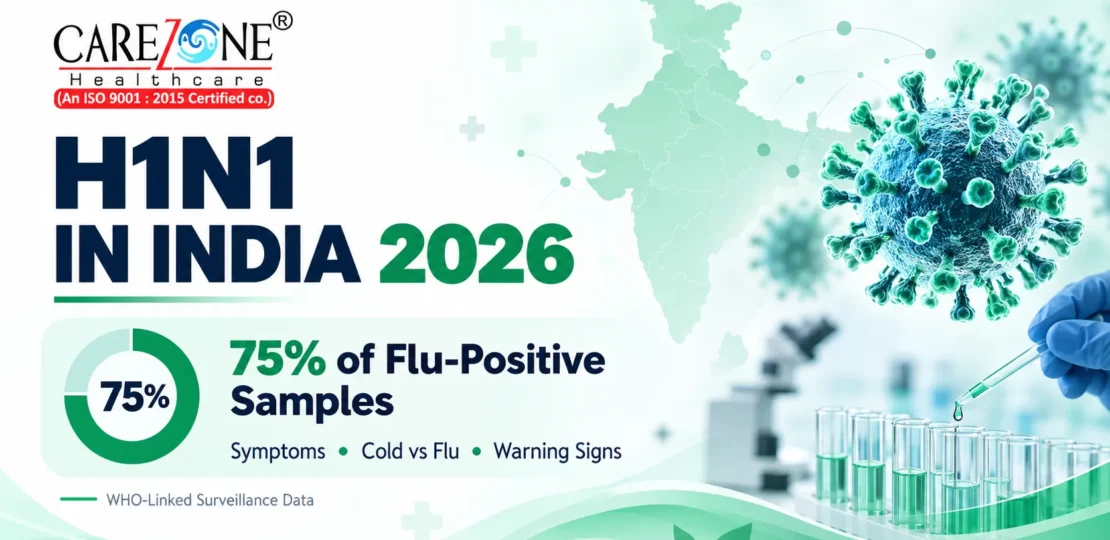
Recent H1N1 in India 2026 surveillance has attracted attention after WHO-linked influenza data showed that A(H1N1)pdm09 accounted for about 75% of influenza-positive samples reported from India during 1–14 September 2026.
That sounds dramatic, but the figure needs to be understood correctly.
It does not mean 75% of Indians have H1N1.
It does not mean 75% of everyone tested for respiratory illness was H1N1-positive.
It means that among the Indian samples that were already confirmed positive for influenza and characterised by subtype in the reported surveillance dataset, approximately three out of four were A(H1N1)pdm09. Indian reporting based on WHO surveillance data says the India share was 75%, compared with around 50% across the wider South-East Asia region during that reporting window.
Just as importantly, H1N1 is not a newly discovered virus in 2026.
The World Health Organization classifies A(H1N1)pdm09 as one of the influenza A subtypes currently circulating in humans, while the Government of India said in August 2026 that surveillance had found no new or unusual influenza strain and no unusual genetic shift in the circulating H1N1 viruses at that time.
So what does the new 75% figure actually tell us?
How does H1N1 differ from a common cold?
Can a “coughless cold” actually be influenza?
When does testing make sense?
Do ordinary cold tablets treat H1N1?
And which symptoms should prompt medical attention?
This Carezone Healthcare guide explains the current evidence without creating unnecessary panic.
Recent surveillance indicates that A(H1N1)pdm09 has become the predominant influenza subtype among positive Indian influenza samples in the reported September window.
Indian reports citing WHO surveillance data for epidemiological weeks 36 and 37, covering 1–14 September 2026, state that A(H1N1)pdm09 accounted for around 75% of influenza-positive samples from India. The same reporting says the South-East Asia regional share was about 50%.
WHO maintains FluNet, its global virological influenza-surveillance platform, where participating national influenza centres and reference laboratories report influenza detections and subtype data. WHO states that FluNet country-level data are publicly available and updated weekly.
WHO FluNet — Global Influenza Surveillance Data
H1N1 is currently prominent in recent Indian influenza surveillance, but the reported 75% figure describes its share among influenza-positive samples—not overall infection prevalence in India.
That distinction is essential.
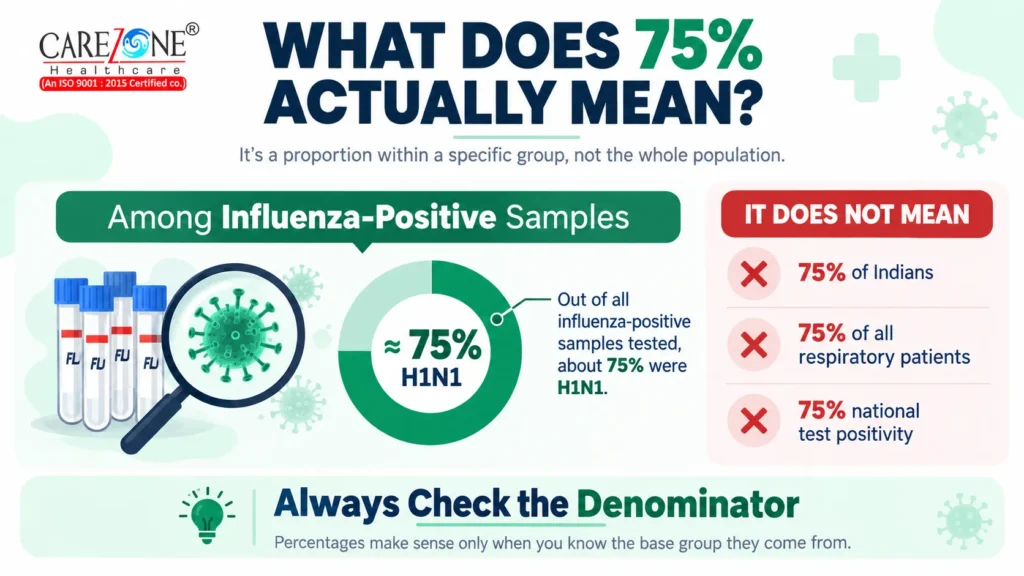
Suppose a surveillance laboratory identifies a group of samples as influenza-positive.
Those influenza viruses can then be characterised into categories such as:
The reported India finding says approximately:
75 out of every 100 influenza-positive samples in the relevant Indian surveillance data were A(H1N1)pdm09.
It does not tell us:
That requires different denominators and, at the individual level, clinical assessment and sometimes testing.
A headline such as:
“75% of India has H1N1”
would be completely misleading.
A more accurate formulation is:
“A(H1N1)pdm09 accounted for about 75% of influenza-positive Indian samples in the reported WHO surveillance period.”
No.
This is probably the single most important question to answer.
The reported number is a distribution among laboratory-confirmed influenza-positive samples.
It is not a population prevalence estimate.
For example, if influenza surveillance identifies multiple influenza-positive specimens and three-quarters of those characterised specimens are H1N1, it means H1N1 is dominant within that influenza-positive group.
It says nothing directly about what percentage of:
have H1N1.
This is why surveillance percentages must always be reported together with the population being measured.
No. A(H1N1)pdm09 is not a new 2026 virus.
WHO explains that A(H1N1)pdm09 is the influenza A(H1N1) virus associated with the 2009 pandemic and that it subsequently became one of the influenza A subtypes circulating seasonally in humans.
India has monitored H1N1 for years through national seasonal-influenza surveillance systems.
The National Centre for Disease Control currently maintains:
NCDC India — Seasonal Influenza & H1N1 Resources
The Government’s 25 August 2026 national update said no new or unusual virus strain had been detected and that genetic analysis of H1N1 showed expected seasonal changes rather than an unusual shift at that time.
That does not mean influenza surveillance can stop.
Influenza viruses continually evolve, which is why WHO, ICMR, NCDC and laboratories continue monitoring them.
Influenza viruses are divided into types.
Seasonal disease in humans is mainly caused by:
Influenza A viruses are further divided into subtypes according to the haemagglutinin and neuraminidase proteins on the virus.
WHO identifies two influenza A subtypes currently circulating in humans:
The term:
pdm09
is used because this lineage emerged during the 2009 influenza pandemic.
It has since become part of seasonal influenza circulation.
So “H1N1” today does not automatically mean:
“a repeat of the 2009 pandemic.”
H1N1 generally causes the clinical syndrome we recognise as influenza.
WHO describes seasonal influenza symptoms as including:
CDC also lists:
Not necessarily.
CDC specifically notes that not everyone with influenza will have fever.
Therefore:
No fever does not automatically rule out influenza.
Likewise:
fever does not automatically prove influenza.
Influenza and the common cold are both respiratory illnesses, but they are caused by different viruses.
CDC notes that flu generally:
A cold is generally:
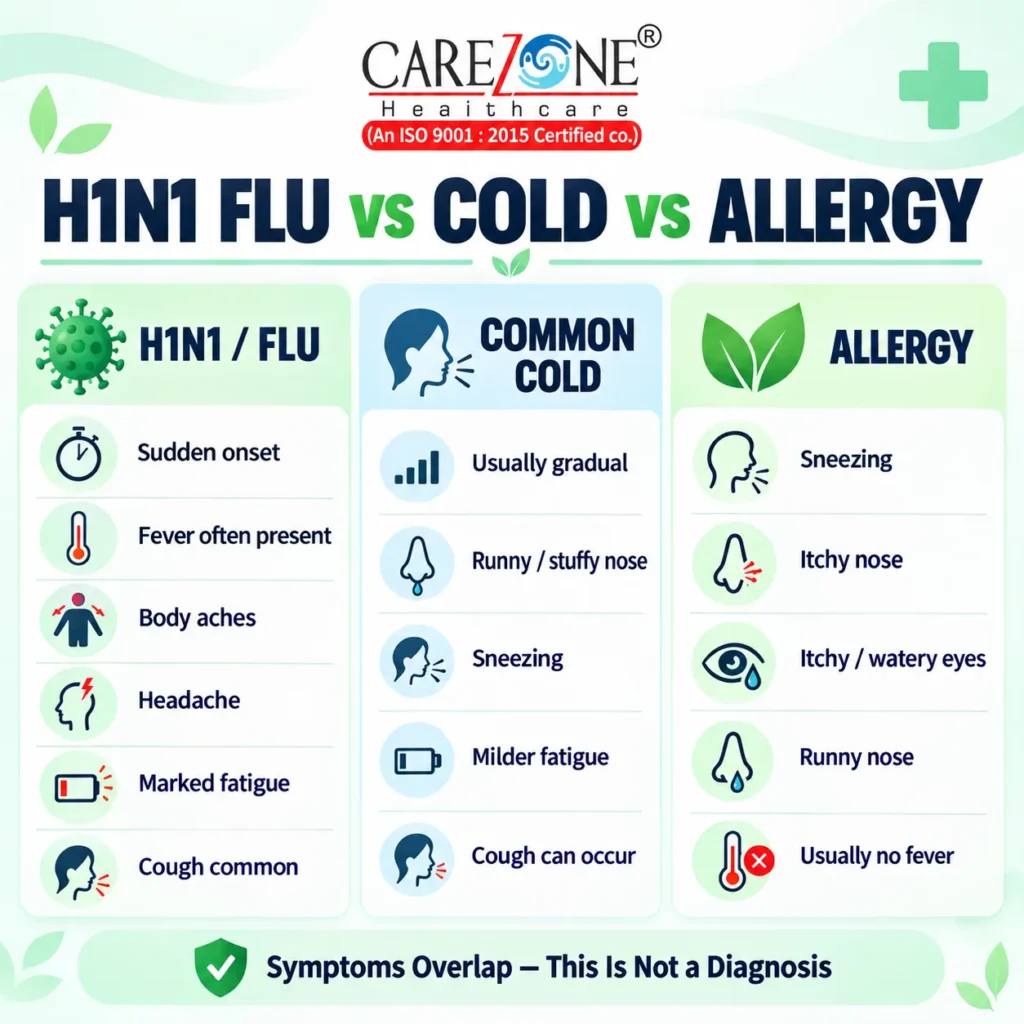
Sudden fever + strong body aches + headache + marked fatigue makes influenza more likely than a simple cold.
But symptoms overlap.
Only clinical assessment and, when appropriate, testing can confirm influenza.
Carezone Healthcare recently covered the September 2026 phrase “coughless cold”, used in reporting for cold-like nasal symptoms without much cough.
That phrase is descriptive and is not an officially recognised new virus name. Carezone’s article also explains cold-vs-flu-vs-allergy patterns using current Government and public-health sources.
Read: Coughless Cold in India 2026 — Is It a New Virus?
A coughless-cold presentation may involve:
Influenza more classically includes systemic symptoms such as:
But one symptom cannot reliably distinguish them.
Allergic rhinitis is not caused by influenza virus.
It is an allergic condition that commonly produces symptoms such as:
Influenza is more likely to cause systemic illness:
Prominent itching and repeated sneezing without fever or systemic illness can support an allergic pattern.
But people should avoid diagnosing themselves solely through an online comparison chart.
| Feature | Common Cold | H1N1 / Seasonal Flu | Allergy |
|---|---|---|---|
| Cause | Various respiratory viruses | Influenza virus | Allergic response |
| Onset | Usually gradual | Often sudden | Often after exposure |
| Fever | Uncommon/mild in many adults | Common | No |
| Body aches | Mild | Often more prominent | No |
| Headache | Less common | Common | Uncommon |
| Strong fatigue | Less typical | Common | Usually absent |
| Runny/stuffy nose | Common | Can occur | Common |
| Sneezing | Common | Sometimes | Often prominent |
| Itchy nose/eyes | Less typical | Less typical | Common |
| Cough | Can occur | Common | Sometimes |
| Serious complications | Uncommon | Possible | Usually not influenza-like complications |
CDC cautions that cold and flu can be difficult or even impossible to distinguish solely by symptoms.
Both H1N1 and H3N2 are influenza A subtypes that circulate in humans.
A person generally cannot determine whether they have H1N1 or H3N2 simply from:
Subtype identification depends on appropriate laboratory surveillance or diagnostic testing.
The major practical point for patients is usually not:
“Which influenza subtype do I personally have?”
but:
“Do I have influenza-like illness, am I at higher risk, and do I need testing or early treatment?”
No.
WHO notes that influenza-like illness can also be caused by:
CDC similarly states that cold and flu symptoms overlap and that special tests can help establish whether a person has influenza.
This is particularly relevant in India during periods when multiple respiratory illnesses are circulating simultaneously.
Testing decisions depend on clinical circumstances.
Testing can be particularly useful when the result could influence:
CDC guidance states that influenza testing may help inform clinical and infection-control decisions, but antiviral treatment in priority patients should not necessarily be delayed while awaiting laboratory confirmation.
India’s NCDC also maintains technical resources covering:
Do not order, interpret or dismiss a flu test based only on an article.
A healthcare professional should decide whether testing is useful in the individual situation.
WHO identifies higher-risk groups including:
CDC additionally lists conditions such as:
People in higher-risk groups should seek medical advice earlier if they develop influenza-like symptoms because timely treatment may matter.
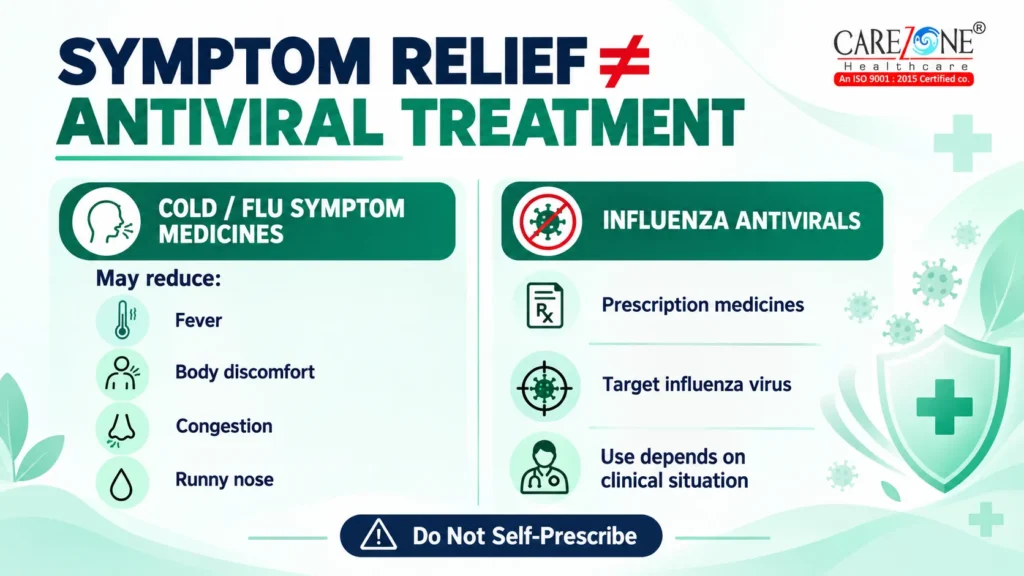
Ordinary multi-symptom cold tablets do not eliminate the influenza virus.
A cold combination may contain ingredients intended to reduce particular symptoms such as:
That is symptom relief, not antiviral treatment.
This distinction is especially important because Carezone Healthcare already receives significant search visibility for cold-tablet queries.
Carezone’s existing educational article discusses anti-cold tablet brands and common cold-medicine ingredient categories.
Read: Top 10 Anti-Cold Tablet Brands in India
Do not combine multiple cold/flu products casually.
Different products may contain overlapping active ingredients.
A person should check:
No. Antibiotics do not treat influenza viruses.
CDC states clearly that antibiotics fight bacterial infections and do not treat influenza.
Using antibiotics without an appropriate bacterial indication can expose a person to:
Carezone has separately covered India’s September 2026 regulatory focus on indiscriminate antibiotic and NSAID use.
Read: CDSCO Painkiller & Antibiotic Advisory 2026
Yes, bacterial complications can sometimes occur.
But that possibility does not justify starting antibiotics “just in case.”
Clinical assessment should determine whether a bacterial infection is suspected.
Influenza antivirals are prescription medicines specifically used against influenza viruses.
They are not the same as:
CDC states that flu antivirals work best when started within approximately 1–2 days after symptoms begin, although they may still be important later for people who are hospitalised, severely ill or at higher risk of complications.
WHO likewise recommends prompt antiviral treatment for people at high risk of severe or complicated influenza.
Especially:
Do not self-select or self-dose prescription antivirals from an online article.
Influenza treatment is time-sensitive in some patients.
CDC advises that higher-risk people with suspected or confirmed influenza should receive prompt clinical consideration for antiviral treatment.
Therefore, someone at higher risk should not necessarily wait several days simply to see whether the illness becomes severe.
If you are:
contact a healthcare professional promptly if influenza is suspected.
Medical evaluation becomes more important when symptoms are:
Seek professional advice when you are concerned about:
Higher-risk patients should generally seek advice earlier rather than waiting for severe illness to develop.
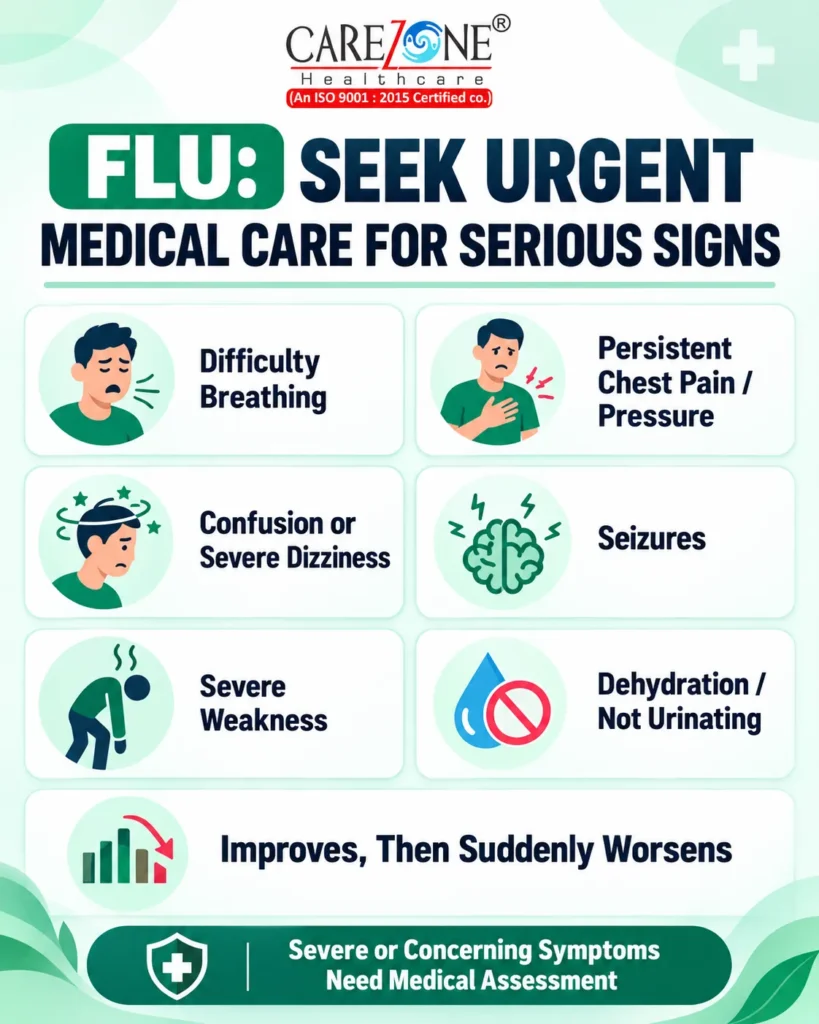
CDC lists emergency warning signs including:
Warning signs can include:
These lists are not exhaustive.
Seek urgent medical help for any symptom that appears severe or alarming.
Seasonal influenza spreads mainly from person to person through respiratory particles produced when infected people:
WHO also notes that contaminated hands can contribute to transmission when people touch their nose or mouth.
People can reduce transmission risk by using sensible respiratory-hygiene measures.
WHO recommends practical influenza-prevention measures such as:
CDC also advises cleaner air, hand hygiene and reducing exposure to people who are ill.
To reduce spread:
Seasonal influenza vaccines are designed to protect against influenza viruses expected to circulate during the relevant season.
WHO recommends annual influenza vaccination because influenza viruses evolve and vaccine protection decreases over time.
WHO identifies priority vaccination groups including:
WHO India also states that influenza vaccination is recommended each year for protection against seasonal influenza.
No vaccine offers absolute protection against every infection.
However, influenza vaccination can reduce:
Individual vaccination decisions should follow current local guidance and professional advice.
WHO India — Influenza Information
Children require extra caution because:
In August 2026, the Government of India expanded restrictions covering fixed-dose combinations containing:
Chlorpheniramine Maleate + Phenylephrine Hydrochloride
and required the warning that the affected combinations shall not be used in children below four years of age.
Carezone has a dedicated article explaining that regulatory development and the existing-stock questions around it.
Read: Cough & Cold FDC Warning 2026
Parents should not use an online H1N1 article to:
Carezone Healthcare’s current organic visibility shows strong consumer interest around:
That creates an important responsibility.
Someone searching:
“cold tablet”
may actually have:
The medicine search should therefore come after understanding the symptom pattern, not before.
A cold tablet does not become an influenza antiviral because it reduces:
And an antibiotic does not become useful simply because an illness feels “stronger than a cold.”
Carezone Healthcare’s existing product catalogue is intended for B2B product and business discussions, including PCD, distribution and manufacturing enquiries—not for personalised patient prescribing. The current Carezone product page explicitly states that product information should not substitute for professional medical diagnosis or treatment.
Explore Carezone Healthcare Product Categories
Coughless Cold in India 2026: Cold vs Flu vs Allergy
Top 10 Anti-Cold Tablet Brands in India
CDSCO Painkiller & Antibiotic Advisory 2026
The content-cluster logic is:
Cold Symptoms → Coughless Cold → H1N1 / Flu → Cold Medicine Safety → Antibiotic Safety → Child Cold-Medicine Regulation
That creates a more useful information journey than isolated medicine-list articles.
Recent reporting based on WHO surveillance data says A(H1N1)pdm09 represented about 75% of influenza-positive Indian samples in the 1–14 September 2026 surveillance window. This means H1N1 was the dominant influenza subtype among those positive samples; it does not mean 75% of Indians have H1N1.
No. The 75% figure refers to the proportion of influenza-positive samples classified as A(H1N1)pdm09 in the reported India surveillance data. It is not a population-infection percentage.
No. A(H1N1)pdm09 has circulated as a seasonal influenza virus since the 2009 pandemic. The Government of India said in August 2026 that surveillance had not detected a new or unusual influenza strain or unusual H1N1 genetic shift at that time.
H1N1 generally causes influenza symptoms such as sudden fever, cough, headache, muscle/body aches, fatigue, sore throat and runny nose. Not everyone experiences every symptom, and fever may be absent in some cases.
Influenza tends to start more suddenly and is more likely to cause significant fever, body aches, headache and pronounced fatigue. Colds tend to be milder and cause more prominent runny/stuffy nose symptoms. However, symptoms overlap, so testing may sometimes be needed.
A lack of prominent cough does not by itself prove or rule out influenza. “Coughless cold” is a descriptive term rather than a formal diagnosis. If influenza is clinically important to distinguish, professional assessment and testing may be appropriate.
No. Cold medicines may help relieve individual symptoms such as fever, congestion or runny nose, but they do not eliminate the influenza virus. Prescription influenza antivirals are a different medicine class.
No. Antibiotics work against bacteria, not influenza viruses. They should not be self-started for viral flu unless a healthcare professional identifies an appropriate bacterial indication.
Older adults, young children, pregnant women and people with certain chronic diseases or weakened immune systems have higher complication risks and should seek advice early when influenza is suspected.
Seek urgent medical attention for warning signs such as difficulty breathing, persistent chest pain/pressure, confusion, seizures, severe weakness, dehydration/not urinating, or symptoms that improve and then worsen.
The H1N1 in India 2026 surveillance update deserves attention, but not panic.
The most important interpretation is:
H1N1 is currently prominent among recent influenza-positive surveillance samples in India, but the 75% figure is not a population infection rate and does not indicate that three out of four Indians have H1N1.
Current evidence also does not support calling this a new H1N1 virus.
The Government of India has said recent H1N1 changes were consistent with expected seasonal evolution at the time of its August assessment, while WHO continues routine global respiratory-virus surveillance.
For most people, influenza is self-limiting.
But the response should be different when someone:
The useful decision path is:
Recognise Flu-Like Symptoms → Consider Risk Factors → Avoid Unnecessary Antibiotics → Seek Early Advice When High-Risk → Watch for Warning Signs
That is more useful than reacting to the number 75% without understanding what it measures.

Carezone Healthcare is based in Ambala, Haryana and supports B2B healthcare enquiries for:
Carezone’s current website states:
Explore Carezone Healthcare PCD Pharma Franchise
Discuss Third-Party Manufacturing With Carezone Healthcare
Browse Carezone Healthcare Products
Contact Carezone Healthcare Business Desk
Call / WhatsApp: +91 7488834800
Email: info@carezonehealthcare.com
Hello Carezone Healthcare, I would like to discuss your PCD franchise / distribution / third-party manufacturing services. My location is ______ and I am interested in ______ product category. Please share the relevant product and business information.
Carezone Healthcare
Trusted Healthcare. Stronger Pharma Partnerships.
This article provides general medical and public-health education only.
It does not diagnose:
Do not use this article to:
People who are pregnant, elderly, immunocompromised, very young or living with significant chronic medical conditions should seek professional advice earlier when influenza is suspected.
Medical content last reviewed: 1 October 2026.
Because influenza surveillance changes week by week, update this article when WHO, MoHFW, ICMR or NCDC publishes materially newer India-specific influenza data.
View all

September 28, 2026 | by Carezone Healthcare