October 26, 2026 | by Carezone Healthcare
Last Regulatory Review: 26 October 2026
India Regulatory Context: CDSCO • State Drugs Control Authorities • Drugs and Cosmetics Act, 1940 • Drugs Rules, 1945 • Revised Schedule M
Primary Audience: Patients, pharmacists, pharmaceutical manufacturers, PCD franchise partners, distributors, wholesalers, third-party brand owners and healthcare-business professionals
Important Safety Note: An NSQ alert is generally linked to the specific sample and batch tested. It should not automatically be interpreted as proof that every batch, every product of the brand, or every medicine made by the manufacturer is defective.
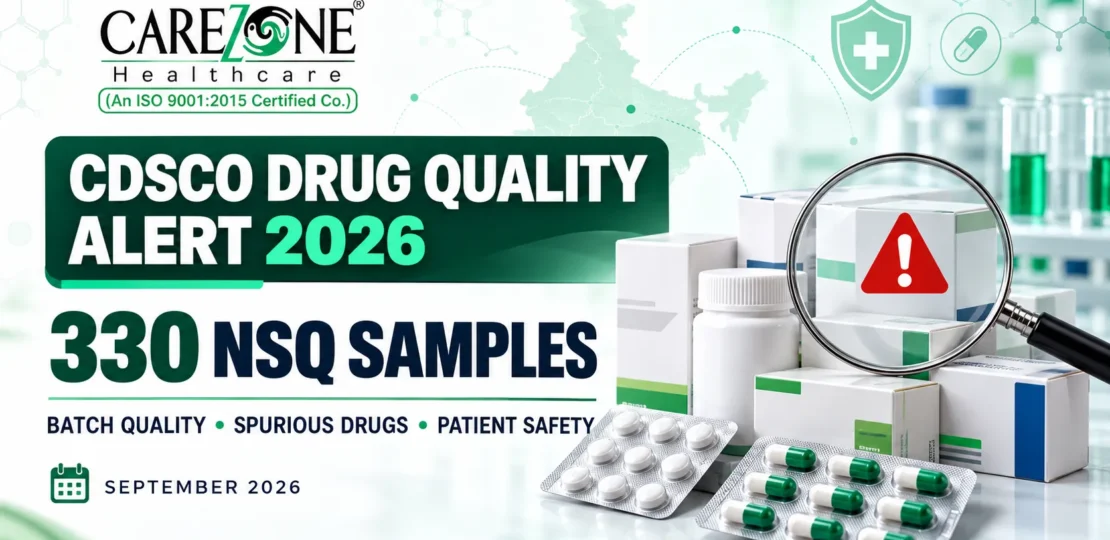
India’s CDSCO drug quality alert 2026 has brought medicine quality, batch traceability and pharmaceutical supply-chain controls back into focus after regulators reported that 330 drug samples tested during September 2026 were identified as Not of Standard Quality (NSQ).
Of those 330 NSQ samples, 42 were identified by Central Drugs Laboratories and 288 by State Drugs Testing Laboratories. Regulators also reported one spurious drug sample from the National Capital Territory of Delhi, involving an unauthorised manufacturer using a brand name belonging to another company; that matter remains under investigation.
But the headline “330 medicines failed quality tests” needs context.
CDSCO’s stated position is that an NSQ classification is based on a sample failing one or more specified quality parameters, and that the finding relates to the particular product/batch tested by the Government laboratory. It does not, by itself, justify declaring every other batch or every medicine in the market unsafe.
That distinction is critical for:
An NSQ medicine is not automatically a fake medicine.
Likewise, a spurious medicine is not simply another name for an NSQ medicine.
Indian drug law separately addresses standard quality, misbranded drugs, adulterated drugs and spurious drugs.
This Carezone Healthcare guide explains what the September 2026 alert actually means, how NSQ differs from spurious or misbranded medicines, why the batch number matters, what quality parameters can fail, what patients should do if their batch appears in an alert, and what pharmaceutical businesses should learn from CDSCO’s continuing market-surveillance programme.
On 23 October 2026, the September drug-quality results were reported publicly.
A total of:
330 drug samples
were identified as Not of Standard Quality.
The split was:
| Testing Source | NSQ Samples |
|---|---|
| Central Drugs Laboratories | 42 |
| State Drugs Testing Laboratories | 288 |
| Total | 330 |
CDSCO also reported one separate spurious sample from NCT Delhi. According to the regulator’s reported statement, the sample was associated with an unauthorised manufacturer using a brand name belonging to another company. Investigation and action under the applicable Act and Rules are continuing.
The CDSCO Drug Quality Alert 2026 does not mean that 330 entire medicine brands have been banned. It means 330 specific tested samples were reported as failing one or more applicable quality parameters during the September surveillance cycle.
This is the first distinction patients and pharma businesses should understand.
NSQ stands for:
Not of Standard Quality.
At a practical level, an NSQ finding means that the tested medicine sample did not comply with one or more applicable quality standards or specifications.
CDSCO’s September statement explains that classification as NSQ occurs where a sample fails one or more specified quality parameters.
Under Section 16 of the Drugs and Cosmetics Act, the concept of “standard quality” is linked to compliance with the standards prescribed under the Act and its Second Schedule.
A product may fail because of a problem involving, for example:
The exact reason depends on the particular product and test.
An NSQ report should therefore be read at batch + test-result level.
Simply writing:
“Medicine X failed.”
can be misleading if the regulator actually reported:
“Batch ABC123 of Medicine X failed a specific test.”
That difference matters.
No.
This is one of the most important facts in the entire article.
A genuine medicine produced by a legitimate licensed manufacturer may still have a batch that fails an applicable quality specification.
That batch can therefore be classified as NSQ.
A spurious drug, however, involves a different legal concept—such as imitation, false identity, substitution or falsely representing another manufacturer.
Imagine:
Company A genuinely manufactures Tablet X.
One specific batch is tested.
The batch fails an assay or dissolution requirement.
That can become an NSQ batch.
Now imagine:
An unauthorised party manufactures something and falsely presents it as Company A’s Tablet X.
That may raise a spurious-drug issue.
These are not the same regulatory situation.
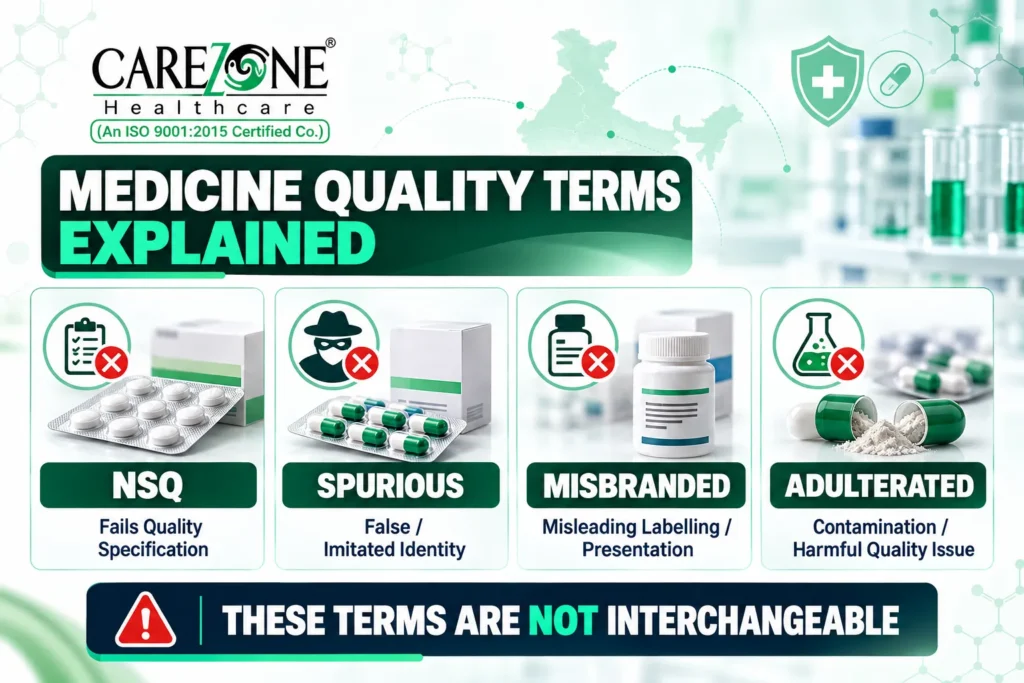
Indian drug regulation uses different classifications for different problems.
| Classification | Simplified Meaning | Main Issue |
|---|---|---|
| NSQ | Tested sample fails applicable quality standard/specification | Quality compliance |
| Spurious | Imitation, substitution, false manufacturer identity or false product identity | Authenticity / identity |
| Misbranded | Improper or misleading labelling, presentation or claims | Labelling / presentation |
| Adulterated | Contamination, harmful substances, insanitary preparation/storage or quality-reducing substitution | Contamination / harmful quality |
The Drugs and Cosmetics Act separately defines misbranded, adulterated and spurious drugs under Sections 17, 17A and 17B.
Under the Act, misbranding can involve issues such as:
The statutory definition can involve:
The law identifies circumstances such as:
Calling every quality failure a “fake medicine” may generate clicks, but it is not accurate regulatory communication.
Carezone Healthcare’s approach should use the exact classification whenever the competent regulator has provided one.
Related Carezone guide:
CDSCO Misbranded Drugs Crackdown 2026 — What Pharma Distributors, PCD Partners & Manufacturers Must Verify.
No.
CDSCO specifically stated in relation to the September findings that the failure relates to the drug product of the batch tested by the Government laboratory and does not by itself warrant concern regarding other drug products available in the market.
This is extremely important.
“Batch ABC123 was declared NSQ.”
into:
“Every Tablet X is unsafe.”
That leap is not supported by a batch-specific laboratory finding.
Pharmaceutical products are manufactured in defined batches.
Each batch may have its own:
This is one reason regulators publish batch-level information.
The batch number connects a physical pack of medicine to a defined manufacturing lot.
If CDSCO publishes an alert, the batch number helps determine whether the pack in a patient’s or distributor’s possession is the same batch that was tested.
Raw Material → Manufacturing Batch → QC Release → Packaging → Dispatch → Distributor
Batch traceability allows an affected lot to be identified without automatically treating unrelated lots as defective.
The September 2026 Central-lab alert reportedly included failures involving a range of quality parameters across tablets, capsules, injections, liquids and surgical products.
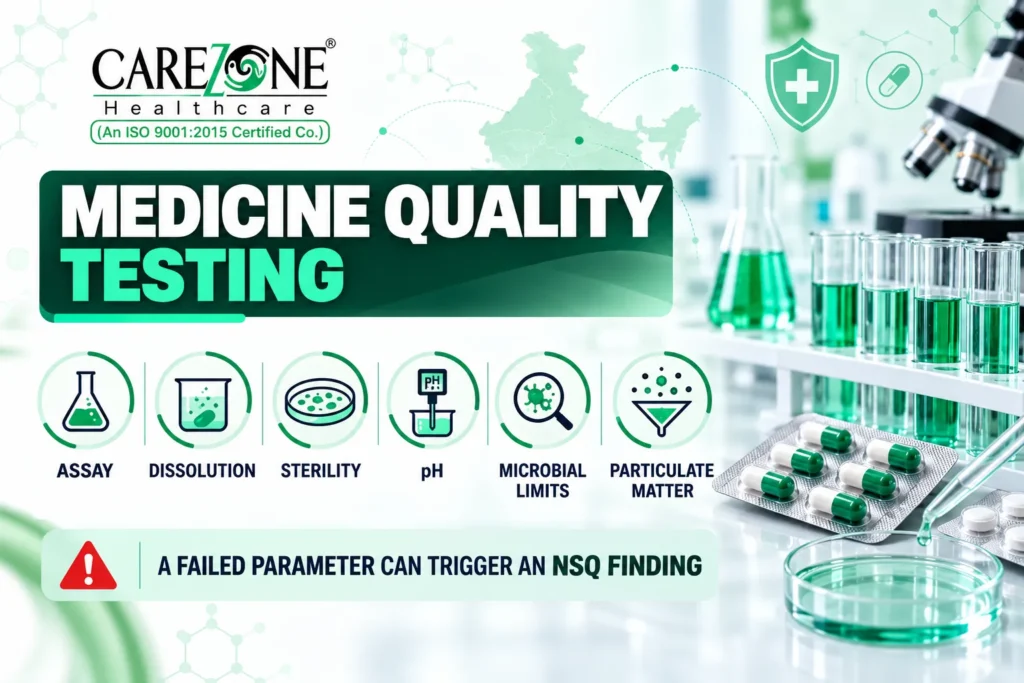
Reported test categories included:
Assay generally examines whether the amount of active ingredient meets the required specification.
If active ingredient content falls outside the permitted range, the product may not comply with its specification.
Dissolution testing evaluates how the medicine releases the drug substance under specified test conditions.
For many oral solid dosage forms, this is an important performance parameter.
Disintegration testing assesses how a tablet or capsule breaks apart under specified conditions.
Sterile medicines—such as certain injections—must comply with applicable sterility requirements.
A sterility failure is therefore fundamentally different from a simple packaging appearance issue.
Certain injectable products must meet limits for bacterial endotoxins.
Some pharmaceutical formulations must remain within a specified pH range.
Injectables may be subject to tests concerning visible or sub-visible particulate contamination, depending on the product and standard.
A test failure tells us which specification the tested sample did not meet.
It does not automatically tell the public:
Those questions may require investigation.
A laboratory result establishes the failure of a tested specification.
It does not automatically establish the root cause.
Possible quality-system areas that may require investigation can include:
The actual cause must be determined through an appropriate investigation.
If a batch fails a test, a responsible quality system should ask:
What happened?
Where did it happen?
Could another batch be affected?
What corrective action is required?
This is part of the broader pharmaceutical quality-system approach strengthened through revised Schedule M.
Drug quality surveillance in India involves both:
The Government has stated that CDSCO and State Drugs Control Authorities draw samples from the supply chain for testing and analysis and publish NSQ, spurious and adulterated findings through monthly drug alerts.
CDSCO issued regulatory guidelines for drug, cosmetic and medical-device sampling in 2024 and its circulars page lists revised regulatory sampling guidelines dated 26 May 2026.
Of the 330 September NSQ samples:
288 came through State Drugs Testing Laboratories.
That shows why India’s drug-quality surveillance is not only a Central Government activity.
State drug regulators are a major part of:
Government information published in 2026 says that, for samples declared NSQ by CDSCO drug-testing laboratories, manufacturers are directed to:
Depending on investigation findings, the competent licensing authority may take additional measures including:
Recall action should be interpreted according to the:
CDSCO’s 2024 Recall and Rapid Alert System guideline applies broadly to quality-defective product reports and is addressed to manufacturers, importers, exporters, stockists, distributors and retailers.
Every business holding pharmaceutical stock should be capable of doing this:
Alert Published
↓
Identify Product
↓
Match Batch
↓
Quarantine Stock
↓
Stop Further Dispatch Where Required
↓
Inform Relevant Parties
↓
Follow Manufacturer / Regulator Recall Instructions
↓
Document Action
A spurious drug involves a more fundamental problem of identity or authenticity.
Under Section 17B of the Drugs and Cosmetics Act, circumstances can include:
Separate from the 330 NSQ samples, one drug sample from NCT Delhi was identified as spurious.
The regulator’s reported statement said it involved an unauthorised manufacturer using a brand name owned by another company. The matter is under investigation.
An NSQ batch may be genuine but fail a quality test.
A spurious drug may involve false identity even before laboratory quality is considered.
Carezone has already examined these supply-chain risks in detail in its article on counterfeit high-value medicines.
Related Carezone guide:
Counterfeit Cancer Drugs India 2026 — What Pharma Buyers Must Verify Before New QR-Code Rules.
Use the official CDSCO NSQ alert resource rather than relying only on:
CDSCO maintains a dedicated NSQ Alerts section for published quality findings.
Official CDSCO resource:
CDSCO NSQ Alerts
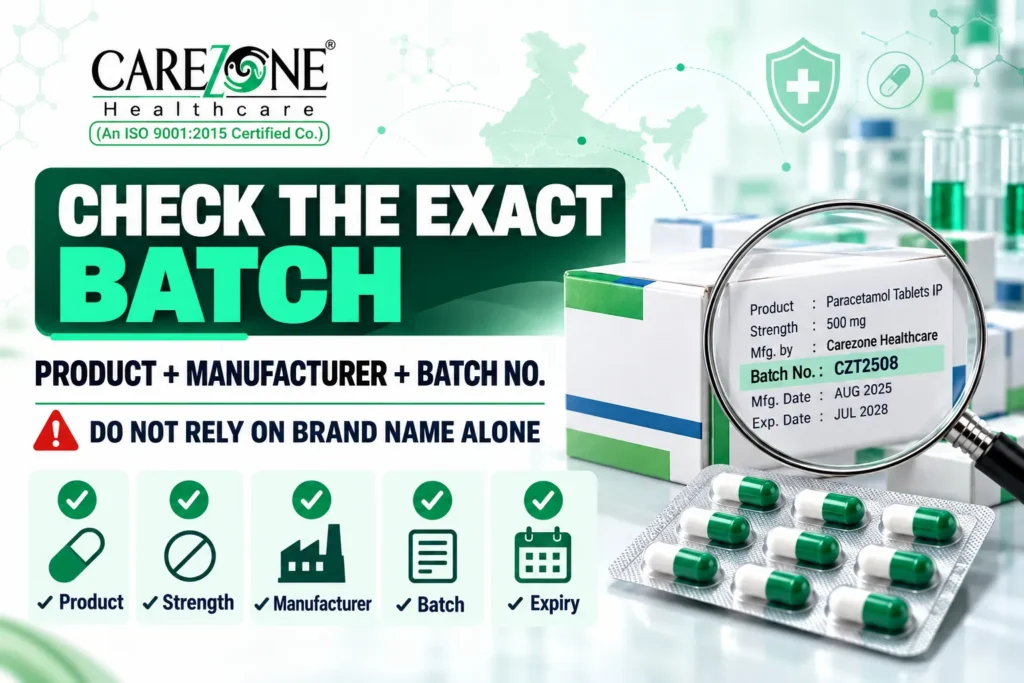
Look for:
1. Product name
2. Composition/strength
3. Manufacturer
4. Batch number
5. Manufacturing date
6. Expiry date
7. Reason for NSQ classification
A brand-name match without a batch-number match is generally not enough to establish that the medicine in your hand is the affected batch.
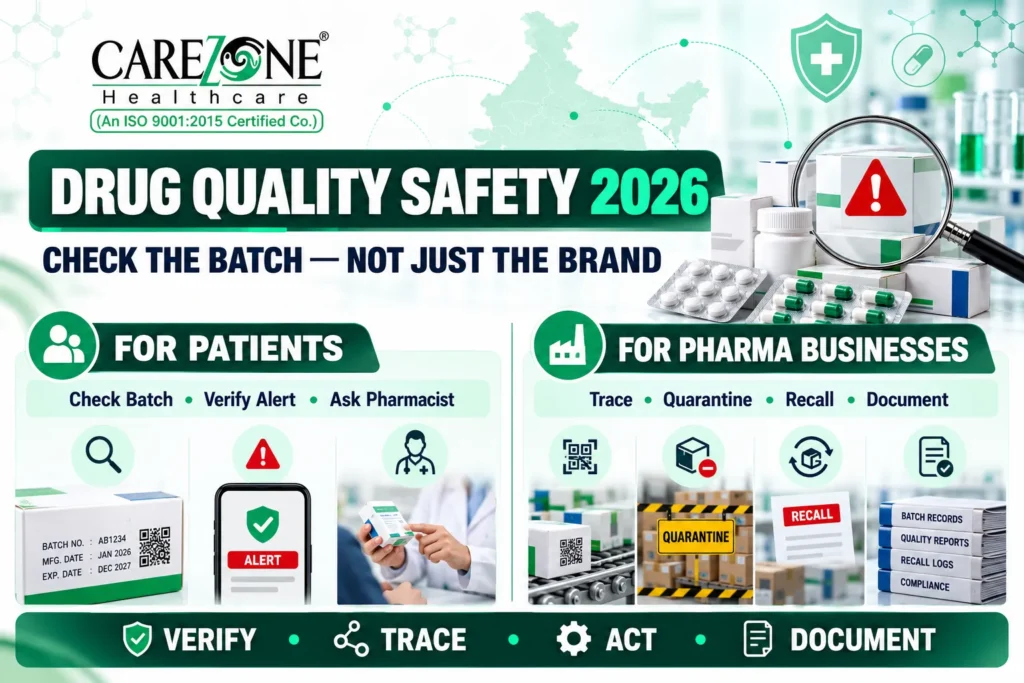
If you believe your pack matches the exact product and batch in an official alert:
Avoid acting on a partial number or similar-looking pack.
Do not discard the packaging immediately.
The carton/strip/bottle may contain information needed for:
Ask the dispensing pharmacy to verify:
Use official contact details, not an unverified number forwarded online.
For essential prescription medicines, abruptly stopping treatment can itself create risk.
Do not stop, replace or double-dose a prescribed medicine solely on the basis of an online article.
If the regulator/manufacturer issues a recall or replacement instruction, follow that guidance.
An NSQ alert concerning one batch should not automatically be extended to unrelated batches.
CDSCO’s September statement expressly emphasised that the finding is specific to the product/batch tested and does not automatically raise concerns regarding other drug products available in the market.
However, an individual patient’s medicine decision still depends on:
When uncertain, confirm with a pharmacist or doctor.
India’s revised Schedule M significantly strengthens Good Manufacturing Practice expectations.
The revised framework was notified through G.S.R. 922(E) dated 28 December 2023.
The Government states that revised Schedule M became effective:
The revised framework includes stronger expectations around:
Schedule M states that manufacturers are responsible for ensuring that pharmaceutical products are fit for intended use, comply with licence requirements and do not put patients at risk because of inadequate quality, safety or efficacy.
NSQ surveillance occurs after products enter the supply chain.
GMP systems aim to prevent quality failures before release.
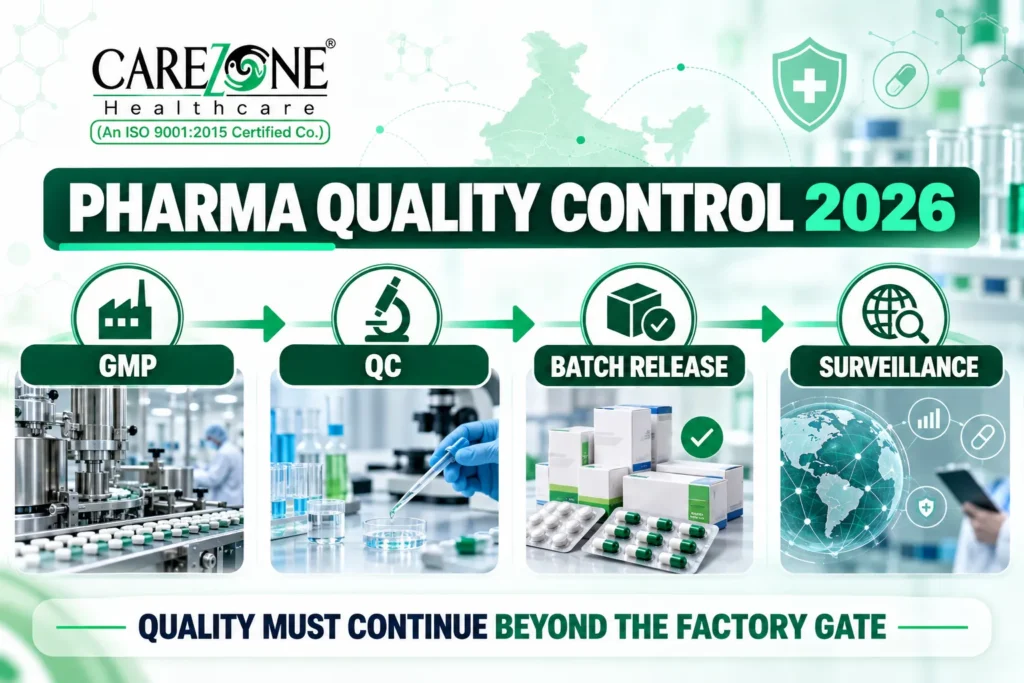
A strong system therefore connects:
GMP
→ Quality Control
→ Batch Release
→ Distribution
→ Market Surveillance
→ Recall / CAPA if required
A manufacturer should follow the applicable direction of the competent authority and its approved pharmaceutical quality system.
Depending on the case, appropriate steps may involve:
CAPA means:
Corrective and Preventive Action.
A quality investigation should not stop at:
“Batch failed.”
The objective should be to understand:
Why did it fail, and how can recurrence be prevented?
This is particularly relevant to Carezone Healthcare’s business audience.
In third-party manufacturing, the brand owner may not physically operate the factory.
But that does not mean quality due diligence becomes irrelevant.
A third-party buyer should discuss and verify, according to the product and transaction:
Carezone Healthcare’s third-party manufacturing platform supports product, packaging and documentation discussions across pharma, nutraceutical and cosmetic categories, subject to feasibility and applicable regulatory requirements.
Internal Link:
Explore Carezone Healthcare Third-Party Manufacturing
“What is your manufacturing rate?”
It should also include:
“How is the batch identified, documented, released and traced?”
PCD partners often buy products for specific territories and then distribute or promote them locally.
Quality and traceability should therefore be part of purchasing—not an afterthought.
Verify:
Carezone Healthcare’s PCD platform supports territory-based business enquiries across its pharma, nutraceutical and cosmetic portfolio.
Internal Link:
Carezone Healthcare PCD Pharma Franchise
A very high commercial margin does not compensate for:
A distributor is a critical link between manufacturer and patient-facing market.
When a quality alert appears, distributors should be capable of identifying affected stock quickly.
1. Check exact product
2. Match batch
3. Identify remaining inventory
4. Stop dispatch where instructed
5. Quarantine affected stock
6. Check customers who received the batch
7. Inform relevant downstream accounts
8. Follow recall/return instructions
9. Preserve invoice and traceability records
10. Document closure
A medicine can leave a factory fully compliant and still be affected by poor:
Therefore pharma quality is not only a manufacturing issue.
It is also a supply-chain issue.
| Area | What to Verify |
|---|---|
| Supplier | Is the source authorised and identifiable? |
| Invoice | Is the purchase properly documented? |
| Product | Exact medicine/product name |
| Composition | Active ingredients and strength |
| Manufacturer | Actual manufacturing entity |
| Batch | Exact batch/lot number |
| Mfg. Date | Correct manufacturing date |
| Expiry | Product remains within valid shelf life |
| Pack Integrity | No suspicious tampering or alteration |
| Storage | Required temperature/conditions maintained |
| COA | Available where applicable to transaction |
| Regulatory Alert | Has the exact batch appeared in an alert? |
| Recall Contact | Is there a defined escalation point? |
| Downstream Traceability | Can dispatched batch quantities be located? |
| Complaint Process | Quality complaint can be documented/escalated |
| Return/Quarantine | Procedure exists for affected stock |
The September total is higher than the 220 NSQ samples reported for August 2026.
It may be tempting to write:
“Drug quality failures increased 50% in one month.”
Carezone should not make that conclusion without knowing:
If regulators test more products—or intentionally target higher-risk products—the raw NSQ count can rise even without proving that the overall national failure rate increased by the same percentage.
The responsible statement is:
The number of samples reported NSQ increased from 220 in August to 330 in September, but raw monthly counts alone do not establish a national deterioration rate without total sampling-volume and methodology context.
That kind of distinction strengthens Carezone’s regulatory credibility.
A public alert can look alarming.
But routine market surveillance serves an important purpose:
finding defective products before more patients are exposed to them.
Government information says CDSCO and State regulators regularly sample products and publish drug-quality findings so that affected medicines can be identified and removed from the market.
In March 2026, the Government also stated that:
The existence of alerts should therefore be understood as evidence of active surveillance, not as proof that every product in India’s pharmaceutical market is defective.
For pharma businesses, quality should not exist only as a claim in a sales brochure.
It should be traceable through:
Approved Product
→ Qualified Manufacturing
→ Documented Batch
→ Quality Testing
→ Correct Packaging
→ Controlled Distribution
→ Complaint Handling
→ Recall Readiness
Carezone Healthcare’s current website presents dedicated business channels for:
CDSCO Misbranded Drugs Crackdown 2026
Explains supply-chain verification, misbranded vs spurious vs NSQ terminology and pharma-buyer checks.
Counterfeit Cancer Drugs India 2026
Explains authentication, QR-code limits and high-value pharmaceutical supply-chain risks.
Cold Tablet Ingredients Explained 2026
Provides patient-facing medicine-safety guidance and current regulatory context for common cold formulations.
Pharma Marketing Rules India 2026
Explains why compliance also extends beyond manufacturing into pharmaceutical promotion and business practices.
The September 2026 CDSCO drug-quality results are important, but they need to be interpreted accurately.
330 tested drug samples were reported as Not of Standard Quality.
Of those:
42 were identified by Central laboratories.
288 were identified by State laboratories.
A separate drug sample from Delhi was classified as spurious and is under investigation.
But an NSQ result does not automatically mean:
The correct response is batch-specific verification.
For patients:
Check the exact product + manufacturer + batch number and follow pharmacist, doctor, manufacturer or regulator guidance.
For pharma businesses:
Trace the affected batch, stop/quarantine/recall where directed, investigate the quality failure and document corrective action.
For manufacturers:
Revised Schedule M makes quality systems, risk management, documentation and management responsibility increasingly central to pharmaceutical operations.
The strongest lesson from the CDSCO Drug Quality Alert 2026 is therefore not:
“Fear every medicine.”
It is:
“Verify the batch, maintain traceability and act on official quality information.”
The September 2026 alert reported 330 drug samples as Not of Standard Quality after testing by Central and State Government laboratories. Forty-two were identified by Central labs and 288 by State labs.
NSQ means Not of Standard Quality. It is used where a tested sample fails one or more applicable quality standards or specifications.
No. A genuine medicine batch can fail a quality parameter and be declared NSQ. A spurious medicine involves separate identity, imitation, substitution or false-manufacturer issues.
No. These are different regulatory concepts. NSQ concerns compliance with applicable quality standards; spurious classification can involve false identity, imitation, substitution or false manufacturer representation.
No. CDSCO specifically stated that the September NSQ findings are specific to the tested product/batch and do not automatically create concern regarding other products available in the market.
CDSCO reported 330 NSQ samples: 42 identified by Central Drugs Laboratories and 288 by State Drugs Testing Laboratories.
Yes. One separate sample from NCT Delhi was reported as spurious. The matter remains under investigation.
Depending on the product, failures may involve assay, dissolution, disintegration, sterility, pH, microbial limits, bacterial endotoxins, particulate matter, description or other applicable specifications.
Compare the official alert with the exact product name, manufacturer, strength and batch number on your pack. Do not rely only on a brand-name match.
Use CDSCO’s official NSQ Alerts section rather than relying only on forwarded messages or screenshots.
Not solely because the same brand name appears. First verify the exact affected batch. For an important prescription medicine, consult your pharmacist or doctor before stopping or replacing treatment.
Government information says affected products may be recalled and further distribution stopped, with licensing authorities taking additional action depending on investigation findings.
The distributor should verify the exact batch, identify remaining and dispatched stock, quarantine or stop distribution where instructed, follow recall directions and maintain documentation of action taken.
Revised Schedule M is India’s updated GMP framework for pharmaceutical products. It strengthens requirements concerning pharmaceutical quality systems, GMP, quality-risk management, premises, equipment, documentation and management responsibility.
No. Monthly alert numbers represent samples tested and reported during surveillance. They should not be generalised to all medicines in the market without knowing overall sampling volumes, methodology and batch-level context.
Carezone Healthcare, Ambala, supports pharmaceutical-business discussions across:
The company’s website currently presents a broad pharma, nutraceutical and cosmetic product portfolio and dedicated enquiry paths for franchise and manufacturing buyers.
Explore Carezone Healthcare PCD Franchise
Discuss Third-Party Manufacturing with Carezone Healthcare
Business enquiries remain subject to product availability, manufacturing feasibility, applicable licences, documentation, regulatory requirements and final commercial discussion.
This article is provided for general educational, pharmaceutical-industry and regulatory awareness only.
It is not:
Do not describe a product as:
unless the classification is supported by appropriate regulatory findings, investigation or competent authority information.
Patients should not stop, replace or modify prescribed treatment on the basis of this article alone.
Pharmaceutical companies, distributors, pharmacies and PCD partners should verify the exact official alert and follow directions issued by the relevant CDSCO/State licensing authority/manufacturer.
View all

August 31, 2026 | by Carezone Healthcare