August 31, 2026 | by Carezone Healthcare
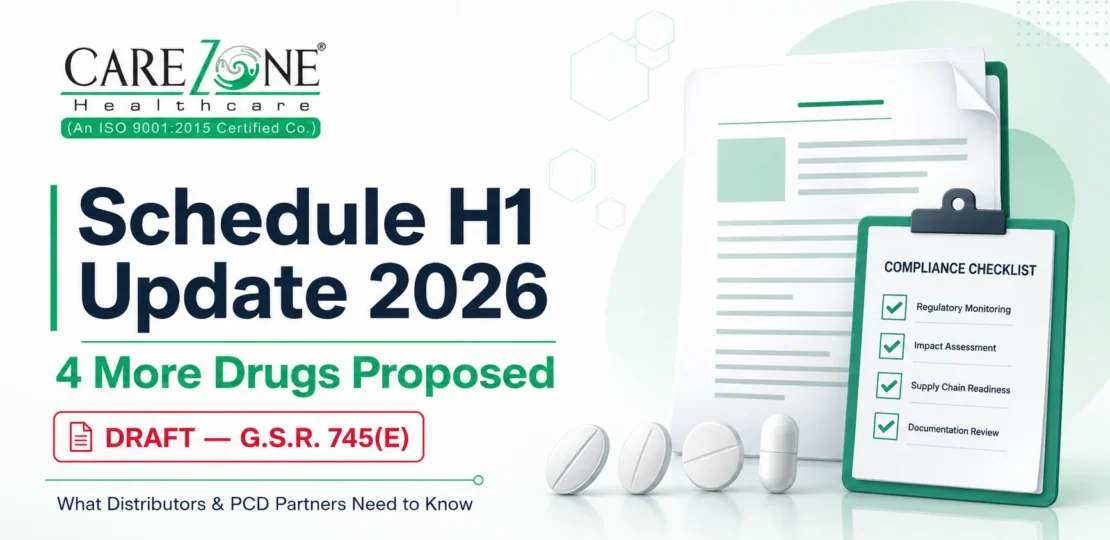
India’s Schedule H1 Update 2026 is an important regulatory development for pharmaceutical manufacturers, marketers, distributors, wholesalers, PCD franchise partners and retail pharmacies.
Through draft notification G.S.R. 745(E), dated 19 August 2026, the Ministry of Health and Family Welfare has proposed adding four drugs to Schedule H1 of the Drugs Rules, 1945:
The most important point for pharma businesses is that these four additions are proposed, not yet finally notified through G.S.R. 745(E). As of 31 August 2026, CDSCO’s official Gazette Notifications page continues to list G.S.R. 745(E) as a draft notification for inclusion of additional four drugs in Schedule H1.
If the proposal is finalised substantially in its current form, the four drugs would become subject to the Schedule H1 framework, including applicable prescription, labelling and retail record-keeping requirements, after the stated implementation period.
For pharma distributors and PCD partners, the correct response today is therefore:
Prepare for a possible regulatory change — but do not treat the draft as a final, operative amendment.
The Schedule H1 Update 2026 discussed here refers to draft notification G.S.R. 745(E), dated 19 August 2026, issued by the Ministry of Health and Family Welfare to propose a further amendment to the Drugs Rules, 1945.
CDSCO’s Gazette Notifications register describes it specifically as:
“Draft notification for inclusion of additional four drugs in Schedule H1.”
The draft proposes inserting the following four entries after serial number 52:
| Proposed Serial Number | Drug |
|---|---|
| 53 | Flupentixol |
| 54 | Zopiclone |
| 55 | Gabapentin |
| 56 | Carisoprodol |
The draft further provides that objections and suggestions received within the specified consultation period will be considered by the Central Government. It states that the rules would come into force 180 days after publication of the final rules in the Official Gazette.
The four drugs have been proposed for Schedule H1, but the August 2026 draft itself does not make the proposed additions immediately operative.
As of 31 August 2026, CDSCO continues to list G.S.R. 745(E) as a draft notification.
This distinction matters greatly for manufacturers, marketers and distributors.
A draft notification communicates what the Government proposes to change. Businesses should therefore track the consultation process and subsequent final notification rather than treating the proposal as if the legal transition has already been completed.
The proposal covers four medicines acting primarily on the central nervous system.
Flupentixol is a centrally acting medicine classified pharmacologically as an antipsychotic.
The August 2026 draft proposes inserting Flupentixol as serial number 53 under Schedule H1.
Its inclusion in this article is solely in the context of the proposed regulatory classification. Medicine selection, dosage and treatment decisions should remain under appropriate medical supervision.
Zopiclone is a sedative-hypnotic medicine used in certain clinical circumstances involving insomnia under medical supervision.
The draft proposes inserting Zopiclone as serial number 54.
The proposed Schedule H1 inclusion should not be interpreted as consumer guidance for using the medicine. Prescription medicines should not be used without appropriate professional advice.
Gabapentin is used in neurological practice, including for certain seizure disorders and neuropathic-pain situations depending on the patient’s diagnosis and clinical circumstances.
The proposed entry is serial number 55.
Importantly, the August notification is a draft. Businesses should therefore avoid messages claiming that G.S.R. 745(E) itself made Gabapentin immediately subject to the proposed new Schedule H1 classification.
Carisoprodol is a centrally acting muscle relaxant used in particular clinical circumstances under medical supervision.
The proposal would insert it as serial number 56 under Schedule H1.
All four proposed entries are also recorded in the official 68th DCC minutes as medicines recommended for inclusion in Schedule H1.
Important: These brief descriptions are provided for regulatory and educational context only. They are not prescribing advice, treatment recommendations or encouragement for self-medication.
No. G.S.R. 745(E) remains a draft notification as of 31 August 2026.
The regulatory sequence is better understood as follows:
| Regulatory Stage | Status as of 31 August 2026 |
|---|---|
| DCC consideration | Completed |
| DCC recommendation | Four drugs recommended for Schedule H1 |
| Draft notification | Issued — G.S.R. 745(E), 19 August 2026 |
| Stakeholder consultation | 30-day period provided in draft |
| Final notification | Not shown as final on the CDSCO Gazette register as of research date |
| Commencement | Draft proposes 180 days after publication of final rules |
CDSCO currently lists the 19 August notification specifically as a draft.
Therefore, a statement such as:
“Gabapentin became Schedule H1 on 19 August 2026”
would not accurately describe the regulatory status of this draft.
A more responsible business communication would be:
“The Government has proposed adding Gabapentin, Flupentixol, Zopiclone and Carisoprodol to Schedule H1 through draft G.S.R. 745(E). Businesses should verify the subsequent final notification and commencement date before implementing the proposed classification.”
The distinction between a proposal, a final notification, and the effective date is critical in regulatory communication.
The August proposal has a regulatory history.
At the 68th meeting of the Drugs Consultative Committee held on 20 March 2026, the DCC considered the report of an expert committee established to examine listing certain drugs under Schedule H1 and Schedule X of the Drugs Rules, 1945 in light of misuse and intoxication.
The official DCC minutes state that the committee approved the subcommittee recommendations for:
This regulatory context is important.
The proposal does not mean these medicines have no legitimate clinical roles, nor does it mean that a patient who has been prescribed one is necessarily misusing it.
Drug scheduling relates to regulatory controls governing areas such as:
For pharmaceutical businesses, this is why regulatory classification must be separated from medical judgement about an individual patient.
Schedule H1 is part of the prescription-drug control framework under the Drugs Rules, 1945.
The Schedule H1 framework was introduced through amendments in 2013, including changes to Rules 65 and 97 covering supply records and product labelling.
For medicines specified in Schedule H1, the framework includes several important controls.
Schedule H1 medicines are not meant for unrestricted over-the-counter retail sale.
The applicable label carries a warning concerning use in accordance with medical advice and retail sale against the prescription of a Registered Medical Practitioner.
Under Rule 65, supply of a drug specified in Schedule H1 is required to be entered in a separate register.
The record includes:
The rule further requires these records to be maintained for three years and kept open for inspection.
Rule 97 contains specific labelling provisions for formulations containing Schedule H1 substances.
Applicable Schedule H1 formulations carry a conspicuous red Rx symbol and a Schedule H1 warning inside a red-bordered box.
The practical significance of a Schedule H1 classification therefore extends beyond simply adding a medicine name to a regulatory list.
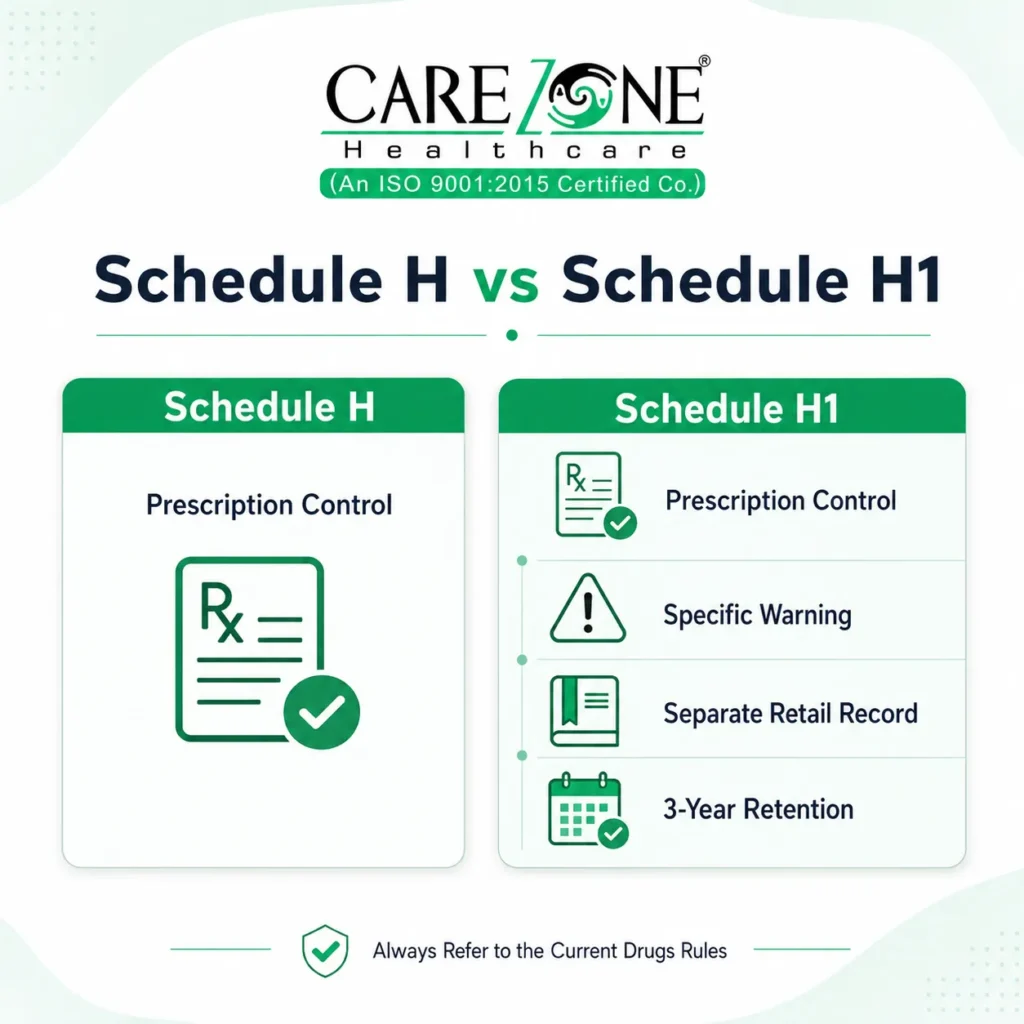
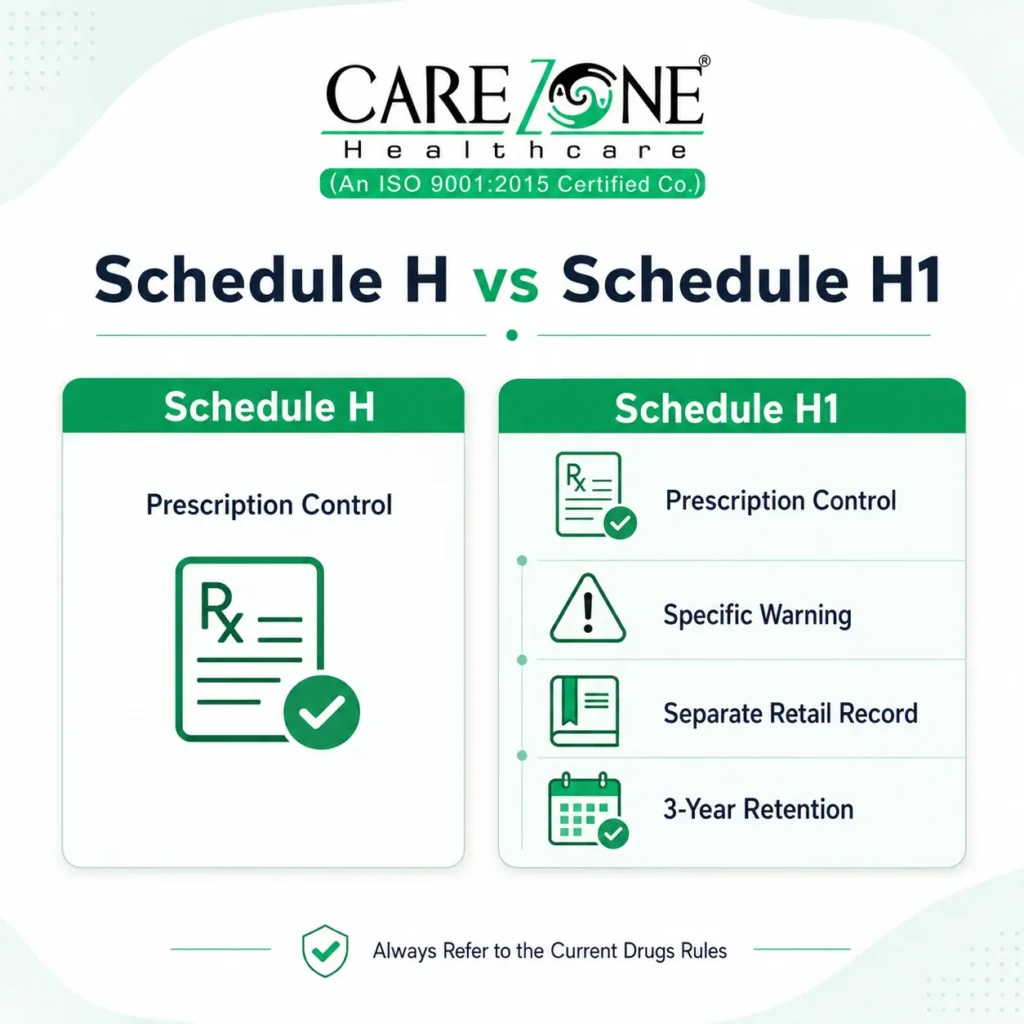
Both Schedule H and Schedule H1 involve prescription medicines, but Schedule H1 introduces additional specific controls, particularly around labelling and dispensing records.
| Area | Schedule H | Schedule H1 |
|---|---|---|
| Prescription-controlled medicine | Yes | Yes |
| Retail sale against prescription | Required | Required |
| Specific Schedule H1 warning | No | Yes |
| Separate Schedule H1 supply register | No specific H1 register | Yes |
| Prescriber and patient details under H1 provision | Not under the specific H1 requirement | Yes |
| Schedule H1 record retention | Not applicable | Three years |
| Additional H1 dispensing traceability | No | Yes |
The purpose of the distinction is therefore practical as well as regulatory.
If a drug is finally brought under Schedule H1, affected businesses need to understand how the classification connects with packaging, dispensing and record-keeping responsibilities.
For distributors, the issue goes beyond what happens at a retail pharmacy counter.
The more useful question is:
What should a distributor prepare for if the final notification confirms the four proposed Schedule H1 additions?
Start by identifying products in your inventory or catalogue containing any of the proposed substances.
Review:
Portfolio mapping can be done during the draft stage without prematurely treating the proposal as final law.
A distributor should not independently redesign a product label or guess the implementation date.
If the amendment is finalised, request written clarification from the manufacturer or relevant marketing entity covering:
Written instructions reduce the risk of inconsistent interpretation across the supply chain.
The specific Schedule H1 patient-and-prescriber register provision must be understood in the context of the applicable rule and licence activity.
A wholesale distributor should not automatically assume that every retail pharmacy record requirement applies identically to each wholesale transaction.
Wholesale licensees must continue to follow the documentation, invoicing, traceability and licence conditions applicable to their activity.
Where one business operates both wholesale and retail functions, the obligations should be reviewed separately.
If the final amendment comes into force, affected SKUs may need changes across internal systems such as:
Preparing the system architecture before the implementation deadline may reduce operational errors later.
Sales representatives and distributor teams should not circulate unverified statements such as:
The appropriate action depends on the final notification, effective date and any relevant regulatory or manufacturer clarification.
A PCD partner often operates between the pharmaceutical company, distributor network, medical market and local stockists.
That makes regulatory communication especially important.
Readers who are new to the franchise model can first understand the broader structure through Carezone Healthcare’s complete guide to what a PCD pharma franchise is. The guide explains the business model, territory discussions and major factors new partners should understand.
PCD partners should identify whether their selected, planned or existing portfolio contains:
Do not assume that a product is available through a particular company merely because its molecule appears in a regulatory notification.
Product availability, composition, permissions and commercial status should be checked against current company documentation.
A proposal for stricter control is also a reminder that prescription medicines should not be marketed like unrestricted consumer wellness products.
PCD teams should avoid communication that:
Pharma marketing must balance commercial communication with regulatory and medical responsibility.
If a final Schedule H1 amendment leads to revised packaging requirements, companies may need to manage a transition involving already-manufactured stock and updated artwork.
PCD partners should not assume that:
Product-specific transition decisions should follow the final rule and appropriate instructions from the manufacturer and competent regulatory authorities.
Once the regulatory position becomes final, an internal compliance update should ideally explain:
A single written circular is far more reliable than multiple interpretations circulating through WhatsApp groups.
If a future classification change affects packaging, stock movement or product promotion, business discussions should clarify responsibility for:
These points should not depend entirely on verbal assurances.
Carezone Healthcare accepts territory-based PCD franchise enquiries and provides product-category, catalogue and business-support discussions for prospective partners.
You can review the current Carezone Healthcare PCD Pharma Franchise opportunity and submit your state, city and business details for a territory discussion. Carezone states that final territory availability, product selection and commercial terms remain subject to company review and current business conditions.
The proposed amendment is also relevant upstream.
A brand owner using third-party manufacturing may need coordination across several stakeholders if an affected formulation ultimately becomes Schedule H1:
Brand Owner → Manufacturer → Packaging Vendor → Distributor → Retailer
Potential areas for preparation include:
A brand owner should not instruct a packaging printer to add Schedule H1 labelling simply because a draft notification has appeared.
The regulatory team or manufacturer should first confirm:
Businesses building products under their own brands can review Carezone Healthcare’s third-party manufacturing services for formulation, packaging, MOQ and documentation discussions. Carezone states that feasibility, MOQ, lead time and documentation can vary according to product category, formulation, packaging and regulatory requirements.
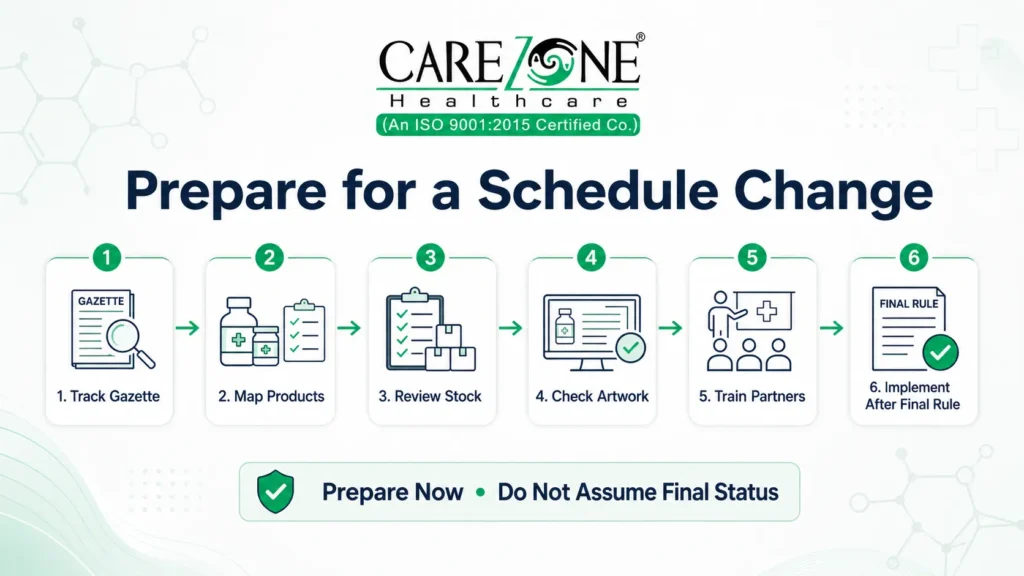
Because G.S.R. 745(E) remains a draft, the appropriate strategy is:
Prepare now. Implement when legally required.
Maintain the regulatory reference:
G.S.R. 745(E) — 19 August 2026
This prevents confusion when multiple regulatory circulars are being tracked simultaneously.
Do not depend exclusively on:
CDSCO and the Official Gazette should remain primary regulatory verification points.
Search product compositions in your:
Know which manufacturer or supplier is responsible for each potentially affected formulation.
This will make future communication faster if a final rule is notified.
Identify existing quantities of:
for potentially affected SKUs.
The purpose is planning—not premature destruction or relabelling.
Your design and regulatory teams can understand the existing Schedule H1 labelling requirements now.
Actual packaging implementation should follow confirmed regulatory instructions.
Check whether agreements clearly address responsibility for:
Ensure ERP or stock-management systems can accommodate a classification update if required.
A designated compliance or management person should communicate final regulatory instructions to:
Retain relevant records such as:
Good documentation helps turn regulatory awareness into operational compliance.
Preparation is important, but premature action can create its own problems.
G.S.R. 745(E) is officially listed as a draft notification as of 31 August 2026.
Do not remove the word “proposed” merely to make a social-media post or sales circular sound more dramatic.
The draft states that the rules would commence 180 days after publication of the final rules, not 180 days from the August draft notification.
Regulatory artwork is not a distributor-level creative decision.
Packaging changes should be controlled through the appropriate manufacturer, regulatory and artwork-approval process.
Prescription-medicine communication should not encourage unsupervised use or self-medication.
A:
can have different operational responsibilities.
Applicable licence conditions and regulatory provisions should be considered individually.
This article explains the issue but does not replace:
A useful 2026 comparison is Pregabalin.
CDSCO’s notification register shows that a draft notification G.S.R. 54(E) concerning inclusion of Pregabalin in Schedule H1 was issued on 21 January 2026.
A final notification, G.S.R. 377(E), dated 13 May 2026, was subsequently issued for amendment of Schedule H1 to include Pregabalin and its formulations.
This sequence demonstrates the difference between:
Draft Proposal → Regulatory Process → Final Notification → Commencement
It does not mean that Flupentixol, Zopiclone, Gabapentin and Carisoprodol will necessarily follow exactly the same timeline or final wording.
It does show why pharma companies and distributors should track an important draft early rather than discovering the final requirement close to implementation.
The practical compliance sequence is:
Draft → Stakeholder Comments → Final Notification → Effective Date → Implementation
A regulatory update should not remain confined to a legal file.
For a pharmaceutical business, a Schedule change can eventually influence:
A practical supply-chain approach is:
Verify the official rule → Identify affected products → Confirm the effective date → Review documentation → Align packaging → Communicate with partners → Monitor implementation
This article does not state that Carezone Healthcare currently markets all four proposed molecules.
Any product-specific enquiry should be checked against the company’s latest catalogue, composition information, availability and supporting documentation.
Business buyers can review the current Carezone Healthcare product range, which includes pharmaceutical, nutraceutical, injection, paediatric, derma, women’s-health and cosmetic categories for business enquiries.
Carezone Healthcare states that it has operated since 2012 and supports PCD franchise, third-party manufacturing, distributor and international business enquiries from Ambala, Haryana.
For businesses evaluating the company beyond an individual regulatory update, Carezone’s PCD and manufacturing pages provide further information on product discussion, documentation, territory enquiries and packaging support.
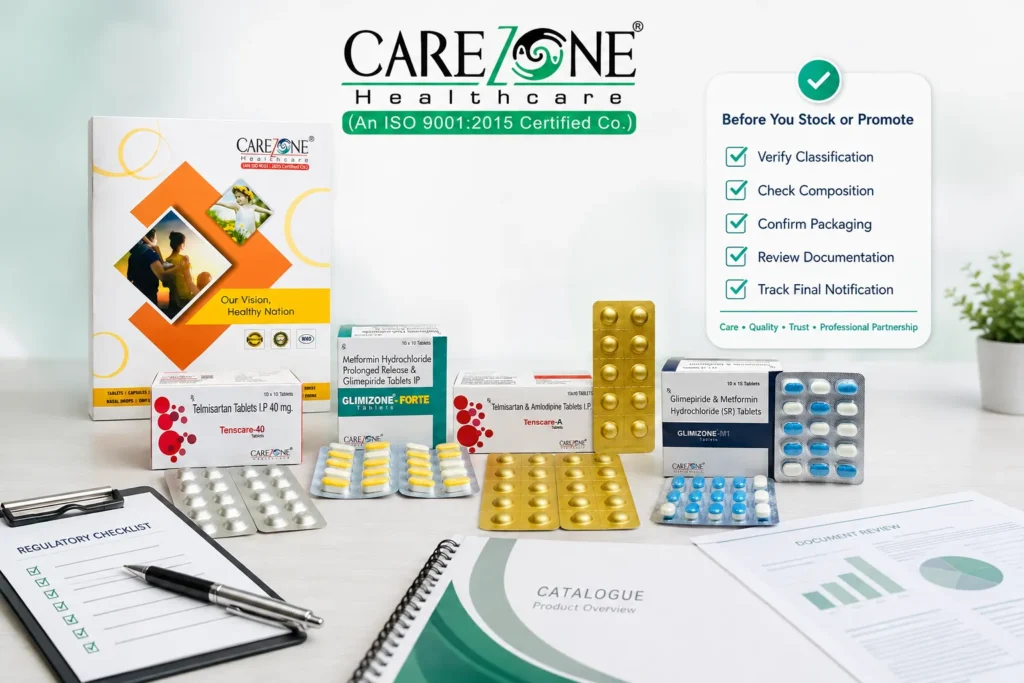
Before purchasing, stocking or promoting a pharmaceutical product affected by a regulatory update, verify the relevant details.
| Verification Area | What to Check |
|---|---|
| Product identity | Exact product name and composition |
| Regulatory classification | Current applicable Schedule |
| Gazette status | Draft or final notification |
| Effective date | Date on which final requirement becomes operative |
| Manufacturer | Applicable licensed manufacturing source |
| Product permission | Relevant product/formulation permission where required |
| Batch information | Batch number and expiry |
| Packaging | Current approved artwork |
| Schedule warning | Applicable prescription and Schedule warning |
| Existing stock | Quantity and batch status |
| Documentation | Invoice and applicable licensed-channel records |
| Partner communication | Written rather than verbal instructions |
| Territory | Current franchise/distribution terms |
| Returns | Agreed complaint or stock-return process |
| State requirements | Relevant State Licensing Authority requirements |
The lowest quotation, highest claimed margin, biggest product catalogue or verbal promise should never replace regulatory verification.
A professional pharma partnership should also consider:
Compliance is sometimes viewed only as a regulatory expense.
For a long-term pharmaceutical business, it is more useful to view compliance as part of business continuity and partner reliability.
Poorly handled regulatory transitions may create:
A structured PCD operation therefore requires more than product promotion.
It requires:
Product Knowledge + Documentation + Inventory Control + Regulatory Awareness + Clear Partner Communication
Carezone Healthcare’s PCD franchise page currently supports territory-based enquiries, product discussions, catalogue requests and documentation guidance, while clearly stating that product availability, territory allocation, monopoly rights and commercial terms depend on the individual business review.
For an entrepreneur or existing distributor, that is the right mindset to apply to any changing regulation:
Understand first, verify second, and act on confirmed information.
The Schedule H1 Update 2026 discussed here is draft G.S.R. 745(E), dated 19 August 2026. It proposes adding Flupentixol, Zopiclone, Gabapentin and Carisoprodol to Schedule H1 of the Drugs Rules, 1945. As of 31 August 2026, CDSCO lists the notification as a draft, so the proposal should not be confused with a final operative amendment.
The four proposed drugs are Flupentixol, Zopiclone, Gabapentin and Carisoprodol. The draft proposes adding them as serial numbers 53, 54, 55 and 56 respectively after serial number 52 in Schedule H1.
The August notification itself is a draft proposal, so G.S.R. 745(E) should not be described as a final operative Schedule H1 addition for Gabapentin. Pharma businesses should track CDSCO and the Official Gazette for a final notification and the corresponding commencement date before implementing the proposed change as law.
The draft states that the rules would come into force 180 days after publication of the final rules in the Official Gazette. Therefore, the 180-day period should not be calculated simply from the 19 August 2026 draft date.
The Drugs Rules provide that supply of a Schedule H1 drug must be entered in a separate register giving the prescriber’s name and address, patient name, drug name and quantity supplied. The records must be retained for three years and remain open for inspection. The requirement should be interpreted within the applicable sale and licence framework.
The specific Schedule H1 register provision should be understood in the context of the applicable retail-supply and licence provisions. A wholesale distributor should not automatically assume that the retail patient-and-prescriber register applies identically to every wholesale transaction. Businesses operating both wholesale and retail activities should assess their respective obligations separately.
PCD partners should monitor the Gazette, identify affected formulations, review stock and packaging, communicate with their manufacturer and prepare their sales teams for a potential transition. They should not prematurely alter labels, announce an unconfirmed effective date or present the draft proposal as final law.
The official minutes of the 68th DCC meeting show that the committee considered an expert report concerning listing certain drugs in Schedule H1 and Schedule X in light of misuse and intoxication. The DCC approved the recommendation to include Flupentixol, Zopiclone, Gabapentin and Carisoprodol in Schedule H1.
Yes. The draft provides a 30-day period for objections and suggestions from the date Gazette copies containing the draft rules are made available to the public. Interested stakeholders should use the official notification and current Government instructions when submitting comments.
The strongest sources are the Official Gazette, CDSCO Gazette Notifications, the Drugs Rules, 1945, and applicable Central or State drug-regulatory authorities. Secondary industry reports may help explain a change, but operational compliance decisions should be based on authoritative regulatory material.
The Schedule H1 Update 2026 matters to manufacturers, marketers, distributors, wholesalers, retailers and PCD franchise partners because it proposes bringing Flupentixol, Zopiclone, Gabapentin and Carisoprodol within the Schedule H1 framework.
The most important word at present is:
PROPOSED.
As of 31 August 2026, CDSCO lists G.S.R. 745(E) as a draft notification.
The draft allows for stakeholder comments and states that the rules would commence 180 days after publication of the final rules.
Pharma businesses should therefore neither ignore the development nor implement unconfirmed assumptions prematurely.
The appropriate approach is:
Monitor → Map Products → Prepare → Verify Final Notification → Confirm Effective Date → Implement Correctly
For distributors and PCD partners, regulatory preparedness becomes most valuable when it connects official information with actual:
That is the difference between simply hearing about a pharma regulation and managing it professionally.
Carezone Healthcare is based in Ambala, Haryana and supports business enquiries across PCD pharma franchise, product distribution, third-party manufacturing and selected international requirements.
The company’s current website states that Carezone Healthcare has been operating since 2012 and offers a portfolio covering pharma, nutraceutical and cosmetic categories.
If you are planning to start or expand a pharma business, review the Carezone Healthcare PCD Pharma Franchise opportunity.
Share your:
Final product availability, territory allocation, monopoly discussions and commercial terms are subject to company review.
If you are building your own pharma, nutraceutical or cosmetic brand, explore Carezone Healthcare Third-Party Manufacturing.
For a more useful discussion, share:
MOQ, manufacturing feasibility, documentation and timelines depend on the product and business requirement.
Businesses can also review the current Carezone Healthcare Product Range before requesting catalogue, availability or distribution information.
Call / WhatsApp: +91 7488834800
Suggested WhatsApp Message:
Hello Carezone Healthcare, I would like to discuss your pharma product range for PCD franchise / distribution / third-party manufacturing. My location is ______ and my required product/category is ______. Please share the relevant business details.
Carezone Healthcare — Trusted Healthcare. Stronger Pharma Partnerships.
This article is provided for general pharmaceutical-industry and regulatory education only. It is not medical, legal or regulatory-compliance advice and should not be used to prescribe, dispense, start, stop or change any medicine.
Prescription medicines should be used only under appropriate medical supervision.
Pharmaceutical manufacturers, marketers, distributors, wholesalers, retailers and PCD partners should confirm the latest regulatory position through the Official Gazette, CDSCO, applicable State Drugs Control/Licensing Authority and qualified regulatory or legal professionals where necessary before making operational decisions.
Because G.S.R. 745(E) is a draft notification as of 31 August 2026, this article should be reviewed and updated promptly if a final notification, revised proposal, implementation date or further regulatory clarification is published.
View all