September 21, 2026 | by admindefault
Last Regulatory Review: 21 September 2026
Regulatory Context: CDSCO Public Health Alert dated 8 September 2026
Primary Audience: Cosmetic manufacturers, importers, private-label brands, third-party manufacturing buyers, distributors, retailers and cosmetic business owners
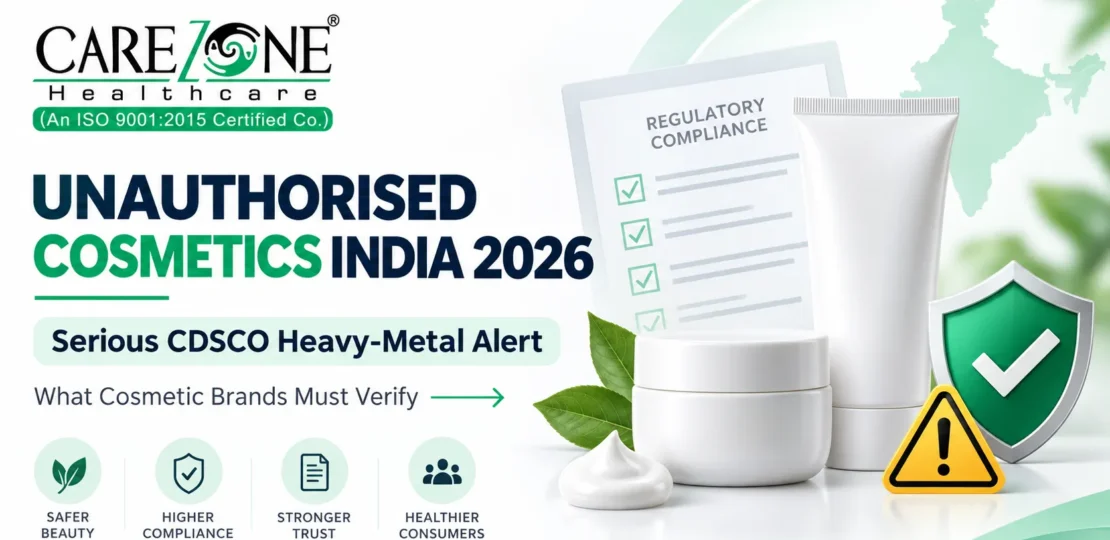
The Unauthorised Cosmetics India 2026 alert issued by the Central Drugs Standard Control Organisation (CDSCO) has put renewed attention on cosmetic import registration, product testing, heavy-metal limits, labelling and supply-chain verification in India.
In its 8 September 2026 Public Health Alert, CDSCO identified two imported cosmetic products—Goree Beauty Cream and Chandni Whitening Cream, both shown in the notice as made in Pakistan—as unauthorised for sale in India because they had not been issued the required import registration certificate. CDSCO also stated that test and analysis found excessive heavy metals beyond specified limits, which may pose health risks including toxic effects.
CDSCO advised consumers not to purchase or use the named products and warned establishments and individuals not to sell, distribute or advertise them. The regulator also advised the public to purchase authorised cosmetics carrying key identifiers such as manufacturer details, manufacturing licence number, batch number, manufacturing/expiry information and, for imported cosmetics, the applicable registration number.
For cosmetic manufacturers, importers and private-label brands, however, the wider lesson is much bigger than two creams.
The central business question is:
Can you prove that the cosmetic you manufacture, import, brand, distribute or sell is legally authorised, properly labelled, traceable to its manufacturing source and compliant with applicable quality and safety standards?
This Carezone Healthcare guide explains the CDSCO alert, the Cosmetics Rules, 2020, manufacturing licence vs import registration requirements, cosmetic label verification, heavy-metal standards, private-label due diligence and the practical checks businesses should complete before bringing a cosmetic product to market.
The Unauthorised Cosmetics India 2026 development refers to CDSCO’s 8 September 2026 Public Health Alert against the use of unauthorised cosmetic products.
CDSCO’s Cosmetics Division stated that cosmetics used by consumers must be safe and that their manufacture and import are regulated under the Drugs and Cosmetics Act, 1940 and Cosmetics Rules, 2020, with relevant product standards published by the Bureau of Indian Standards.
CDSCO found two imported cosmetic products to be unauthorised for sale in India because they had not received the required import registration certificate. CDSCO also reported that laboratory testing found excessive heavy metals beyond specified limits.
The regulator instructed consumers not to purchase or use the products and told establishments and individuals not to sell, distribute or advertise them.
Read the official CDSCO Public Health Alert dated 8 September 2026
The CDSCO notice specifically lists:
The notice identifies the product as Made in Pakistan.
The notice also identifies this product as Made in Pakistan.
CDSCO stated that the products had not been issued an import registration certificate by the competent authority for sale in India.
This article should not expand the CDSCO alert to unrelated brands merely because they have:
The regulatory finding in the notice concerns the named products.
For another product, its own regulatory status should be verified independently.
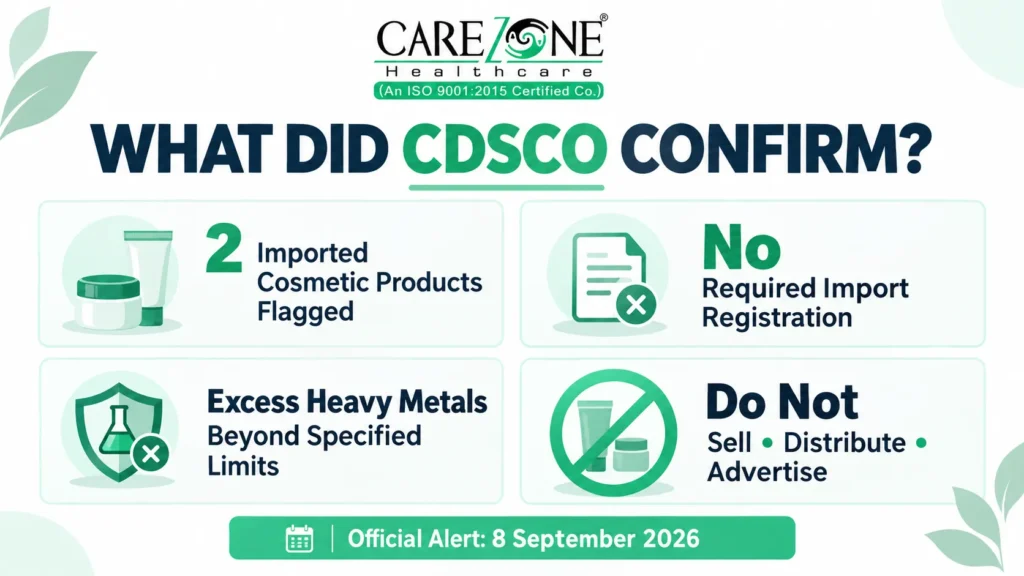
CDSCO states that the named unauthorised cosmetics contained “excessive heavy metals beyond the specified limits” and that this may pose health risks including toxic effects.
However, the public notice does not provide:
This distinction is essential for medically responsible reporting.
The alert confirms excessive heavy metals beyond applicable limits, but it does not publicly identify the individual heavy metals or measured concentrations in the notice.
Therefore, Carezone Healthcare should not write:
“CDSCO found mercury in these two creams”
unless an official laboratory report or subsequent regulatory notice specifically confirms that.
That would go beyond the source.
In this particular CDSCO alert, “unauthorised” means that the identified imported products had not been issued the required registration certificate for import by the competent authority for sale in India.
That is different from saying:
These are separate questions.
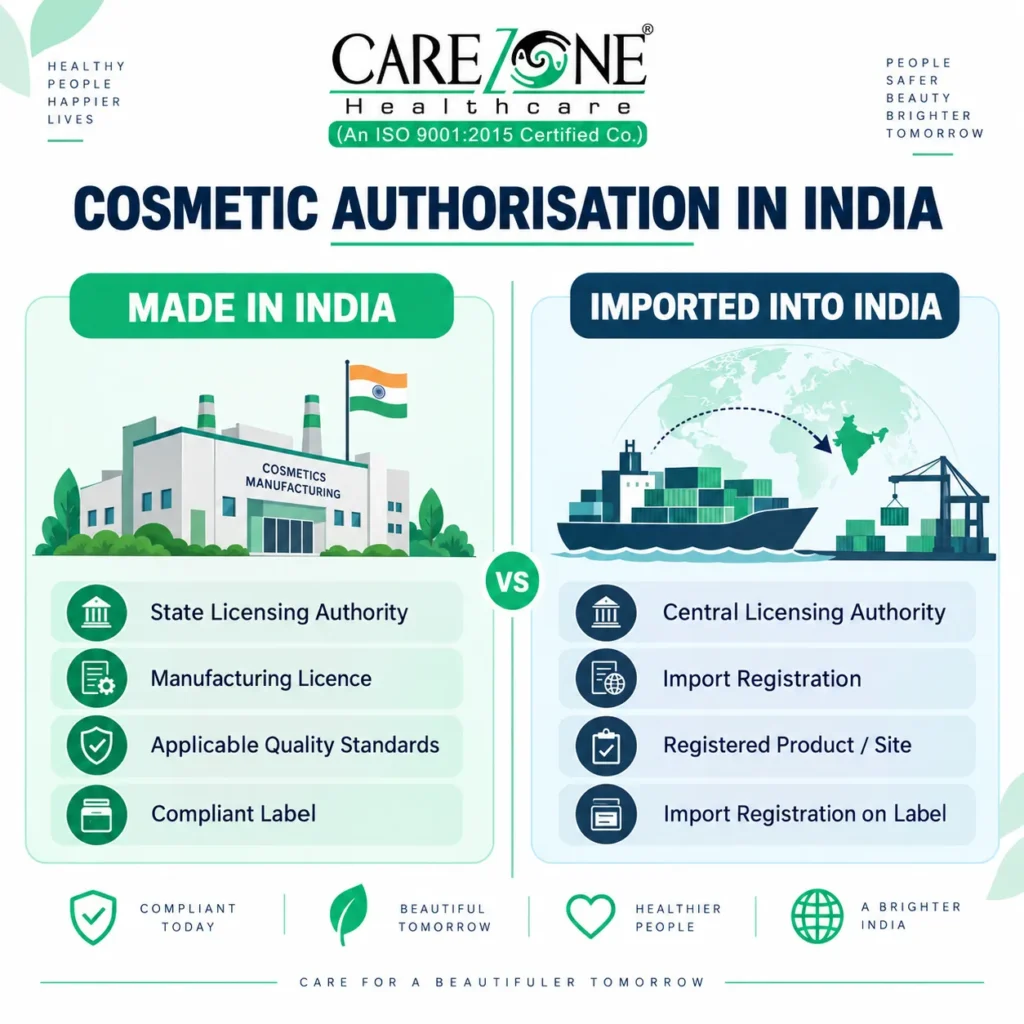
CDSCO states that any cosmetic falling within the regulatory definition must be registered, together with applicable pack size, variants and manufacturing premises, before import into India. Rule 12 states that no cosmetic shall be imported unless registered in accordance with the Cosmetics Rules.
Domestic manufacturing is regulated through licensing by the State Licensing Authority. CDSCO’s official Cosmetics page states that the State Drugs Controller is the authority for manufacture for sale/distribution and the sale, stock, exhibit or offer for sale/distribution of cosmetics.
Therefore, authorisation needs to be considered in relation to how the product enters the Indian market.
Two regulatory pathways should not be confused.
The State Licensing Authority regulates manufacture for sale or distribution.
The Central Licensing Authority, with the Drugs Controller General (India) functioning as the Central Licensing Authority, regulates cosmetic import registration.
This creates a simple compliance distinction:
Made in India → Manufacturing Licence / State Licensing Framework
Imported into India → Import Registration / Central Licensing Framework
Businesses should still check the complete applicable requirements for the specific product.
CDSCO official Cosmetics regulatory information
The two are not interchangeable.
| Requirement | Domestic Cosmetic | Imported Cosmetic |
|---|---|---|
| Primary regulatory route | Manufacturing licence | Import registration |
| Main authority | State Licensing Authority | Central Licensing Authority |
| Manufacturing source | Indian licensed premises | Overseas registered manufacturing premises |
| Batch / label requirements | Applicable | Applicable |
| Registration certificate number on imported unit pack | Not an import requirement | Required where applicable under the Rules |
| Applicable safety/quality standards | Yes | Yes |
| BIS / Cosmetics Rules compliance | Yes | Yes |
Under Rule 12, imported cosmetics generally must be registered before import.
Rule 34 further requires imported cosmetics marketed in India to carry the product’s registration certificate number and the name and address of the registration-certificate holder on the label.
A private-label buyer should therefore not ask only:
“Can you manufacture this cream?”
A better discussion includes:
The Cosmetics Rules, 2020 create the main regulatory framework for cosmetic manufacture, import, labelling, quality standards, testing and enforcement in India.
Several provisions are particularly relevant to this alert.
A cosmetic should not be imported into India unless registered according to the Rules.
The Rules prescribe information to be displayed on cosmetic labels, including applicable manufacturer information, batch identification, expiry/use-before information and manufacturing licence details. Imported products also have registration-certificate labelling requirements.
The Rules state that a cosmetic should not make or convey an idea that is false or misleading to the intending user.
Cosmetics must comply with applicable specifications prescribed under the Ninth Schedule or other relevant standards of quality and safety.
Read the official Cosmetics Rules, 2020 on CDSCO
Rule 39 of the Cosmetics Rules contains standards relating to permitted colours and certain metal limits.
For permitted synthetic and natural organic colours used in cosmetics, the Rules specify that they should not contain more than:
The Rules also state that:
Bureau of Indian Standards specifications also form part of India’s cosmetic-safety framework. CDSCO notes that products covered by the Ninth Schedule must comply with relevant BIS standards.
BIS information on IS 4707 cosmetic raw-material standards
These are general regulatory standards.
They should not be presented as the exact laboratory results for the two creams in the CDSCO alert.
The alert itself only states that excessive heavy metals were found beyond specified limits.
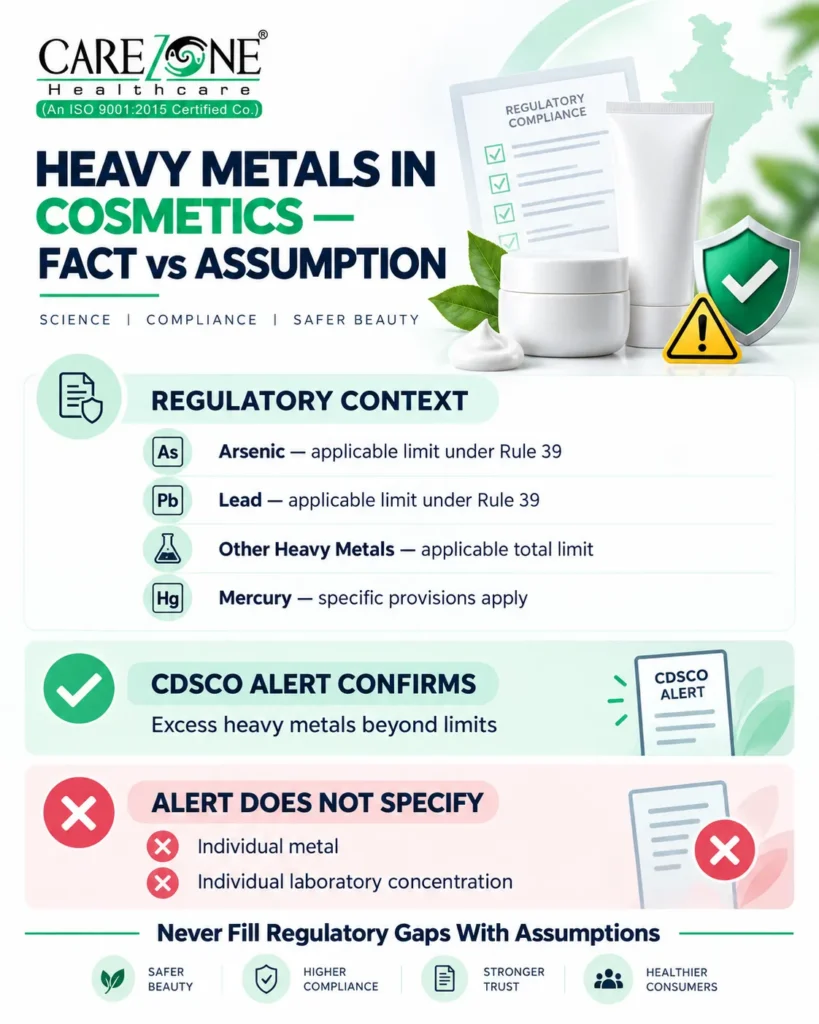
The public notice does not specifically say that mercury was the heavy metal found in the two named products.
That distinction matters because skin-lightening products are often discussed internationally in relation to mercury.
WHO warns that mercury-containing skin-lightening products are hazardous and can affect the kidneys, nervous system and skin. WHO continues international efforts to eliminate mercury-containing skin-lightening products.
But WHO’s wider evidence should not be used to fill a gap in the CDSCO laboratory finding.
CDSCO Alert: Excess heavy metals beyond specified limits.
WHO Evidence: Mercury-containing skin-lightening products can cause serious health risks.
Not Confirmed by This CDSCO Notice: That mercury was specifically detected in the two named creams.
This fact-vs-evidence separation improves medical accuracy and gives the article stronger E-E-A-T value.
WHO — Elimination of mercury-containing skin-lightening products
A compliant cosmetic business begins before production starts.
Verify that the manufacturing activity is covered through the applicable State Licensing Authority framework.
Do not assume that a general business registration or GST registration replaces a cosmetic manufacturing licence.
Establish the exact cosmetic category and applicable regulatory standard.
For example:
may involve different formulation, testing and labelling considerations.
Review:
Manufacturers should maintain appropriate incoming-quality controls and specifications for raw materials.
The product should comply with applicable quality and safety standards.
Each manufacturing batch should be traceable through appropriate production and quality records.
Artwork should be reviewed for:
Avoid unsupported language such as:
unless the exact statement is lawful, factual and properly substantiated.
Rule 36 prohibits cosmetics from making false or misleading claims.
Private-label businesses have a particularly important role because their brand name may appear prominently even when manufacturing is outsourced.
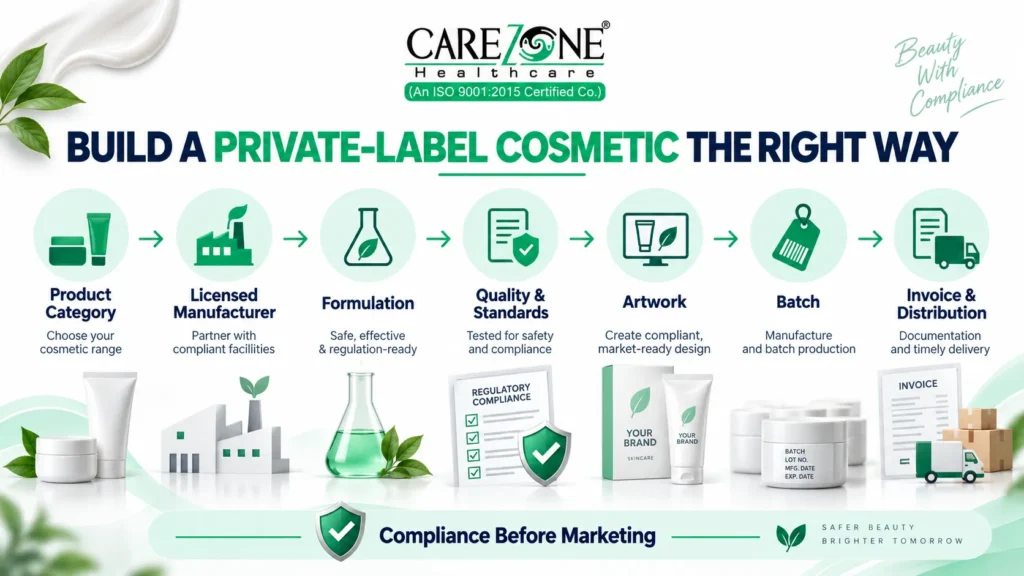
A strong private-label process should answer:
Who manufactures it? → Under what licence? → What formulation? → What testing? → What artwork? → Which batch? → Who receives it?
Do not confuse:
Discuss whether the project uses:
Never approve marketing claims first and formulation later.
A premium carton can still be non-compliant.
The exact testing/documentation package depends on the cosmetic category and manufacturing arrangement.
Commercial requirements and regulatory requirements are not the same thing.
Carezone Healthcare currently supports selected cosmetic and skin-care private-label and third-party manufacturing enquiries, with final feasibility depending on product category, documentation, packaging, MOQ and internal business review.
Discuss third-party manufacturing with Carezone Healthcare
Planning a cosmetic or skin-care private-label range? Share your category, proposed product format, quantity and packaging requirement with Carezone Healthcare for a structured feasibility discussion.
Importers carry another layer of regulatory responsibility.
Rule 12 requires registration of cosmetics before import into India.
Registration is connected not only to the cosmetic identity but also to pack size, variants and manufacturing premises.
The unit pack should carry the applicable registration certificate number and details required under the Cosmetics Rules.
The importer should understand:
An imported cosmetic still needs to meet applicable Indian quality and safety requirements.
Import registration should not be viewed merely as paperwork added after the product arrives.
It should be part of product-selection due diligence.
The CDSCO alert directly warns establishments and individuals not to sell, distribute or advertise the two named products.
A cosmetic distributor or retailer should have a simple inward-product checklist.
Can you identify who made the product?
For applicable domestically manufactured cosmetics, check the licence information carried on the label.
An imported cosmetic should carry the applicable import-registration details.
Batch traceability matters if:
Avoid altered or suspicious coding.
Know who supplied the product to your business.
Do not rely only on a marketplace screenshot or salesperson’s message.
Cosmetic labelling requirements vary depending on product characteristics and packaging, but the Cosmetics Rules include key information such as:
For imported cosmetics marketed in India, Rule 34 additionally requires the import registration certificate number and the name/address of the registration-certificate holder.
In its September 2026 alert, CDSCO specifically advised consumers to purchase authorised cosmetics displaying:
That provides a practical consumer and retailer verification checklist directly from the regulator.
No. Marketplace availability is not regulatory authorisation.
A product being available through:
does not prove that it meets Indian import, manufacturing, labelling or quality requirements.
WHO has similarly noted that hazardous mercury-containing skin-lightening products may continue to be advertised or available online even in markets with regulatory controls.
Marketplace Listing + Attractive Packaging
is weaker than:
Manufacturer / Importer → Licence / Registration → Label → Batch → Invoice → Applicable Standards
For imported products, the registration status is particularly important.
Cosmetic compliance is not only about heavy metals or licensing.
Marketing claims matter too.
Rule 36 of the Cosmetics Rules states that a cosmetic should not purport or claim to convey an idea that is false or misleading to the intending user.
This is especially relevant for advertising phrases such as:
when the company does not have reliable evidence to substantiate the exact statement.
A cosmetic is intended for functions such as cleansing, beautifying, promoting attractiveness or altering appearance within the statutory definition.
A cosmetic business should be cautious about turning appearance-related marketing into unsupported disease-treatment claims.
Traceability matters even when the product is legal and properly manufactured.
A useful B2B model is:
Brand Owner → Licensed Manufacturer → Batch → Packaging → Invoice → Distributor → Retailer
Each stage should be capable of answering:
If a regulatory alert appears, this makes it easier to:
Identify → Isolate → Verify → Communicate → Act
The same principle underlies Carezone Healthcare’s broader supply-chain content on misbranded and counterfeit medicines.
Read Carezone’s CDSCO Misbranded Drugs Crackdown 2026 guide
If an official alert identifies the product, follow the regulator’s instruction.
For the two products named in the September CDSCO alert, establishments and individuals were specifically warned not to sell, distribute or advertise them.
Keep:
Determine who placed the product into your supply chain.
For imported products, verify the applicable import registration.
CDSCO advised that label violations involving products manufactured in India may be reported to the relevant State Drugs Controller, while imported-product issues may be reported to the Drugs Controller General (India).
Do not accuse unrelated manufacturers or brands merely because their packaging appears similar.
The lowest quote does not prove the strongest manufacturing or compliance system.
Artwork should follow confirmed formulation and regulatory information.
The marketing agency and actual manufacturer may be different entities.
Foreign origin is not regulatory authorisation.
It does not.
Every serious private-label project should be traceable at batch level.
A cosmetic should not be promoted as though it cures a disease unless a different legally appropriate regulatory framework applies.
Cosmetic regulations, standards, registrations and product permissions can change.
The Unauthorised Cosmetics India 2026 alert demonstrates why cosmetic businesses should not treat packaging and branding as the first step in product development.
For a professional private-label project, the sequence should be:
Product Category → Manufacturing Source → Regulatory Feasibility → Formulation → Quality Requirements → Artwork → Batch → Documentation → Distribution
not:
Logo → Packaging → Influencer Marketing → Compliance Later
Carezone Healthcare is based in Ambala, Haryana and its current website states that the business has operated since 2012, with a broad 600+ product portfolio across pharma, nutraceutical and cosmetic business discussions.
Carezone’s dedicated Cosmetic & Skin Care Range page currently supports enquiries related to selected:
subject to product feasibility, packaging, documentation, MOQ and commercial review.
Explore Carezone Healthcare’s Cosmetic & Skin Care Range
Carezone Healthcare’s third-party manufacturing route accepts enquiries covering pharma, nutraceutical and cosmetic categories, while explicitly stating that final MOQ, pricing, lead time and manufacturing approval depend on the project requirements.
Carezone Healthcare Third-Party Manufacturing
CDSCO Misbranded Drugs Crackdown 2026
Counterfeit Cancer Drugs India 2026
These articles together strengthen Carezone’s broader content cluster around:
Before selecting a manufacturer, importer or supplier, verify the items that apply to your transaction.
| Verification Area | What to Check |
|---|---|
| Company Identity | Legal/business name and official contact |
| Actual Manufacturer | Who physically manufactures the cosmetic |
| Manufacturing Licence | Applicable licence for Indian manufacture |
| Import Registration | Required registration for imported cosmetic |
| Manufacturing Premises | Correct site covered by documentation |
| Product Category | Exact cosmetic category |
| Formulation | Confirmed ingredients and product format |
| Applicable Standards | Cosmetics Rules / BIS requirements |
| Restricted Ingredients | Review applicable restrictions |
| Claims | Accurate and non-misleading |
| Artwork | Current approved product information |
| Batch Number | Product traceability |
| Mfg. / Expiry | Correct label information |
| Importer Details | Applicable for imported cosmetics |
| Registration Number | Applicable imported-product number |
| Testing | Relevant product/category testing |
| Packaging | Product-compatible and properly labelled |
| Invoice | Commercial traceability |
| Complaint Process | Defined escalation route |
| Recall Readiness | Ability to identify affected batches |
A private-label cosmetic partner should not be selected only because it offers:
A stronger decision considers:
Compliance + Product Quality + Documentation + Packaging + Traceability + Communication + Commercial Terms
CDSCO’s own September 2026 advice provides a practical starting point.
Consumers should look for:
Consumers should also be cautious with cosmetics that:
CDSCO has specifically advised consumers not to use the named products identified in its alert.
For a suspected cosmetic-related health problem, stop relying on online product claims and seek appropriate medical advice where symptoms or exposure concerns require professional evaluation.
The Unauthorised Cosmetics India 2026 alert refers to CDSCO’s 8 September 2026 Public Health Alert concerning Goree Beauty Cream and Chandni Whitening Cream. CDSCO stated that the imported products had not received the required import registration certificate and that testing found excessive heavy metals beyond specified limits.
CDSCO named Goree Beauty Cream and Chandni Whitening Cream, both described in the notice as made in Pakistan. The regulator advised consumers not to purchase or use the products and warned businesses not to sell, distribute or advertise them.
The September public notice does not identify the individual heavy metal or provide product-specific laboratory concentrations. It states that excessive heavy metals beyond specified limits were detected. Therefore, mercury should not be attributed to these products unless another authoritative source specifically confirms it.
Under Rule 12 of the Cosmetics Rules, 2020, cosmetics intended for import into India generally need to be registered with the Central Licensing Authority. Imported cosmetic labels must also meet applicable Indian labelling requirements, including registration information.
Cosmetic manufacture for sale or distribution is regulated by the State Licensing Authority. CDSCO states that State Drugs Controllers are responsible for enforcing manufacturing and sale-related requirements, while the Central Licensing Authority handles cosmetic import registration.
A private-label buyer should verify the actual manufacturer, applicable manufacturing licence, product category, formulation, relevant quality standards, testing requirements, artwork, claims, batch controls, packaging and documentation. Commercial factors such as MOQ and price should be considered separately from regulatory requirements.
Imported cosmetics marketed in India should comply with the Cosmetics Rules and carry the applicable import registration certificate number together with registration-certificate-holder information, along with other required product details.
No. The regulatory framework is more specific. Rule 39 sets particular standards and limits for certain metals and permitted colours, and contains separate mercury provisions. The applicable requirement should be assessed according to the product and relevant standard rather than simplified to a universal “zero heavy metals” statement.
No. Online availability is a sales-channel fact, not proof of regulatory authorisation. Buyers and sellers should verify manufacturing/import documentation, label information and traceability independently.
Businesses should use official sources such as CDSCO, the Cosmetics Rules, 2020, applicable State Licensing Authorities and relevant BIS standards. Product-specific legal or regulatory questions may require professional regulatory advice.
The Unauthorised Cosmetics India 2026 alert should not be read only as a warning about two imported creams.
It is also a practical reminder for every business operating in cosmetic manufacturing, private label, import or distribution:
A good-looking cosmetic pack is not the same as a compliant cosmetic product.
A stronger verification model is:
Authorised Manufacturer / Importer → Appropriate Licence or Registration → Compliant Formulation → Applicable Quality Standards → Accurate Label → Traceable Batch → Proper Invoice → Responsible Distribution
For manufacturers, the priority is regulatory and quality control.
For importers, it is valid registration and compliant labelling.
For private-label brand owners, it is knowing exactly who makes the product and under what framework.
For distributors and retailers, it is verifying the product before putting it into the market.
Carezone Healthcare’s practical conclusion is:
Build the brand only after the product, manufacturer, documentation and compliance pathway have been verified.
That approach creates a stronger foundation for long-term cosmetic and personal-care business.
[IMAGE 6 — CAREZONE COSMETIC / PRIVATE-LABEL TRUST CTA]
Carezone Healthcare supports B2B discussions from Ambala, Haryana across selected:
Carezone Healthcare’s current website states that it has operated since 2012 and supports a broad 600+ product portfolio across pharma, nutraceutical and cosmetic business discussions.
Prepare:
Discuss cosmetic third-party manufacturing with Carezone Healthcare
Explore Carezone Healthcare Cosmetic & Skin Care Range
Explore Carezone Healthcare PCD Pharma Franchise
View Carezone Healthcare Product Range
Contact Carezone Healthcare Business Desk
Call / WhatsApp: +91 7488834800
Email: info@carezonehealthcare.com
Hello Carezone Healthcare, I would like to discuss a cosmetic / skin-care private-label or third-party manufacturing requirement. My product category is ______, approximate quantity is ______ and packaging requirement is ______. Please share the relevant feasibility and business details.
Carezone Healthcare
Trusted Healthcare. Stronger Pharma Partnerships.
This article is provided for general cosmetic-industry, regulatory, business and consumer education only.
The article is based on publicly available information current to 21 September 2026.
The CDSCO Public Health Alert identifies the two named imported cosmetics as unauthorised and reports excessive heavy metals beyond specified limits. This article does not independently test those products and does not infer specific metals or laboratory concentrations that CDSCO has not published in the cited notice.
Cosmetic manufacturers, private-label buyers, importers, distributors and retailers should verify current requirements through:
This article is not a substitute for medical diagnosis or treatment.
Anyone who experiences symptoms or has concerns following cosmetic exposure should seek advice from an appropriately qualified healthcare professional.
Business availability, manufacturing feasibility, MOQ, packaging, lead time, private-label options and commercial terms vary according to the product and business requirement. Carezone Healthcare does not guarantee product approval, business returns or regulatory acceptance merely because an enquiry is submitted.
Regulatory content last reviewed: 21 September 2026. Review this article if CDSCO publishes additional test details, enforcement updates or material changes to the Cosmetics Rules or applicable standards.
View all