September 15, 2026 | by admindefault
Last Regulatory Review: 15 September 2026
Current News Context: Bengaluru Police SIT + Drugs Control Department investigation
Upcoming Regulatory Change: Schedule H2 QR/barcode expansion — anti-cancer drugs from 1 July 2027
Primary Audience: Pharma distributors, wholesalers, PCD franchise partners, institutional buyers, third-party brand owners, manufacturers and pharmaceutical marketers
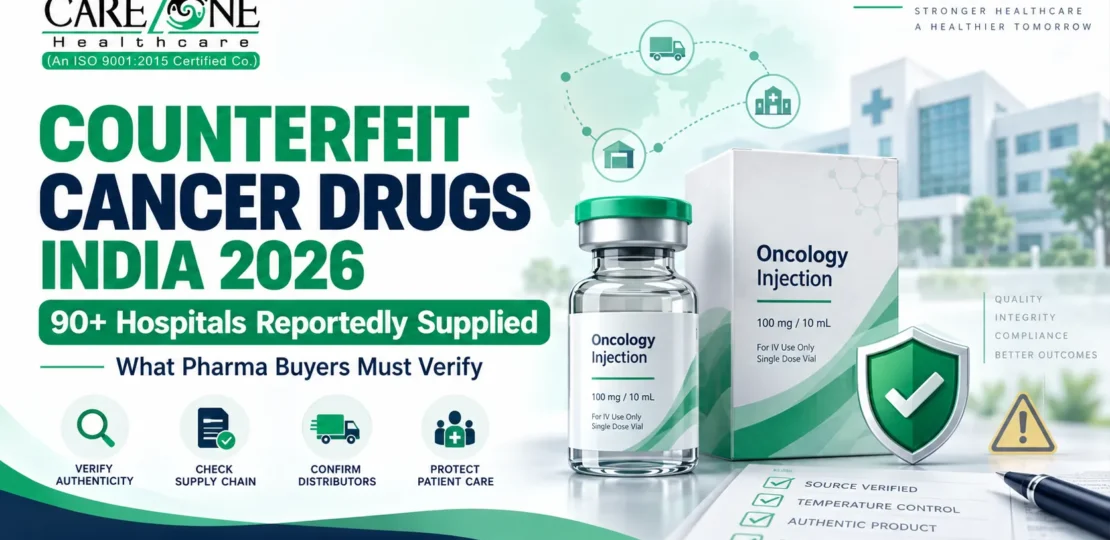
The Counterfeit Cancer Drugs India 2026 investigation in Bengaluru has raised serious questions about how high-value and life-saving medicines move through the pharmaceutical supply chain.
On 12 September 2026, The Indian Express reported that a Special Investigation Team of Bengaluru Police and the Drugs Control Department was probing a suspected counterfeit-medicine network that allegedly supplied cancer drugs, ICU injections and other critical medicines to more than 90 hospitals and clinics. A pharmacy owner was arrested, and investigators were examining allegations involving suspect medicines sold at discounts reportedly reaching around 50%.
The investigation follows an earlier August raid near Bidadi in which authorities reported the seizure of alleged spurious and relabelled medicines worth about ₹4.91 crore from an unlicensed operation. Officials alleged that lower-cost medicines were being relabelled to resemble more expensive products before entering the market.
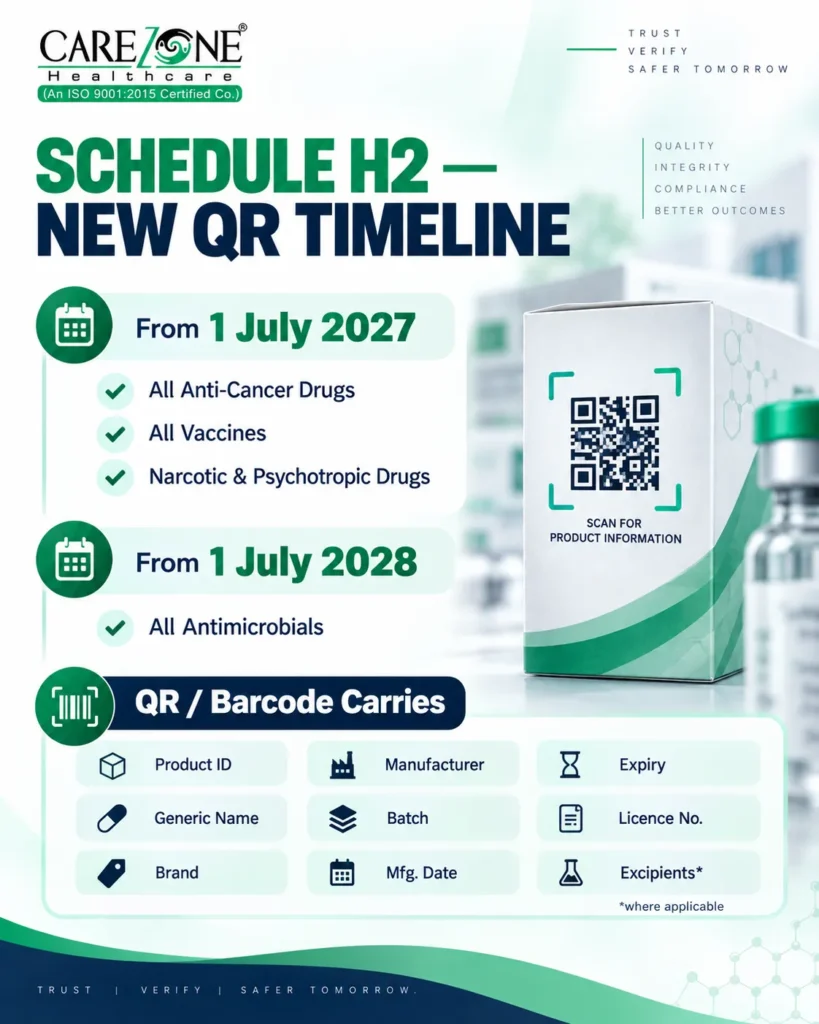
At the same time, India is preparing a major pharmaceutical traceability change. Under the Drugs (Seventh Amendment) Rules, 2026, all anti-cancer drugs, vaccines and specified narcotic and psychotropic drugs will come under expanded Schedule H2 barcode/QR-code requirements from 1 July 2027. Antimicrobials will follow from 1 July 2028.
For Carezone Healthcare’s B2B audience, the central question is therefore not simply:
“How do counterfeit medicines look?”
The more important question is:
“Can you verify the supplier, invoice, batch, manufacturer, packaging and complete supply-chain history of the medicines you buy, market or distribute?”
This guide explains what is currently known about the Bengaluru case, what remains under investigation, how pharma businesses should verify high-value pharmaceutical stock, and what the upcoming Schedule H2 QR-code framework will—and will not—change.
On 12 September 2026, The Indian Express reported that investigators in Bengaluru had uncovered a suspected counterfeit-medicine distribution network while following leads from an earlier spurious-drug case.
A Special Investigation Team of Bengaluru Police, working with the Drugs Control Department, had raided Krupa Healthcare near Minerva Circle and seized a large quantity of suspected counterfeit medicines.
Police arrested the pharmacy owner in connection with the investigation. Investigators were reportedly examining whether suspected fake cancer medicines, ICU injections and other critical medicines had been supplied to more than 90 hospitals and clinics in Bengaluru.
Reports further alleged that medicines were being offered at discounts of up to approximately 50%, raising questions about procurement practices and the origin of the stock.
The probe is related to a broader investigation that followed an August raid near Bidadi, where police and Karnataka drug authorities reported the seizure of alleged spurious and relabelled medicines worth around ₹4.91 crore from an unlicensed pharmaceutical repacking/relabeling operation.
The Bengaluru counterfeit-drug investigation highlights a supply-chain vulnerability: sophisticated packaging and a recognised medicine name are not enough to establish that a pharmaceutical product came through an authorised and traceable channel.
For pharma businesses, the incident reinforces the need to verify:
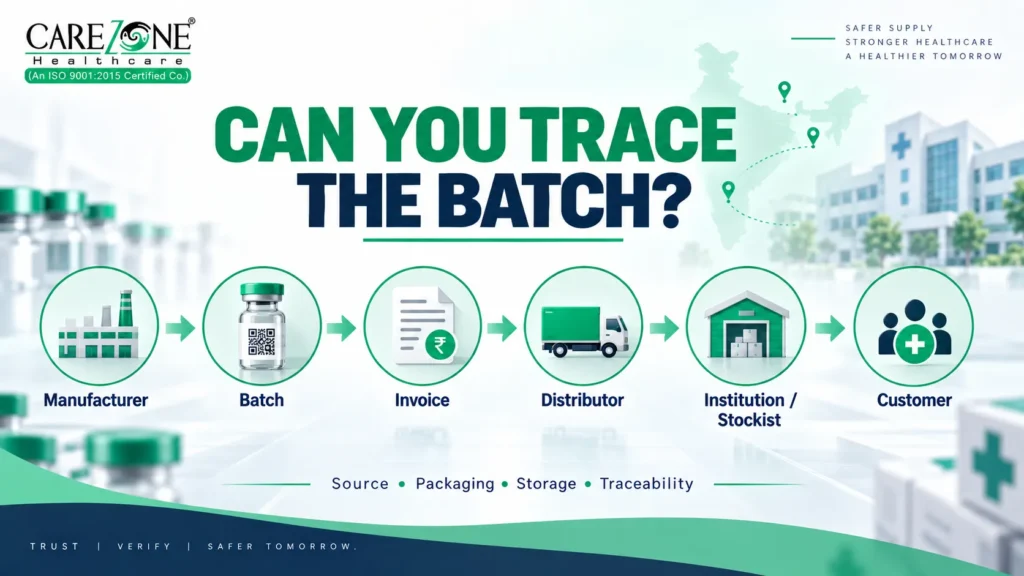
Supplier → Licence → Invoice → Manufacturer → Batch → Packaging → Storage → Downstream Supply
rather than depending only on appearance or price.
This distinction is important because the Bengaluru matter remains an active criminal/regulatory investigation.
| Issue | Current Position |
|---|---|
| SIT investigation exists | Reported / confirmed by authorities through media reporting |
| Pharmacy owner arrested | Reported |
| Suspected counterfeit drugs seized | Reported |
| More than 90 hospitals/clinics received supplies from the network | Reported by investigators |
| Every hospital knowingly purchased counterfeit drugs | Not established by the reporting |
| Every medicine supplied to those hospitals was counterfeit | Not established |
| Discounts around 50% were reportedly offered | Reported allegation |
| ₹4.91 crore earlier seizure near Bidadi | Reported by authorities |
| Full national network and final liability | Still under investigation |
Regulatory content should not convert an allegation into a concluded fact.
For example, writing:
“90 hospitals bought fake cancer drugs”
would be stronger than what the current investigation supports.
A more accurate formulation is:
“Investigators suspect that medicines from the network were supplied to more than 90 hospitals and clinics.”
Accuracy is particularly important in pharma and healthcare content because reputational and patient-safety consequences can be significant.
High-value medicines create particular incentives for illegal substitution, repackaging or diversion.
Cancer medicines and ICU products may involve:
These characteristics do not mean high-value medicines are commonly counterfeit.
They mean that procurement controls matter more because the consequences of a supply-chain failure can be serious.
For a distributor or institutional supplier, suspect stock can create:
The lowest purchase price should therefore never be evaluated independently from the credibility of the source.
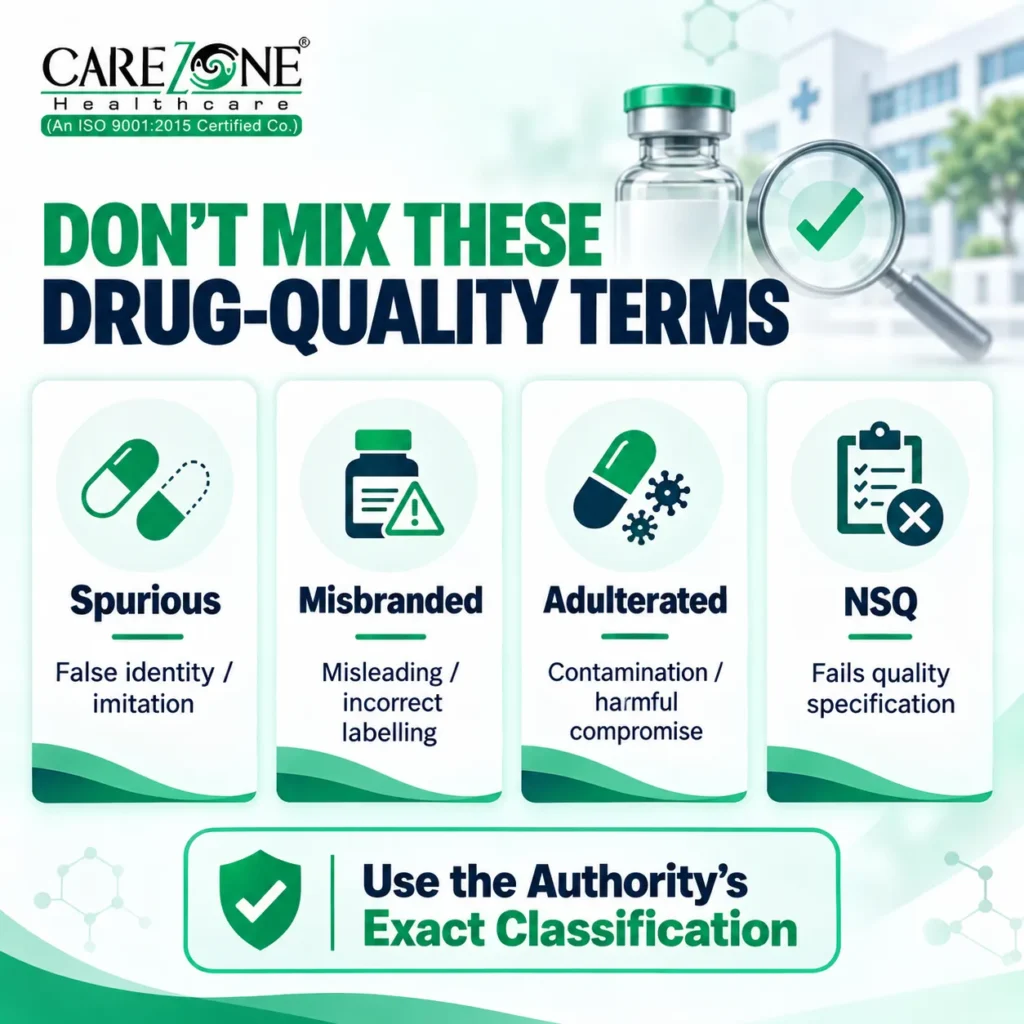
“Counterfeit” is widely used in public discussion, but Indian drug law uses more specific classifications such as spurious, misbranded, adulterated and Not of Standard Quality (NSQ).
For regulatory communication, the exact classification matters.
A product can be problematic because:
These situations should not automatically be collapsed into one category.
Carezone Healthcare recently covered these distinctions in its detailed article on the CDSCO Misbranded Drugs Crackdown 2026.
Read Carezone’s CDSCO Misbranded Drugs Crackdown 2026 guide
A business responding to suspected stock should use regulatory terminology carefully.
| Term | Simplified Regulatory Meaning |
|---|---|
| Spurious Drug | May involve imitation, substitution, false identity or false representation of the manufacturer |
| Misbranded Drug | Can involve improper labelling, misleading presentation or false/misleading claims |
| Adulterated Drug | Can involve contamination, harmful substances, insanitary conditions or quality-compromising substitution |
| NSQ | Product fails applicable quality standards or specifications |
NSQ does not automatically mean counterfeit or spurious.
A genuinely manufactured batch can fail a quality specification.
Conversely, a product may appear professionally packaged while its identity or source is false.
That is why visual inspection and laboratory/regulatory classification serve different purposes.
The precise Bengaluru supply chain is still under investigation.
However, from a risk-management perspective, suspect products can enter commercial channels when controls are weak at one or more points.
An illustrative risk pathway could look like:
Unverified Source → Repackaging / False Labelling → Trader / Pharmacy → Distributor / Buyer → Hospital / Clinic
This is an illustrative risk model, not an official reconstruction of the Bengaluru investigation.
The goal is not to make every transaction burdensome.
The goal is to ensure that basic verification exists before high-risk or high-value pharmaceutical stock enters the market.
A low price is not proof of illegality.
Legitimate commercial discounts can exist because of:
However, a large unexplained discount on a high-value medicine should trigger additional verification.
In the Bengaluru investigation, suspect products were reportedly supplied at discounts reaching around 50%.
A pharma buyer should ask:
Do not ask only:
“What margin am I getting?”
Also ask:
“Can I defend and trace this purchase if the batch is questioned tomorrow?”
For oncology, ICU or other high-value medicines, distributors should use an inward verification process.
Verify:
The seller on the invoice should make commercial sense in relation to the actual supplier.
Check that the supplier is authorised for the pharmaceutical activity being performed.
Do not rely solely on:
Keep a proper invoice containing relevant transaction information.
For traceability, your internal records should connect the purchase with the corresponding product and batch.
Review:
Unexpected inconsistencies require clarification.
Batch information should be captured accurately in:
Check for:
High-value medicines may have legitimate packaging changes over time.
Therefore, a packaging difference is a reason to verify, not automatic proof of counterfeiting.
Where product storage requires temperature control, check:
A genuine medicine that has been improperly stored can still create a quality risk.
If a transaction is unusual or the product is high-value, determine whether the supplier can demonstrate its upstream source.
Know how to:
The Bengaluru investigation is especially relevant to institutional procurement.
Hospitals and clinics handle complex product ranges and may buy through:
For a life-saving or high-value medicine, procurement teams should ask why a quotation is dramatically below the expected channel price.
The lowest bidder is not automatically the best supplier if source integrity cannot be verified.
Most PCD partners may not routinely handle expensive oncology medicines, but the same verification principles apply across pharmaceutical categories.
PCD partners should verify:
Carezone Healthcare currently supports PCD franchise enquiries across a broad product portfolio and asks applicants to share their location, licence status, product interest and business profile.
Explore Carezone Healthcare PCD Pharma Franchise opportunities
For readers new to the PCD model:
Read Carezone’s Complete 2026 PCD Pharma Franchise Guide
Do not choose a company only because it claims:
Evaluate documentation, consistency and supply reliability as well.
Counterfeit-risk discussions often focus only on distributors, but manufacturers and brand owners also need strong controls.
A third-party manufacturing chain may involve:
Brand Owner → Manufacturer → Packaging Vendor → Warehouse → Transporter → Distributor
Every stage should have controlled records.
Unauthorised access to:
can increase brand-protection risk.
Outdated or excess packaging material should be managed according to the company’s quality and regulatory procedures.
Carezone Healthcare supports third-party manufacturing discussions for pharma, nutraceutical and cosmetic categories. Its current page states that feasibility, MOQ, pricing, lead time and documentation depend on formulation, packaging, product category and final internal review.
Discuss Third-Party Manufacturing with Carezone Healthcare
No single packaging element can guarantee authenticity by itself.
A hologram, QR code, barcode, batch number or professional carton can improve verification—but buyers should use these features within a wider traceability process.
A strong verification stack is:
Supplier + Licence + Invoice + Manufacturer + Batch + Packaging + QR/Barcode + Storage + Traceability
not:
QR present = genuine
This is especially important because counterfeiters may imitate visual packaging elements. Recent reporting on fake medicines in India has highlighted how convincing copied labels, codes and packaging can become.
For many anti-cancer medicines, the expanded Schedule H2 QR requirement does not become mandatory until 1 July 2027.
Therefore, in September 2026:
The absence of the future Schedule H2 code on an anti-cancer product is not by itself evidence that the medicine is counterfeit.
The effective date matters.
Schedule H2 is part of the Drugs Rules, 1945 framework for barcode/QR-code-based pharmaceutical identification and traceability.
The mechanism already applied to the top 300 pharmaceutical brands, following earlier amendments.
In June 2026, the Ministry of Health and Family Welfare expanded Schedule H2 to add entire therapeutic categories:
The amendment is G.S.R. 506(E), dated 22 June 2026, listed by CDSCO as a final notification concerning additional categories under Schedule H2.
Schedule H2 requires manufacturers of specified medicines to print or affix a barcode or QR code carrying prescribed product information on the primary packaging label, or on secondary packaging where there is insufficient space.
The purpose is to improve medicine authentication and traceability across the pharmaceutical supply chain.
From 1 July 2027, the expanded Schedule H2 provisions will apply to:
Antimicrobials receive a longer implementation period and come into scope from 1 July 2028.
For affected products, manufacturers should plan for:
The manufacturing obligation does not mean distributors can ignore the code.
Distributors should understand:
According to the Union Health Ministry, the Schedule H2 code will carry key product information including:
The code is intended to make key product information digitally accessible and improve authentication and supply-chain verification.
A buyer asking:
“What information will the Schedule H2 QR code contain?”
should be able to get the answer above directly without needing to interpret an entire Gazette notification.
| Area | Existing Schedule H2 Framework | Expanded 2026 Framework |
|---|---|---|
| Coverage | Top 300 pharmaceutical brands | Adds entire therapeutic categories |
| Anti-cancer drugs | Only where already within existing list | All anti-cancer drugs |
| Vaccines | Limited by earlier list | All vaccines |
| NDPS drugs | Limited by earlier list | Specified category-wide inclusion |
| Antimicrobials | Limited by earlier list | All antimicrobials |
| Anti-cancer effective date | Existing-listed brands already covered where applicable | 1 July 2027 for expanded category |
| Antimicrobial expansion date | — | 1 July 2028 |
| Packaging | Primary package; secondary if space inadequate | Same framework |
| Purpose | Authentication / traceability | Expanded authentication / traceability |
The 2026 amendment does not create the QR system from scratch.
It expands its scope from a finite top-brand list to entire therapeutic categories.
Every pharma business should be able to answer these questions for a questioned batch:
Can the company quickly generate:
Batch → Remaining Inventory → Customers Supplied → Quantity Supplied
If not, the traceability system needs improvement.
Packaging inspection remains useful.
Possible warning signs include:
A packaging difference can result from:
Therefore:
Red Flag → Verify
not:
Red Flag → Publicly Declare Counterfeit
This distinction protects both patient safety and responsible business communication.
Temporarily segregate the questioned stock from saleable inventory.
Do not casually destroy it.
Capture:
Seek written clarification.
For high-value branded medicines, manufacturer verification may be appropriate where authenticity is genuinely in doubt.
Review CDSCO and applicable State Drugs Control Authority communications.
Potentially illegal pharmaceutical stock should be reported or handled through competent regulatory/law-enforcement channels rather than social-media accusations.
Verification comes first.
NSQ and spurious are distinct concepts.
A WhatsApp transaction history is not a substitute for proper commercial records.
Verify why the price is lower.
It is one layer of verification.
The expanded anti-cancer requirement begins 1 July 2027.
This article is about pharmaceutical regulation and supply-chain controls, not cancer treatment.
The Counterfeit Cancer Drugs India 2026 investigation reinforces a principle relevant to the entire pharmaceutical sector:
Product quality begins with manufacturing—but product trust depends on the full supply chain.
A strong system connects:
Manufacturer → Product → Batch → Packaging → Invoice → Distributor → Customer
Carezone Healthcare is based in Ambala, Haryana and its current website states that the company has operated since 2012 with a 600+ product portfolio, supporting PCD franchise, product catalogue, distribution, third-party manufacturing and selected international enquiries.
Carezone’s role in this article is not to claim involvement with oncology or the Bengaluru investigation.
The business lesson is broader:
Before you stock, market or distribute a pharmaceutical product, verify what you are buying and where it came from.
Carezone has already developed related regulatory guides:
Schedule H1 Update 2026: 4 More Drugs Proposed
CDSCO Misbranded Drugs Crackdown 2026
Cough & Cold FDC Warning 2026: Existing Stock & FOPE Clarification
Together, these articles strengthen Carezone’s informational coverage around:
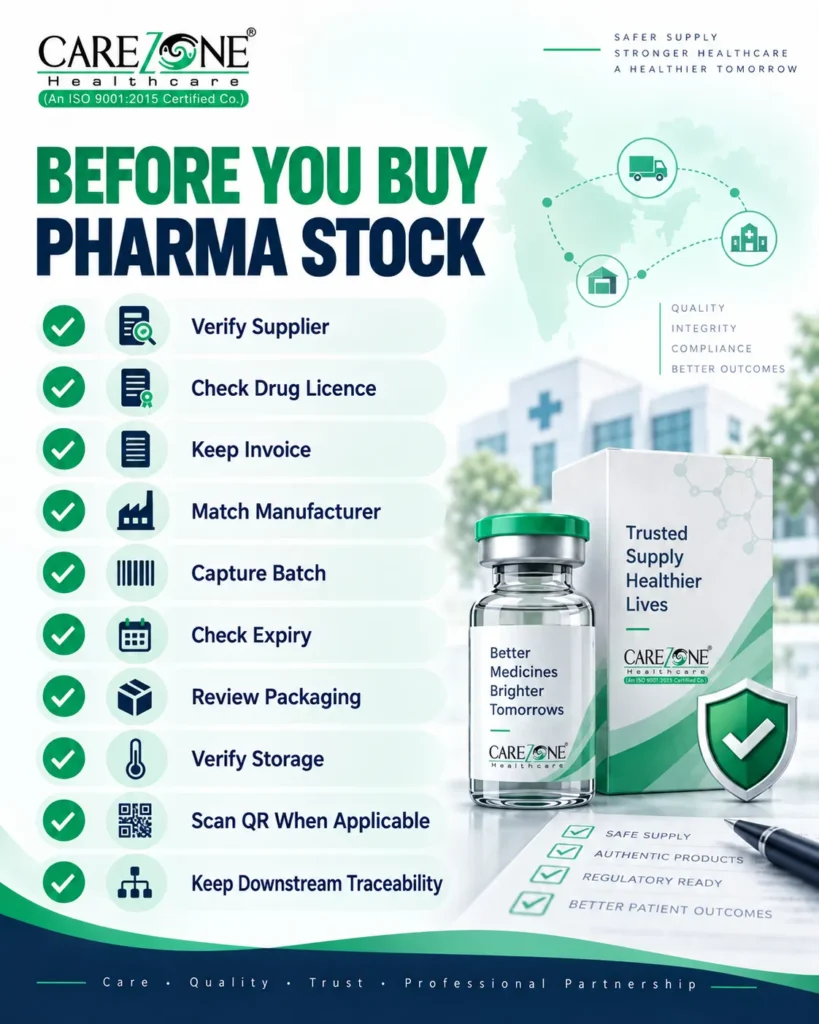
Before selecting a pharma supplier, distributor, marketing company or manufacturing partner, verify what is relevant to the transaction.
| Verification Area | What to Check |
|---|---|
| Company identity | Legal/business name and address |
| Drug licence | Applicable current licence |
| GST / commercial identity | Where applicable |
| Manufacturing source | Actual manufacturer |
| Marketing company | Correct marketer |
| Product | Exact name |
| Composition | Verified ingredients/strength |
| Product permission | Where applicable |
| Batch | Exact batch identification |
| Mfg. / Expiry | Clear coding |
| Invoice | Proper purchase documentation |
| Packaging | Current untampered pack |
| QR / Barcode | Applicable current requirement |
| Storage | Required conditions |
| Cold chain | Where applicable |
| Source chain | Supplier’s upstream source |
| Price | Commercially explainable |
| Recall readiness | Ability to locate batch |
| Complaint channel | Manufacturer/supplier contact |
| Downstream records | Customer and batch traceability |
Instead assess:
Counterfeit life-saving medicines are a serious patient-safety issue, but patients should not try to independently judge cancer medicines solely from packaging or social-media reports.
If you are undergoing cancer treatment:
Do not delay cancer treatment while trying to authenticate medicines independently.
Concerns about a specific medicine should be raised promptly with the treating healthcare team and appropriate pharmacy/supplier.
The Counterfeit Cancer Drugs India 2026 investigation refers to a Bengaluru Police SIT and Drugs Control Department probe into a suspected network involving counterfeit or repackaged cancer medicines, ICU injections and other critical products. Investigators reportedly suspect that products from the network were supplied to more than 90 hospitals and clinics. The investigation remains ongoing.
That has not been established by the current reporting. Investigators reportedly believe medicines from the suspected network reached more than 90 hospitals and clinics. That does not prove every institution knowingly bought counterfeit medicines or that every product received was counterfeit.
A large discount is not proof of counterfeiting, but it should trigger additional supplier and batch verification. In the Bengaluru investigation, suspect medicines were reportedly offered at discounts of around 50%. For high-value medicines, buyers should understand why the price differs substantially from the expected authorised channel.
A distributor should verify the supplier and applicable licence, invoice, manufacturer, marketer, product details, batch, manufacturing and expiry dates, packaging, storage requirements and upstream source. If there is a genuine authenticity concern, manufacturer and regulatory verification may also be appropriate.
No. A QR/barcode is an important authentication and traceability tool, but it should work alongside licensed sourcing, invoices, batch records and supply-chain controls. Counterfeit packaging can imitate visual elements, so buyers should not rely on one signal alone.
The expanded Schedule H2 provisions for all anti-cancer drugs take effect on 1 July 2027. Vaccines and specified narcotic/psychotropic drugs have the same date. The expanded antimicrobial requirement takes effect on 1 July 2028.
The code will contain key information including the unique product identification code, generic/proper name, brand name, manufacturer name/address, batch number, manufacturing date, expiry date, manufacturing licence number and excipient details where applicable.
No. The expanded anti-cancer requirement becomes effective from 1 July 2027. In September 2026, absence of that future mandatory code alone is not proof of counterfeiting. Some products may already carry applicable codes under earlier requirements or voluntary systems.
PCD partners should verify the company, product composition, manufacturer, applicable documents, invoice, batch, expiry, packaging and supply source. Written territory and commercial terms should also be confirmed rather than relying only on verbal assurances.
Stop further movement of the questioned stock, preserve the product and records, document the batch and invoice details, contact the supplier/manufacturer where appropriate, review official alerts and escalate genuine concerns to the relevant drugs-control authority rather than making unverified public allegations.
The Counterfeit Cancer Drugs India 2026 investigation is significant because it demonstrates that pharma authentication cannot depend on packaging appearance alone.
For high-value pharmaceutical products, a reliable verification model is:
Licensed Source → Proper Invoice → Verified Manufacturer → Traceable Batch → Correct Packaging → Appropriate Storage → Documented Distribution
The upcoming Schedule H2 expansion strengthens this system by bringing all anti-cancer medicines under barcode/QR-code traceability from 1 July 2027.
But QR codes are not a substitute for basic pharmaceutical due diligence.
Pharma businesses should continue to verify:
For distributors, this protects supply-chain integrity.
For hospitals, it strengthens procurement controls.
For PCD partners, it supports responsible stock management.
For manufacturers and brand owners, it protects brand identity and traceability.
Carezone Healthcare’s practical conclusion is:
Verify the product. Verify the source. Trace the batch. Keep the documentation.
That is more valuable than relying on packaging appearance, price or a single authentication feature.
Carezone Healthcare supports B2B pharmaceutical business discussions from Ambala, Haryana across:
Carezone Healthcare’s current website states that it has operated since 2012 and presents a 600+ product portfolio.
Share:
Explore Carezone Healthcare PCD Pharma Franchise
Final product availability, territory allocation, monopoly discussion and commercial terms depend on current company policy and business review.
For third-party manufacturing, share:
Discuss Third-Party Manufacturing with Carezone Healthcare
MOQ, pricing, feasibility, documentation and lead time depend on product, formulation, packaging and final review.
Carezone’s Distributor Enquiry desk asks prospective partners for details such as:
Contact Carezone Healthcare for Distributor Enquiry
View Carezone Healthcare Product Range
Call / WhatsApp: +91 7488834800
Email: info@carezonehealthcare.com
Hello Carezone Healthcare, I would like to discuss your PCD franchise / distribution / third-party manufacturing opportunity. My location is ______ and I am interested in ______ product category. Please share the relevant product and business details.
Carezone Healthcare
Trusted Healthcare. Stronger Pharma Partnerships.
This article is provided for general pharmaceutical-industry, regulatory, supply-chain and educational purposes only.
It does not establish that any named hospital, clinic, company, distributor or person knowingly handled counterfeit medicines unless such responsibility is finally determined by competent authorities.
The Bengaluru investigation discussed in this article is ongoing. Statements relating to suspect medicines, distribution networks, discounts and institutions should be understood in the context of the current investigation and cited reporting.
This article is not a substitute for:
Patients should not stop, change or substitute cancer or other prescription treatment because of this article. Concerns about a medicine should be discussed promptly with the treating healthcare professional and legitimate dispensing pharmacy/supplier.
Carezone Healthcare does not guarantee business returns, franchise profitability, territory availability or monopoly allocation.
Regulatory and news content last reviewed: 15 September 2026. This article should be updated if the Bengaluru SIT investigation produces material new findings or if the Government issues further Schedule H2 implementation guidance.
View all


May 21, 2025 | by Carezone Healthcare
April 15, 2025 | by Carezone Healthcare

May 28, 2025 | by Carezone Healthcare