September 17, 2026 | by admindefault
Last Regulatory Review: 17 September 2026
Regulatory Reference: Draft G.S.R. 791(E), dated 8 September 2026
Status: Draft proposal — not yet a final nationwide rule
Primary Audience: Retail pharmacies, medical-store owners, PCD franchise partners, pharma distributors, wholesalers, marketers, manufacturers and pharmaceutical business owners
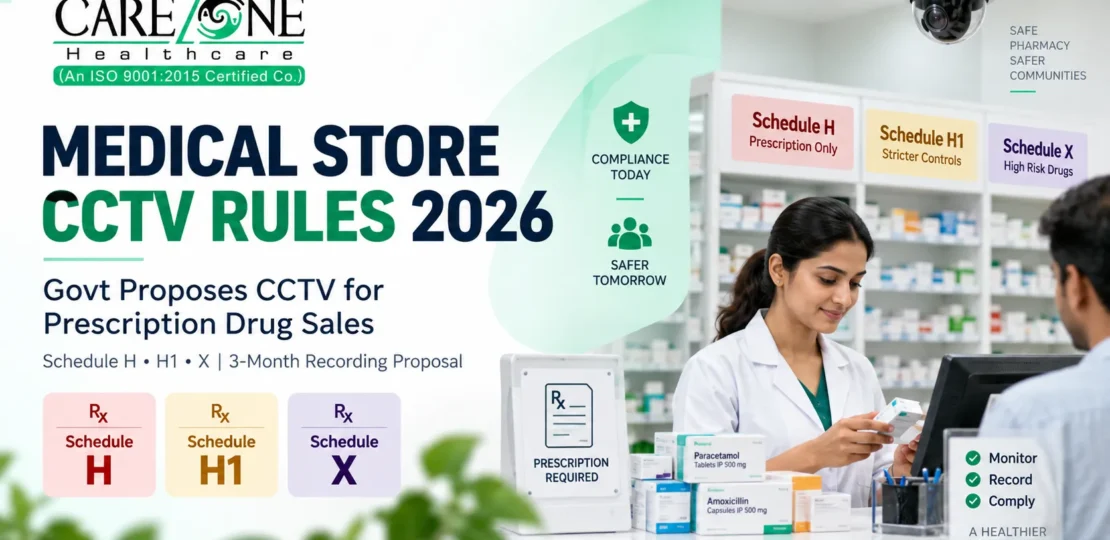
India’s Medical Store CCTV Rules 2026 proposal could introduce a major new compliance layer for prescription-drug dispensing at licensed retail premises.
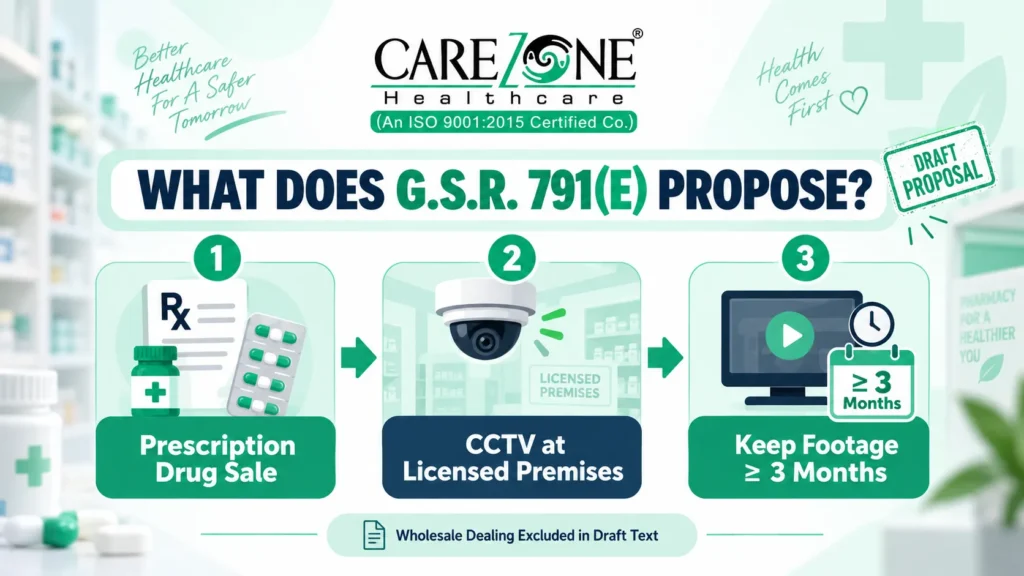
Through Draft G.S.R. 791(E), dated 8 September 2026, the Ministry of Health and Family Welfare has proposed amending Rule 65 of the Drugs Rules, 1945 so that prescription medicines supplied other than through wholesale dealing would be dispensed under a Closed-Circuit Television (CCTV) surveillance system installed and maintained at the licensed premises. The proposed rule also requires CCTV recordings to be preserved for at least three months.
The Government has framed the proposal as a measure to strengthen oversight of Schedule H, H1 and X drugs and curb unauthorised access to prescription medicines. However, there is an important regulatory nuance: the draft amendment itself uses broader wording and refers to “any drug supplied on the prescription of a Registered Medical Practitioner”, other than wholesale dealing.
Most importantly, this is still a draft proposal. Medical stores across India should not treat CCTV as a newly finalised nationwide Rule solely on the basis of this draft. The Central Government has invited objections and suggestions and the amendment would come into force only from the date specified when final rules are published.
For Carezone Healthcare’s B2B audience, the practical question is therefore:
What could this proposed CCTV rule mean for medical stores, PCD partners, pharma distributors, manufacturers and businesses handling prescription medicines—and what should they prepare before the proposal becomes final?
This guide separates confirmed provisions from interpretation, explains the existing Schedule H/H1/X framework, and provides a practical compliance-readiness checklist for pharmaceutical businesses.
The Medical Store CCTV Rules 2026 are currently a proposed amendment to India’s Drugs Rules, 1945—not a final nationwide CCTV mandate.
Draft G.S.R. 791(E) proposes inserting a new sub-rule (2A) after Rule 65(2).
The proposed text provides, in substance, that prescription-drug supply other than wholesale dealing should take place under a CCTV surveillance system installed and maintained at the licensed premises, with the recordings retained for at least three months.
As of 17 September 2026, the Central Government has proposed CCTV surveillance for prescription-drug supply at licensed retail premises, but the proposal has not yet become a final nationwide rule.
The Ministry has invited objections and suggestions, and the draft specifically says the rules would come into force from the date specified by the Government at the time of final publication.
That distinction should remain visible in:
Do not publish:
“CCTV is now mandatory at every Indian medical store.”
The more accurate statement is:
“The Health Ministry has proposed making CCTV surveillance mandatory for prescription-drug dispensing at licensed retail premises.”
No, not under this Central draft alone.
Draft G.S.R. 791(E) is open for consultation. It states that the draft rules will be considered after the prescribed period and that the final rules will take effect on a date specified at final publication.
This means a medical-store owner should distinguish between:
A proposed nationwide amendment to Rule 65.
A State, Union Territory or local authority may already have issued its own directions or enforcement instructions.
For example, Delhi had previously directed medical/pharmaceutical shops to install CCTV as part of local efforts to prevent misuse of scheduled medicines.
Therefore:
“Not yet final nationwide” does not automatically mean “no CCTV obligation can exist anywhere.”
Every licensee should verify both:
The draft proposes three central changes in practical terms.
Prescription-drug supply, other than wholesale dealing, would need to occur under an installed and maintained CCTV surveillance system.
The recordings would need to be preserved for at least three months.
The proposed provision would be inserted into the existing conditions governing drug-sale licences.
The consultation document also states that objections and suggestions received within the specified period will be considered by the Central Government.
Government communication describes the proposal as strengthening oversight over Schedule H, H1 and X drugs.
But the proposed sub-rule itself does not say only:
“Schedule H, H1 and X”.
Instead, it refers more broadly to:
any drug supplied on the prescription of a Registered Medical Practitioner, except wholesale dealing.
This distinction is important.
A final rule, explanatory guidance or enforcement interpretation may clarify the practical scope further.
Businesses should therefore follow the final notification wording, not only media headlines.
The Health Ministry says the objective is to strengthen regulatory oversight and address unauthorised access to and sale of Schedule H, H1 and X drugs.
The proposal was considered by the Drugs Consultative Committee (DCC) and subsequently by the Drugs Technical Advisory Board (DTAB) before the draft amendment was issued.
Earlier DCC discussions also supported positioning cameras in a manner that would allow sales at medical stores to be verified.
A CCTV record could potentially help verify:
However, CCTV cannot independently prove all aspects of compliance.
A camera cannot by itself confirm:
That is why CCTV should be understood as one compliance layer, not the entire compliance system.
If finalised substantially in its present form, the proposed Rule would focus on licensed premises supplying prescription medicines otherwise than by wholesale dealing.
In practical terms, this principally points towards:
The Indian Express specifically reports that the proposal does not apply to wholesalers.
This requires careful wording.
The Government’s stated objective focuses on those schedules.
However, the draft Rule text refers to any drug supplied on prescription.
Therefore, businesses should avoid assuming that the final legal wording will necessarily be narrower than the text currently proposed.
The proposal concerns medicines supplied on a Registered Medical Practitioner’s prescription.
It is not drafted as a general rule requiring every retail transaction—such as every non-prescription wellness item—to be separately classified as a CCTV-monitored prescription sale.
The proposed CCTV provision expressly excludes supply “by way of wholesale dealing.”
That is a major point for:
But this does not mean wholesale businesses have no compliance obligations.
Existing Rule 65 provisions already require wholesale supply records containing relevant information such as:
The CDSCO Drugs Rules also require relevant wholesale sales records to be maintained for prescribed periods.
So the compliance picture becomes:
Retail dispensing → possible new CCTV layer
while:
Wholesale dealing → existing documentation, invoice, licensing and traceability obligations continue
This distinction is useful for distributors who may wrongly assume the CCTV proposal changes all wholesale operations.
The schedules are often discussed together, but their record and handling requirements are not identical.
| Area | Schedule H | Schedule H1 | Schedule X |
|---|---|---|---|
| Retail sale against RMP prescription | Yes | Yes | Yes |
| Additional special register | General Rule 65 records apply | Separate H1 register required | Different stricter controls apply |
| H1 register retention | — | 3 years | — |
| Prescription duplicate requirement | Not the Schedule X duplicate rule | Not the Schedule X duplicate rule | Prescription in duplicate; one copy retained 2 years |
| Enhanced record oversight | Yes | Higher specific H1 record requirement | Higher controlled handling requirements |
| CCTV proposal relevance | Government objective includes H | Government objective includes H1 | Government objective includes X |
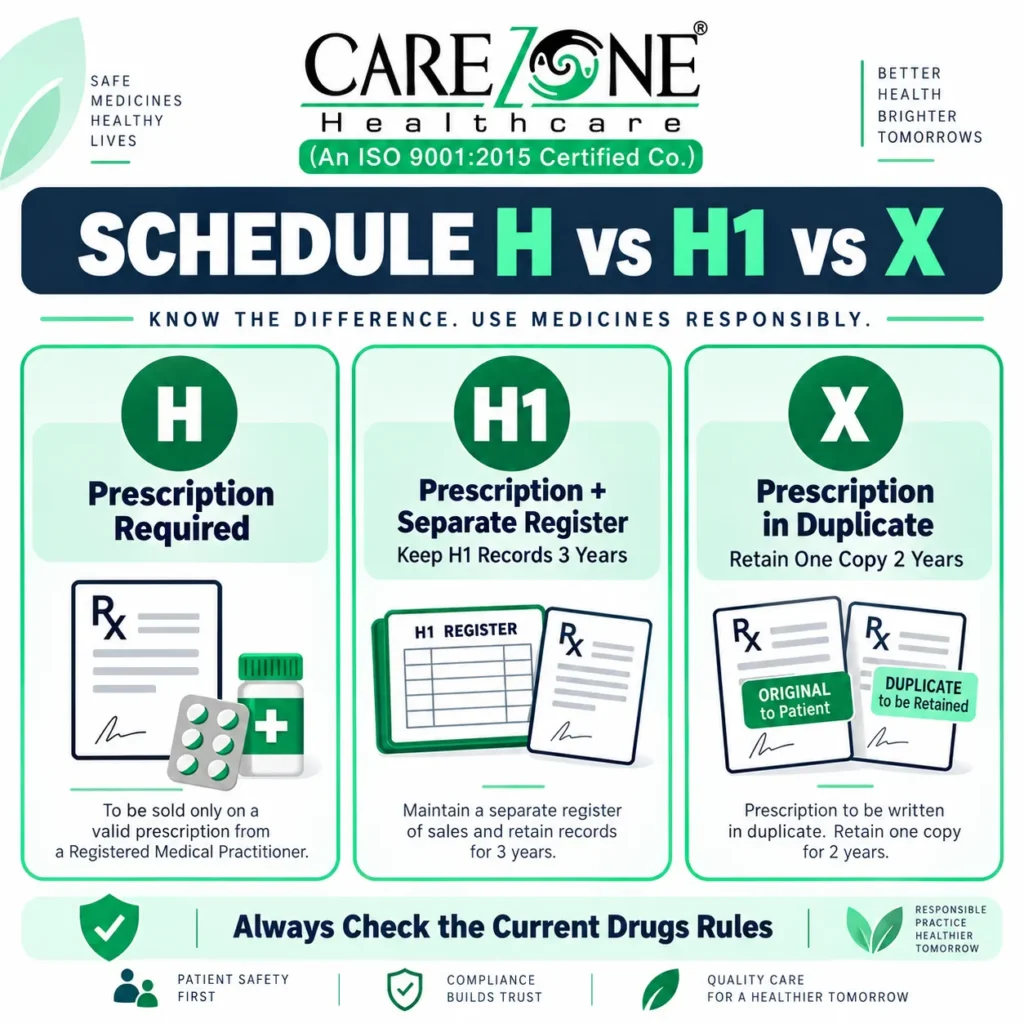
Under current Rule 65, Schedule H, H1 and X substances must not be sold by retail except on and in accordance with the prescription of a Registered Medical Practitioner.
For Schedule H1, the Rules require a separate register recording details including:
Those H1 records must be maintained for three years and be open for inspection.
For Schedule X, prescriptions are required in duplicate, with one copy retained by the licensee for two years.
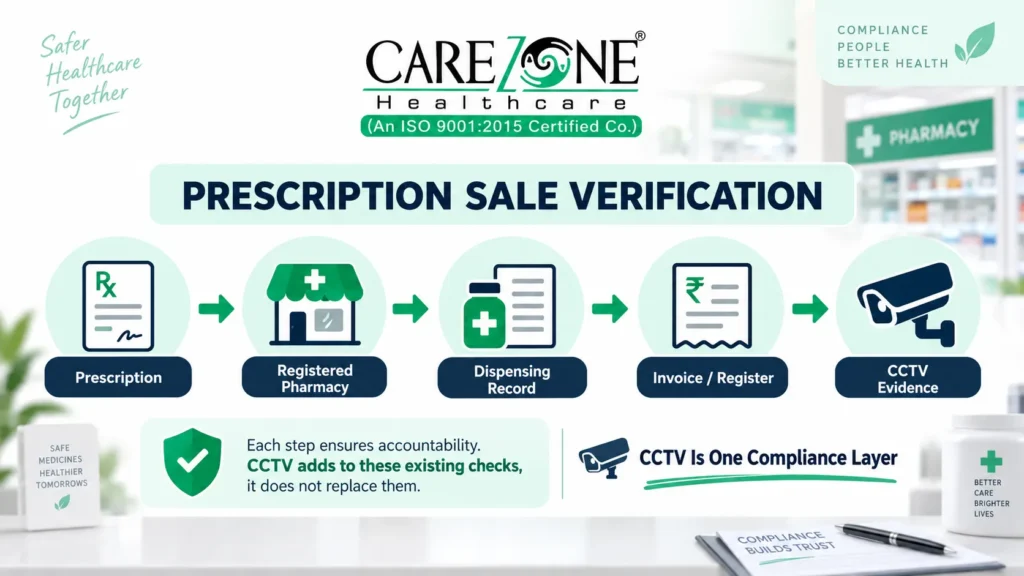
CCTV would not replace India’s existing medicine-sale controls.
Current Rule 65 already covers:
CDSCO’s current Drugs Rules state that relevant registers and records generally must be preserved for at least two years from the date of the last entry, unless another provision specifies a different period.
Schedule H1 records must be maintained for three years.
One duplicate prescription copy is retained for two years.
CCTV would add a visual verification record to existing documentary controls.
So the model becomes:
Prescription + Pharmacist / Licensed Premises + Register / Invoice + CCTV Record
not:
CCTV instead of documentation
At least three months.
Draft G.S.R. 791(E) states that CCTV recordings must be preserved for a minimum period of three months.
The word minimum matters.
The draft does not say:
“exactly three months and then delete immediately.”
It establishes a minimum retention threshold.
Businesses should wait for final rules and any implementation guidance before finalising:
A pharmacy considering CCTV infrastructure should calculate storage capacity based on:
number of cameras × recording resolution × frame rate × recording hours × minimum retention period
But until the final rule is notified, businesses should avoid spending on unusually complex systems solely on assumptions not stated in the draft.
The April DCC discussion, as reported, suggested cameras should be placed appropriately so that sales made at the premises are verifiable.
That suggests a practical compliance principle:
A camera that records only the ceiling or entrance may not serve the intended purpose of verifying dispensing activity.
However, the draft itself does not specify technical requirements such as:
Businesses should not invent these requirements.
If the proposal becomes final, pharmacies should review implementation instructions issued by:
No.
Nothing in the draft says CCTV replaces existing drug-sale records.
The current Drugs Rules already require records that CCTV alone cannot provide reliably.
A video may show a dispensing event.
It does not automatically capture:
The strongest compliance system combines:
Prescription → Dispensing Supervision → Required Register → Invoice / Bill → Batch Records → CCTV Evidence
This is an important point for medical-store owners who may otherwise assume that once a transaction is recorded on camera, documentary records become less important.
They do not.
Because the proposal remains a draft, medical stores do not need to treat every draft detail as a final implementation obligation.
But they can begin compliance-readiness planning.
Confirm:
Identify:
If CCTV already exists:
Do not wait until final notification to discover that the existing DVR stores only a few days.
CCTV recordings contain potentially sensitive information about customers.
Access should therefore be limited to authorised persons and handled carefully.
Staff should understand that CCTV—if finalised—is not permission to sell prescription drugs without a valid prescription.
It exists to strengthen verification.
PCD partners typically work between the pharmaceutical company and downstream medical-market channels.
The proposed rule therefore matters even if the PCD partner is not itself a retail pharmacy.
A PCD partner should understand:
Businesses researching the franchise model can review Carezone Healthcare’s current PCD information.
Explore Carezone Healthcare PCD Pharma Franchise
A PCD business exists to promote and distribute products according to applicable law and commercial terms.
Sales targets should never override:
PCD partners should not assume schedule classification from brand name or therapy category alone.
Check:
Carezone’s product portfolio page allows business buyers to review current catalogue information and request updated product details.
Review the Carezone Healthcare Product Range
The proposed CCTV rule excludes wholesale dealing, but distributors remain a critical part of compliance.
Why?
Because regulated retail sales depend on a traceable upstream supply chain.
A distributor should be able to connect:
Manufacturer → Purchase Invoice → Batch → Distributor Stock → Sales Invoice → Retailer
Current Rules already require records around wholesale sale and purchase, including batch and manufacturer information.
A distributor should review:
It simply means the proposed CCTV dispensing requirement is not framed around wholesale dealing.
Licensing and documentation obligations remain.
For a broader supply-chain verification guide, read Carezone Healthcare’s article on misbranded drugs and batch traceability.
Read the CDSCO Misbranded Drugs Crackdown 2026 guide
The proposed CCTV requirement is aimed primarily at licensed dispensing premises, but manufacturers and pharma marketing companies should still prepare.
Sales teams should know which products fall under:
Do not present prescription medicines as ordinary OTC products.
If the draft becomes final, partner communication can explain:
Until final notification:
Do not tell partners:
“Government has made CCTV mandatory nationwide from today.”
Instead state:
“The Central Government has issued a draft amendment proposing CCTV surveillance for prescription-drug dispensing.”
Businesses planning their own product brand can also review Carezone Healthcare’s third-party manufacturing enquiry route, where product category, dosage form, packaging and documentation requirements can be discussed.
Discuss Third-Party Manufacturing with Carezone Healthcare
The CCTV proposal is especially relevant because Schedule H1 itself is also an active regulatory topic.
In August 2026, the Government proposed adding:
to Schedule H1 through draft G.S.R. 745(E).
Carezone Healthcare has already covered that proposal in a dedicated regulatory article.
Read the Schedule H1 Update 2026 guide
If additional medicines are ultimately moved into Schedule H1, retail pharmacies could face:
More Schedule H1 products + existing three-year H1 records + potentially new CCTV verification
That creates a wider compliance trend:
Prescription Classification → Record Keeping → Dispensing Verification → Digital / Visual Traceability
For pharmacies and pharma businesses, regulatory monitoring is therefore becoming increasingly important.
The proposed CCTV rule is part of a broader pattern of pharmaceutical traceability and monitoring.
In 2026, India has also expanded Schedule H2 QR/barcode requirements for categories including anti-cancer medicines, vaccines and other specified drug groups.
Carezone Healthcare recently explained that expansion in the context of the Bengaluru counterfeit-cancer-drug investigation.
Read Counterfeit Cancer Drugs India 2026 and the Schedule H2 QR guide
QR / Barcode
Helps identify and trace product information.
Batch / Invoice Records
Help trace commercial movement.
Schedule H1 Register
Documents specified retail supply information.
Prescription
Establishes the authorised basis for retail dispensing.
CCTV
Could provide visual evidence that the transaction occurred at the licensed premises.
The future compliance model is increasingly:
Product Traceability + Transaction Traceability + Prescription Control + Dispensing Verification
rather than reliance on only one record.
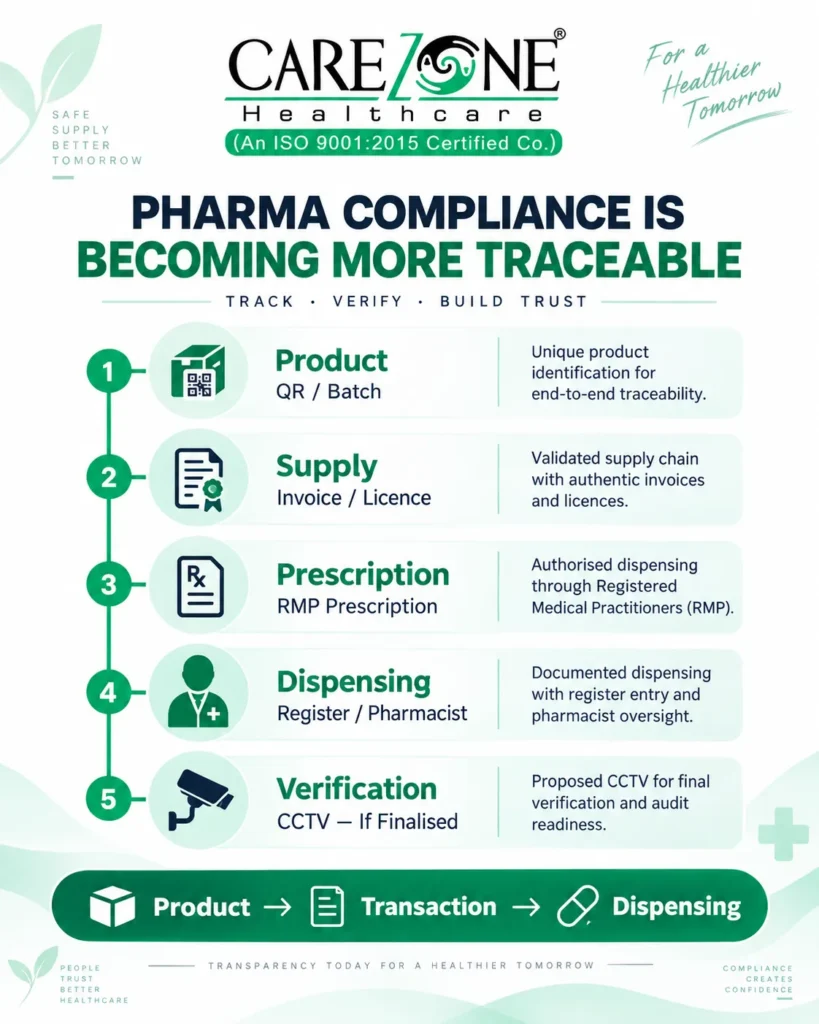
It is not.
Final nationwide implementation has not yet occurred under G.S.R. 791(E).
The Government objective focuses on them, but the draft’s operative wording refers more broadly to drugs supplied on prescription.
Wholesale dealing is expressly excluded from the proposed wording.
It does not.
The draft specifies at least three months.
Do not invent:
Local directions may already exist.
The Medical Store CCTV Rules 2026 proposal is primarily a retail-dispensing development, but its significance extends across the pharmaceutical business chain.
A medicine may move through:
Manufacturer → Marketing Company → PCD Partner → Distributor → Medical Store → Patient
Compliance weakens if only one participant understands the rules.
Manufacturers need accurate classification.
PCD partners need responsible promotion.
Distributors need traceable stock.
Medical stores need compliant dispensing.
Carezone Healthcare is based in Ambala, Haryana and currently supports PCD franchise, third-party manufacturing, distribution, product catalogue and selected international business enquiries. Its current website states that the company has operated since 2012 and presents a broad 600+ product portfolio for business discussions.
The practical lesson for Carezone partners is not:
“Install CCTV because Carezone says so.”
It is:
“Know the regulatory status of the products you handle and follow the requirements applicable to your role in the supply chain.”
Carezone’s recent regulatory content already covers:
Together, these topics form a broader compliance theme:
Know the product → verify the source → understand the schedule → maintain the records → follow current regulatory requirements.
Read Carezone Healthcare Pharma Insights
Use this checklist for preparation if the CCTV proposal becomes final.
| Compliance Area | What to Review |
|---|---|
| Drug-sale licence | Correct licence and licensed premises |
| Registered pharmacist | Appropriate supervision for retail dispensing |
| Schedule H products | Prescription sale requirements |
| Schedule H1 products | Prescription + separate register |
| H1 record retention | Three years |
| Schedule X products | Applicable stricter prescription controls |
| Schedule X prescription copy | Retention as required |
| Invoices / bills | Proper sale documentation |
| Purchase records | Supplier, batch and manufacturer details |
| CCTV coverage | Dispensing/sale area capable of verification |
| CCTV storage | Prepare for minimum three-month retention if finalised |
| System date/time | Accurate recording timestamp |
| Footage access | Limited to authorised persons |
| Backup / retrieval | Ability to retrieve footage when legitimately required |
| Staff training | Prescription and schedule compliance |
| State instructions | Check local Drugs Control requirements |
| Final Gazette | Do not implement assumptions instead of final wording |
The Medical Store CCTV Rules 2026 refer to Draft G.S.R. 791(E), dated 8 September 2026, which proposes adding CCTV surveillance to prescription-drug dispensing at licensed premises, excluding wholesale dealing. The draft also proposes retaining recordings for at least three months. As of 17 September 2026, the proposal is not yet a final nationwide rule.
Not under this Central draft itself. G.S.R. 791(E) remains a proposed amendment and the Government has invited objections and suggestions. Some States or local authorities may already have separate CCTV directions, so medical stores should also verify applicable local requirements.
The draft proposes a minimum retention period of three months for CCTV recordings. The final rule or later implementation guidance may provide additional operational details.
The proposed wording expressly excludes supply by way of wholesale dealing. However, wholesalers remain subject to existing licensing, invoice and drug-record requirements under the Drugs Rules.
The Ministry has said the objective is to strengthen oversight of Schedule H, H1 and X medicines. However, the draft operative text refers more broadly to any drug supplied on the prescription of a Registered Medical Practitioner, except wholesale dealing. The final notification should therefore be checked carefully.
Current Rule 65 requires Schedule H1 supply to be recorded in a separate register showing prescribed details such as the prescriber, patient, drug and quantity. Those H1 records must be maintained for three years and be open for inspection.
No. The proposed CCTV provision adds a surveillance record; it does not remove existing prescription, register, invoice or record-keeping obligations.
Current Rule 65 requires Schedule X substances sold at retail to be supplied in accordance with a Registered Medical Practitioner’s prescription, with the prescription in duplicate and one copy retained by the licensee for two years.
PCD partners should monitor the final notification, correctly identify products by schedule, avoid encouraging unauthorised OTC sale of prescription medicines and ensure downstream partners receive accurate regulatory information. They should not tell pharmacies that the proposal is already a final nationwide mandate.
Medical stores should monitor the Official Gazette, Ministry of Health & Family Welfare, CDSCO and their State/UT Drugs Control Authority. The draft should not be treated as the final legal position until the final notification is published.
The Medical Store CCTV Rules 2026 proposal represents a potentially important change in how prescription-drug dispensing is verified in India.
If finalised substantially in its current form, licensed retail premises supplying medicines on prescription would need an additional compliance layer:
Prescription → Correct Dispensing → Existing Records → CCTV Surveillance → Minimum 3-Month Footage Retention
But the most important fact today is equally simple:
G.S.R. 791(E) is still a draft.
Medical stores should prepare—but should not confuse preparation with final legal implementation.
PCD partners should understand the proposal—but should not issue inaccurate retailer instructions.
Distributors should continue strong batch and invoice traceability.
Manufacturers and marketing companies should ensure their product classification and communication remain accurate.
The broader direction of pharmaceutical compliance is increasingly clear:
Trace the product. Verify the transaction. Maintain the records. Follow the final regulatory requirement.
That approach is more useful than reacting to headlines.
Carezone Healthcare supports B2B pharmaceutical business enquiries from Ambala, Haryana, including:
Carezone’s current website states that it has operated since 2012 and maintains a broad product portfolio for business enquiries.
Share:
Explore Carezone Healthcare PCD Pharma Franchise
Share:
Discuss Third-Party Manufacturing with Carezone Healthcare
MOQ, lead time, pricing and manufacturing feasibility depend on product category, formulation, packaging and final business discussion.
Distributors and stockists can share:
Contact Carezone Healthcare Business Desk
Review Carezone Healthcare Product Range
Call / WhatsApp: +91 7488834800
Email: info@carezonehealthcare.com
Hello Carezone Healthcare, I would like to discuss your PCD franchise / distribution / third-party manufacturing opportunity. My location is ______ and I am interested in ______ product category. Please share the relevant product and business details.
Carezone Healthcare
Trusted Healthcare. Stronger Pharma Partnerships.
This article is provided for general pharmaceutical-industry, regulatory and business education only.
Draft G.S.R. 791(E) discussed in this article is not yet a final nationwide CCTV rule as of 17 September 2026.
Businesses should verify the final legal position through:
This article does not replace:
Patients should not use this article to select, stop, substitute or dose prescription medicines.
PCD, distribution and manufacturing business performance varies according to territory, products, market conditions and commercial execution. Carezone Healthcare does not guarantee business returns, monopoly allocation or profits.
Regulatory content last reviewed: 17 September 2026. Update this article immediately if G.S.R. 791(E) is finalised, amended, withdrawn or followed by implementation guidance.
View all


April 29, 2025 | by Carezone Healthcare

June 10, 2025 | by Carezone Healthcare

April 15, 2025 | by Carezone Healthcare