September 8, 2026 | by admindefault
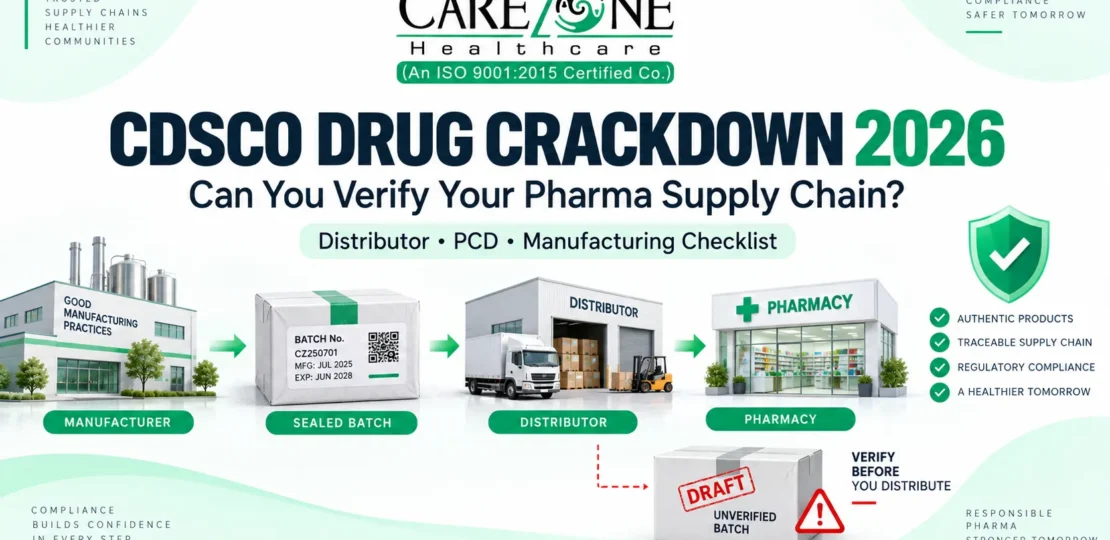
India’s pharmaceutical supply chain is under renewed regulatory attention after the Central Drugs Standard Control Organisation (CDSCO) published a public notice on 5 September 2026 stating that drug-regulatory and law-enforcement agencies had intensified coordinated action against the illegal manufacture and distribution of misbranded drugs.
The immediate case involved vaccine vials seized from an unlicensed premises in Delhi during enforcement activity earlier in 2026. The tested sample was declared misbranded and Not of Standard Quality (NSQ) by the Central Drugs Laboratory, Kasauli. The Drugs Controller General of India subsequently asked State Drugs Controllers to maintain strict vigilance over the movement, distribution and availability of the concerned batch. Four people were arrested in connection with the case.
For a pharma distributor, PCD franchise partner or third-party brand owner, however, the bigger lesson goes beyond one product or one enforcement case.
The CDSCO Misbranded Drugs Crackdown 2026 highlights a fundamental business question:
Can you trace every pharmaceutical product you buy, market or distribute back to a legitimate manufacturer, licensed supplier, documented batch and authorised supply chain?
That question matters for compliance, patient safety, stock security, business reputation and long-term pharma partnerships.
This Carezone Healthcare guide explains what the latest development means, how misbranded, spurious, adulterated and NSQ drugs differ, which warning signs businesses should watch for, and what distributors, PCD partners and third-party manufacturing buyers should verify before accepting pharmaceutical stock.
On 5 September 2026, CDSCO listed a new public notice titled:
“Drug Regulatory and Law Enforcement Agencies Intensify Coordinated Action Against Illegal Manufacture and Distribution of Misbranded Drugs.”
According to government news reporting on the action, surveillance by the Delhi Police Crime Branch and drug-control authorities led to the seizure of rabies-vaccine vials from an unlicensed premises in Delhi.
Testing by the Central Drugs Laboratory, Kasauli subsequently resulted in the seized sample being classified as misbranded and Not of Standard Quality. The DCGI issued a communication on 27 August 2026 asking State Drugs Controllers to alert their inspectorate staff and maintain strict vigilance regarding the movement, distribution and availability of the concerned batch.
Authorities also confirmed that no part of the concerned batch was exported to another country, while four individuals were arrested in connection with the case.
Further reporting stated that the manufacturer associated with the genuine brand said the seized vials were not its product. Differences were reportedly identified between the seized samples and genuine retained samples, including aspects of labelling, artwork, QR-code verification, cap colour and licence details.
The CDSCO Misbranded Drugs Crackdown 2026 is not simply about a failed pharmaceutical batch. It demonstrates why pharma businesses need to verify both product quality and the legitimacy of the supply chain from which the product originates.
A product can display:
and still require independent verification of its source and authenticity.
That is the key B2B lesson.
It would be a mistake for a distributor or PCD partner to read the September CDSCO notice and conclude:
“This was one vaccine case, so it does not affect my business.”
The underlying issue is broader.
Every pharma business operates somewhere inside a chain such as:
Manufacturer → Marketing Company → C&F / Super Stockist → Distributor → Wholesaler → Retailer / Institution
or, in a PCD model:
Manufacturer / Pharma Company → PCD Partner → Stockist → Retail Market
or, for own-brand manufacturing:
Brand Owner → Third-Party Manufacturer → Packaging → Dispatch → Distributor → Market
Each additional commercial handoff creates another point where businesses need clear:
The Government stated in March 2026 that CDSCO and State Drugs Control Authorities draw drug samples for test and analysis from the pharmaceutical supply chain and that NSQ, spurious and adulterated findings are made publicly available through drug alerts.
This means verification should not be treated as something required only when a regulator arrives.
It should be built into routine pharmaceutical purchasing and distribution.
A misbranded drug has a specific meaning under Section 17 of the Drugs and Cosmetics Act, 1940.
Broadly, a drug may be deemed misbranded when:
This is much more precise than simply calling a medicine “fake”.
A labelling failure and a counterfeit product may involve very different regulatory facts.
Businesses should therefore avoid casually using terms such as:
fake, counterfeit, misbranded, substandard and spurious
as if they all mean exactly the same thing.
Understanding the terminology makes both regulatory communication and AI/search content more accurate.
| Classification | Simple B2B Explanation | Regulatory Context |
|---|---|---|
| Misbranded | Problems involving misleading presentation, labelling or claims | Defined under Section 17 |
| Adulterated | Contamination, insanitary preparation/storage, harmful substances or quality-reducing substitution may trigger this classification | Defined under Section 17A |
| Spurious | Product may imitate another drug, falsely represent a manufacturer or substitute another product/substance | Defined under Section 17B |
| Not of Standard Quality (NSQ) | Product fails applicable quality standards or specifications | Linked to Section 16 quality standards |
The Drugs and Cosmetics Act separately defines misbranded, adulterated and spurious drugs.
CDSCO explains NSQ drugs as those that fail to meet required quality standards or specifications.
No. An NSQ finding does not automatically mean a product is spurious.
A legitimate product from a legitimate manufacturer may fail a particular quality specification and therefore be classified NSQ.
A spurious product involves different issues relating to identity, imitation, substitution or false manufacturer representation.
That is why responsible pharma businesses should use the exact regulatory classification rather than convert every quality alert into a “fake medicine” claim.
The September 2026 case provides several practical lessons.
The concerned samples were reportedly seized from an unlicensed premises.
For pharmaceutical buyers, the source of supply should therefore never be treated as a minor administrative issue.
Ask:
The seized vials reportedly carried the identity of an established product, while the manufacturer said the examined vials were not manufactured by it.
Therefore:
Known Brand Name ≠ Automatically Verified Product
Counterfeit or unauthorised products can reproduce information printed on legitimate packaging.
Batch information becomes meaningful when it can be reconciled with:
In the latest case, differences were reportedly noted in:
But packaging inspection should be treated as a screening tool, not laboratory proof of authenticity.
A genuine pharmaceutical product can still become compromised if storage or transportation requirements are ignored.
For temperature-sensitive products, verification should therefore cover not only who manufactured the product, but also how it reached you.
A pharma distributor should build an inward-stock verification process rather than depend solely on familiarity with a salesperson or company name.
Verify the legal/business identity appearing on:
A supplier offering prescription medicines from an unexplained residential or unlicensed location deserves additional scrutiny.
The appropriate licence depends on the activity being conducted.
The distributor should ensure that the supplier is legally authorised for the relevant manufacture, sale, wholesale or distribution activity.
Do not rely only on a licence number typed into a WhatsApp message.
An invoice provides essential commercial traceability.
Check:
Avoid unexplained stock offered without proper documentation simply because the purchase rate is attractive.
The pack should display relevant manufacturer and marketer information according to applicable labelling requirements.
Where anything appears inconsistent, confirm the product through the company or authorised supplier.
Match batch information across:
Never accept stock with:
Check:
Again, packaging inspection helps identify warning signs but cannot replace formal regulatory or laboratory testing.
Where a product requires controlled temperature or particular storage conditions, verify the logistics accordingly.
Depending on the product and transaction, relevant documentation may include:
Not every document is required for every distributor transaction, so the checklist should be adapted to the product and licence structure.
Know whom to contact if:
A distributor should be able to move from alert → identification → isolation → communication quickly.
PCD franchise partners carry a different type of risk.
They often sell products under a pharma company’s brand portfolio and develop trust with doctors, chemists, stockists and local distributors.
Their due diligence therefore begins before the first order.
Businesses new to the model can first review Carezone Healthcare’s dedicated PCD Pharma Franchise information and its guide explaining how a PCD pharma franchise works. Carezone Healthcare PCD Pharma Franchise page
Check:
Do not assume every composition shown in an old catalogue is currently available.
Confirm:
Carezone Healthcare’s current product section allows business buyers to review its multi-category portfolio before requesting the latest catalogue.
Explore the Carezone Healthcare Product Range
If discussing franchise territory or monopoly rights, confirm the arrangement according to current company policy and availability.
Do not rely only on verbal promises.
Know whether stock will be supplied:
Local market relationships should never replace formal stock documentation.
For a private-label or third-party pharma project, the brand owner has an additional layer of responsibility because the final product may carry their own brand identity.
Before approving manufacturing, check the following.
Know the actual manufacturing unit involved in your product.
Do not confuse:
Before launching a composition, verify the relevant manufacturing feasibility and required permissions.
Do not order only because a competing brand already sells a similar composition.
The approved composition should be clear before artwork is finalised.
Review:
For confirmed manufacturing orders, businesses should discuss which batch and quality documents will be provided and retained.
Uncontrolled third-party printing of pharmaceutical packaging can create unnecessary risk.
Artwork versions should be controlled so outdated or unauthorised packs do not continue circulating.
Know:
Carezone Healthcare accepts third-party manufacturing enquiries for pharma, nutraceutical and cosmetic product categories and asks buyers to share product category, dosage form, quantity and packaging requirements before feasibility and quotation discussion.
Discuss Third-Party Manufacturing with Carezone Healthcare
No single visual feature should be treated as absolute proof that a pharmaceutical product is genuine.
QR codes, holograms, seals, labels and batch numbers can be valuable authentication and traceability tools, but their usefulness depends on how the system behind them is managed.
The latest Delhi case illustrates why.
Reported discrepancies included QR verification, artwork, font, cap colour, licence details and other packaging features.
For a distributor, a better verification model is:
Packaging Check + Supplier Verification + Invoice Trail + Batch Traceability + Manufacturer Confirmation Where Required
rather than:
QR Code Present = Genuine
A sophisticated-looking box cannot replace an authorised supply chain.
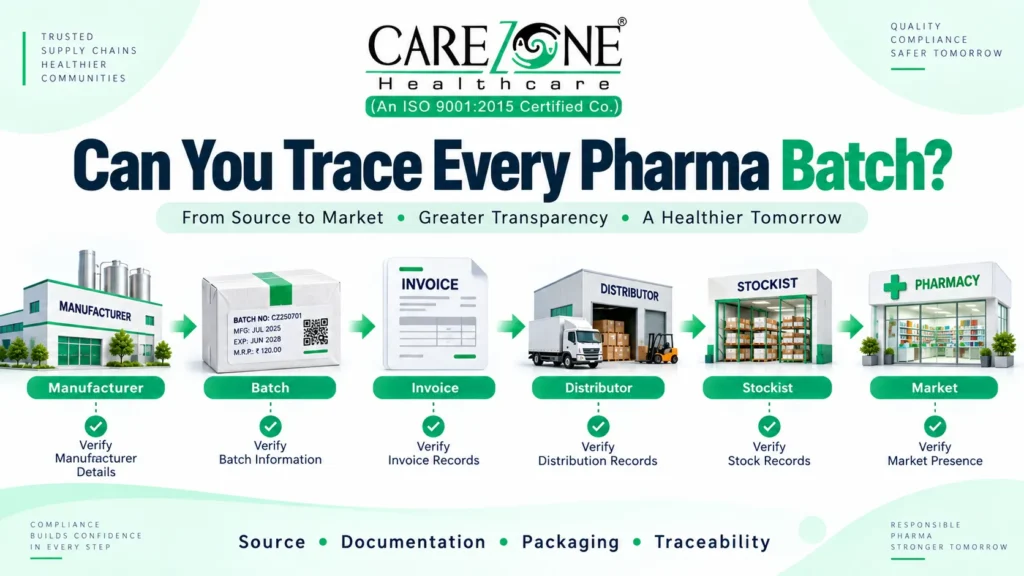
Batch traceability allows a pharmaceutical business to answer five critical questions:
Without these answers, even a business dealing in genuine products may face difficulties responding to a quality alert.
A practical internal system should connect:
Purchase Invoice → Batch Entry → Warehouse Location → Sales Invoice → Customer
For smaller PCD businesses, this does not necessarily require complicated software.
Even a properly maintained billing and inventory system can significantly improve traceability.
Price is naturally important in pharmaceutical distribution.
But an unusually low quotation should lead to more questions—not fewer.
A distributor or franchise partner should be cautious when a seller offers:
The lowest purchase price becomes irrelevant if the stock later creates:
The better commercial question is:
“What is the total risk-adjusted value of this supply relationship?”
not simply:
“Who is giving the lowest rate?”
This principle also applies when selecting a third-party pharmaceutical manufacturer.
Quality, documentation, communication and traceability should be evaluated alongside price.
CDSCO and State Drugs Control Authorities routinely draw samples from the drug supply chain.
The Government stated in March 2026 that findings concerning NSQ, spurious and adulterated drugs are uploaded through monthly drug alerts to make the information publicly available.
CDSCO’s alerts archive separately lists NSQ and spurious-drug alerts, reinforcing why these classifications should not be casually merged.
A distributor, PCD company or pharma brand should therefore establish a simple monthly compliance routine:
Review:
Search by:
A simple compliance log can record:
This creates a repeatable system instead of depending on chance.
A distributor or PCD partner should not independently declare a product fake or spurious based solely on appearance.
Instead, follow a controlled response.
Temporarily isolate the suspicious stock from normal saleable inventory until the issue can be clarified.
Document:
Request written clarification.
Ask whether the packaging and batch correspond with genuine product records.
Check CDSCO and State Drugs Control communications.
If there is genuine concern about illegal or unsafe pharmaceutical stock, the matter should be handled through the appropriate regulatory and law-enforcement framework rather than through social-media accusations.
Do not destroy suspected stock or documentation if it may be required for regulatory investigation.
The CDSCO Misbranded Drugs Crackdown 2026 reinforces an important principle for the pharmaceutical business:
Quality is not only what happens during manufacturing. Trust must continue through documentation, packaging, dispatch and distribution.
For a pharma company, partner confidence should be built through:
Carezone Healthcare is based in Ambala, Haryana and states that it has been operating since 2012. Its current business model supports PCD franchise, third-party manufacturing, distributor, product catalogue and selected international enquiries across pharmaceutical, nutraceutical and cosmetic categories.
The company’s website currently presents a 600+ product portfolio and separate enquiry routes for franchise partners, manufacturing buyers and distributors.
For businesses evaluating Carezone Healthcare as a B2B pharma partner, the relevant next step depends on the business requirement.
Review product categories, preferred territory, investment requirements and licence status before starting the discussion.
Explore Carezone Healthcare PCD Pharma Franchise
Share:
Discuss Carezone Third-Party Manufacturing
Carezone asks prospective distributors to share their:
Contact the Carezone Distributor Enquiry Desk
Business buyers can review Carezone’s current portfolio before requesting product availability and documentation.
View Carezone Healthcare Products
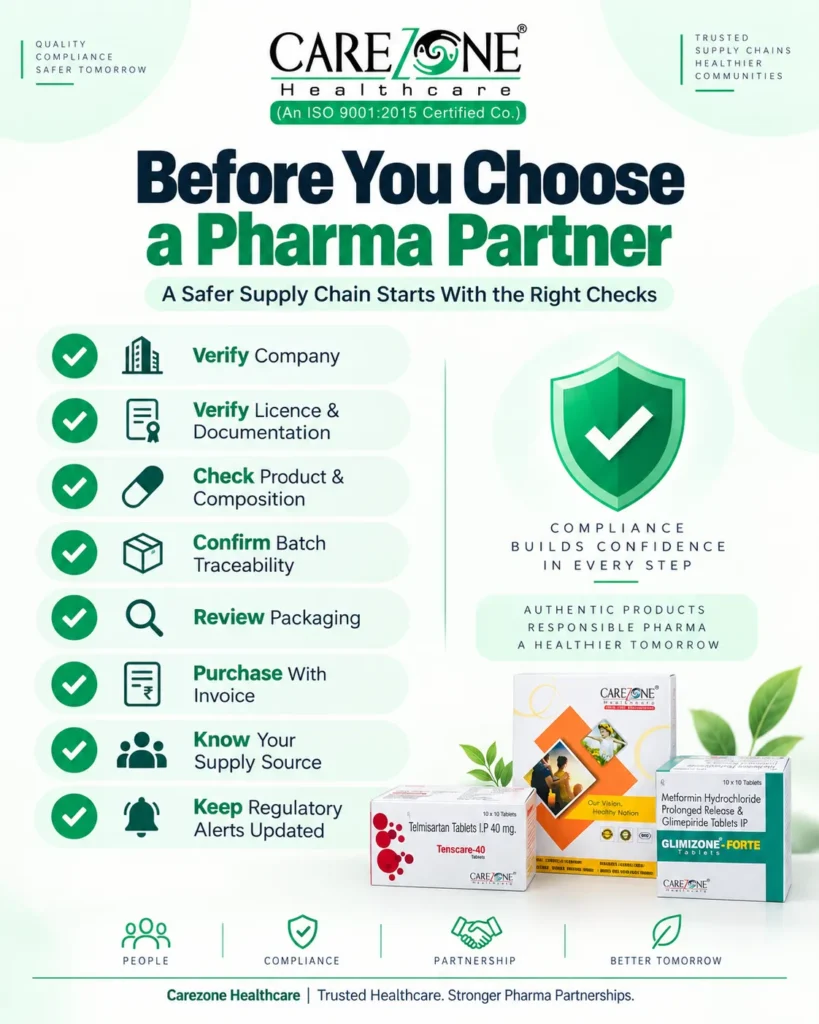
Before entering a new pharmaceutical business relationship, use this checklist according to the transaction and applicable law.
| Verification | What to Check |
|---|---|
| Company Identity | Legal business name, official address and contact details |
| Drug Licence | Applicable licence for the activity being performed |
| GST / Commercial Details | Business and invoice information where applicable |
| Manufacturer | Actual manufacturing source |
| Product Permission | Relevant permission where applicable |
| Composition | Exact active ingredients and strength |
| Dosage Form | Tablet, capsule, syrup, injection, topical etc. |
| Packing | Current approved/authorised pack |
| Batch Number | Consistency across stock and records |
| Mfg. / Expiry | Clear, untampered coding |
| Invoice | Proper documented purchase |
| Packaging | Seal, artwork, statutory information and condition |
| Storage | Relevant temperature/storage requirement |
| Source Chain | Who supplied the product and where it came from |
| Quality Documents | Applicable documents based on transaction/product |
| Complaint Process | Defined contact for quality or supply issues |
| Recall Process | Ability to identify and isolate affected batches |
| Regulatory Alerts | Regular review of CDSCO / State notices |
| Commercial Terms | Written payment, territory, return and supply terms |
| Partner Communication | Official written channel rather than informal verbal claims |
A pharma partnership should never be selected only because the company claims:
Verify what matters to the actual transaction.
Without clear purchase documentation, tracing the source of a disputed batch becomes far more difficult.
Counterfeit or unauthorised products may imitate recognised brands.
Verification should extend to the complete supply chain.
A printing change can sometimes be legitimate, but unexplained differences should be clarified rather than ignored.
NSQ and spurious are not the same classification.
Do not circulate WhatsApp claims about a manufacturer, batch or regulatory action unless the information is verified.
Higher margin cannot compensate for weak sourcing or documentation.
A business cannot respond promptly to a batch alert if nobody is responsible for checking alerts.
The CDSCO Misbranded Drugs Crackdown 2026 refers to renewed regulatory and law-enforcement action highlighted by a CDSCO public notice issued on 5 September 2026 concerning illegal manufacture and distribution of misbranded drugs. The immediate case involved vaccine vials seized from an unlicensed Delhi premises and subsequently classified as misbranded and NSQ.
Under Section 17 of the Drugs and Cosmetics Act, a drug may be considered misbranded if damage is concealed through colouring/coating or similar presentation, if it is not labelled as prescribed, or if the label/container or accompanying material contains a false or misleading claim, statement, design or device.
No. Indian law treats misbranded and spurious drugs as distinct categories. A spurious drug can involve imitation, substitution, false identity or false representation of the manufacturer, while misbranding primarily concerns matters such as misleading presentation or improper labelling.
CDSCO describes Not of Standard Quality (NSQ) drugs as drugs that fail to meet applicable quality standards or specifications. Section 16 of the Drugs and Cosmetics Act connects standards of quality with standards specified under the Act.
No. An NSQ finding should not automatically be described as a fake or spurious-drug finding. Different regulatory categories have different definitions and circumstances. Businesses should use the classification stated by the competent regulatory authority rather than make additional allegations.
A distributor should verify the supplier’s identity and applicable licence, purchase invoice, manufacturer information, product name and composition, batch number, manufacturing and expiry details, packaging integrity, storage conditions and supply-chain source. Where doubts remain, confirmation should be sought from the relevant manufacturer or regulator.
No. A QR code can support authentication and traceability but should not be the only verification method. The September 2026 case reportedly included discrepancies in QR verification as well as artwork, licence details and other packaging features. Supplier verification, invoices and batch traceability remain important.
A PCD partner should verify the pharma company, official product list, composition, relevant business documentation, supplier channel, invoice process, packaging, batch details, territory terms and commercial policies. Written documentation should take priority over verbal promises.
Third-party buyers should verify the manufacturing source, product feasibility, composition, applicable permissions, packaging artwork, manufacturer and marketer details, batch-level documentation, manufacturing quantity, invoice, dispatch information and quality-document requirements relevant to the product.
Pharma businesses should monitor CDSCO’s official Public Notices and Alerts sections as well as relevant State Drugs Control Authority communications. The Government has confirmed that CDSCO and State authorities routinely sample medicines and publish regulatory alerts concerning NSQ, spurious and adulterated products.
The CDSCO Misbranded Drugs Crackdown 2026 should be viewed as more than a single enforcement story.
For the pharmaceutical trade, it is a reminder that product trust must be supported by a traceable and documented supply chain.
The strongest verification model is not:
Good Packaging = Genuine Product
or:
Known Brand = Safe Supply
or:
Low Price = Better Business
A stronger model is:
Licensed Source → Verified Product → Proper Invoice → Traceable Batch → Correct Packaging → Appropriate Storage → Documented Distribution
For distributors, that reduces sourcing risk.
For PCD partners, it protects market trust.
For third-party brand owners, it strengthens control over the product carrying their own brand name.
And for the broader pharmaceutical ecosystem, it helps create the accountability that regulated healthcare products require.
Carezone Healthcare’s view is simple:
A strong pharma partnership begins before the order and continues beyond dispatch.
Documentation, product clarity, traceability, communication and responsible distribution should remain part of every serious pharma business relationship.
Carezone Healthcare supports B2B healthcare business enquiries from Ambala, Haryana, including:
Carezone Healthcare states that it has operated since 2012 and currently presents a 600+ product portfolio, with separate enquiry pathways for franchise, manufacturing and distribution partners.
Share:
Explore Carezone Healthcare PCD Pharma Franchise
For a third-party manufacturing enquiry, share:
MOQ, pricing, manufacturing feasibility, lead time and packaging depend on product category, formulation and final business discussion.
Discuss Third-Party Manufacturing With Carezone Healthcare
Distributors, wholesalers and stockists can share:
Contact Carezone Healthcare Distributor Desk
Explore Carezone Healthcare Product Range
Call / WhatsApp: +91 7488834800
Hello Carezone Healthcare, I would like to discuss your PCD franchise / distributor / third-party manufacturing opportunity. My location is ______ and I am interested in ______ product category. Please share the relevant product and business details.
Carezone Healthcare
Trusted Healthcare. Stronger Pharma Partnerships.
This article is provided for general pharmaceutical-industry, regulatory and business education only.
It is not a substitute for:
A product should not be labelled “spurious”, “misbranded”, “adulterated”, “counterfeit” or “Not of Standard Quality” merely because its appearance seems unusual. Regulatory classifications should be based on applicable law, competent authority findings and appropriate testing/investigation.
Pharma manufacturers, marketers, distributors, wholesalers, retailers and PCD franchise partners should verify current regulatory requirements through official government sources and competent regulatory authorities before taking compliance action.
Patients should not start, stop, replace or modify prescription medicines on the basis of this article. Medicine-related decisions should be made with an appropriately qualified healthcare professional.
Regulatory content last reviewed: 8 September 2026. Because enforcement notices and drug-quality alerts can change, this article should be updated when CDSCO or the relevant State Drugs Control Authority publishes materially new information.
View all

April 15, 2025 | by Carezone Healthcare
May 16, 2025 | by Carezone Healthcare

May 29, 2025 | by Carezone Healthcare