October 9, 2026 | by Carezone Healthcare
Last Regulatory Review: 9 October 2026
Regulatory Context: Supreme Court of India • Department of Pharmaceuticals • UCPMP 2024
Case: Federation of Medical & Sales Representatives Association of India & Ors. v. Union of India & Ors.
Citation: 2026 INSC 1097
Primary Audience: Pharmaceutical companies, PCD franchise partners, distributors, wholesalers, medical representatives, third-party brand owners and healthcare-business professionals
India’s pharma marketing rules in 2026 have moved back into the regulatory spotlight after the Supreme Court directed the Union Government to undertake a fresh, time-bound review of pharmaceutical marketing practices.
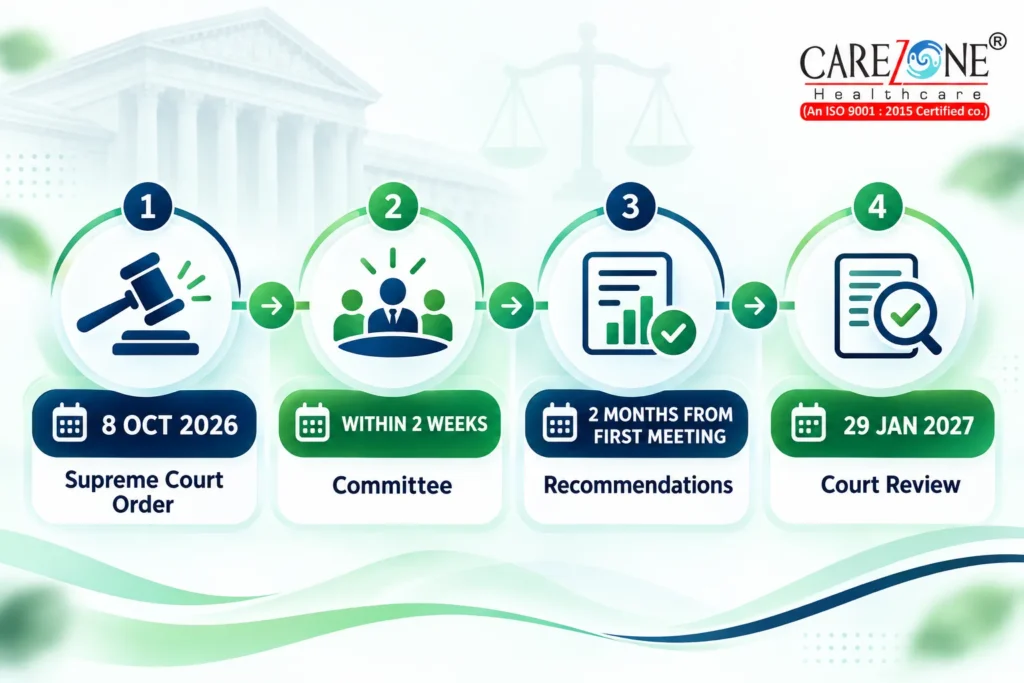
On 8 October 2026, the Supreme Court ordered the Centre to constitute its proposed committee within two weeks to comprehensively examine unethical pharmaceutical marketing practices, the adequacy of the existing framework, monitoring and enforcement mechanisms, transparency, accountability and whether a stronger regulatory or statutory framework is required.
The committee is expected to submit its recommendations to the Union Government within two months from its first meeting. After considering those recommendations, the Government must take a reasoned decision and file a compliance affidavit before the Court. The matter is scheduled to return before the Supreme Court on 29 January 2027.
However, an important distinction must be understood:
The Supreme Court did not ban all pharma-doctor interactions on 8 October 2026, nor did it create an entirely new statutory pharma-marketing law that day.
Until the committee’s recommendations are considered and further action is taken, the existing Uniform Code for Pharmaceutical Marketing Practices 2024 — UCPMP 2024 — continues to govern pharmaceutical marketing practices. The Department of Pharmaceuticals’ official UCPMP portal currently describes UCPMP 2024 as a mandatory code.
That makes the present moment especially important for pharmaceutical companies, distributors, PCD partners and medical representatives.
The key question is no longer simply:
“Are pharma freebies allowed?”
The bigger compliance questions are:
This Carezone Healthcare guide explains the current position without confusing existing rules with possible future statutory changes.
The Supreme Court’s order in Federation of Medical & Sales Representatives Association of India & Ors. v. Union of India & Ors. is reported as 2026 INSC 1097.
The case concerns alleged unethical pharmaceutical marketing practices and their wider implications for:
The petitioners raised concerns about alleged practices such as monetary benefits, gifts, hospitality, sponsored travel, entertainment and other inducements that could influence prescribing behaviour.
The Court directed the Union Government to:
The matter has been listed for 29 January 2027.
The Supreme Court has ordered a structured review of India’s pharmaceutical-marketing framework; it has not itself enacted a replacement pharma-marketing law.
That distinction is critical.
The dispute is not simply about whether ethical guidelines exist.
The larger issue is whether the present system is effective enough in implementation, monitoring, transparency, accountability and enforcement.
The Court observed that the effectiveness of regulation cannot be judged only by the existence of written standards. It must also be assessed by how effectively those standards are implemented and enforced.
The petitioners have argued that unethical promotional incentives may contribute to problems such as:
These allegations and policy concerns formed part of the material before the Court; they should not be interpreted as findings that every pharmaceutical company engages in such conduct.
Strong marketing compliance is not only about avoiding enforcement.
It can also help protect:
A compliant pharmaceutical business should be able to market professionally without depending on inappropriate inducements.
UCPMP stands for:
Uniform Code for Pharmaceutical Marketing Practices.
The Department of Pharmaceuticals issued UCPMP 2024 in March 2024 and asked pharmaceutical associations to circulate it to their members for strict compliance and establish Ethics Committees for Pharmaceutical Marketing Practices.
The official Department portal describes UCPMP 2024 as a mandatory code intended to establish ethical standards for pharmaceutical promotion and interactions between pharmaceutical companies and healthcare professionals.
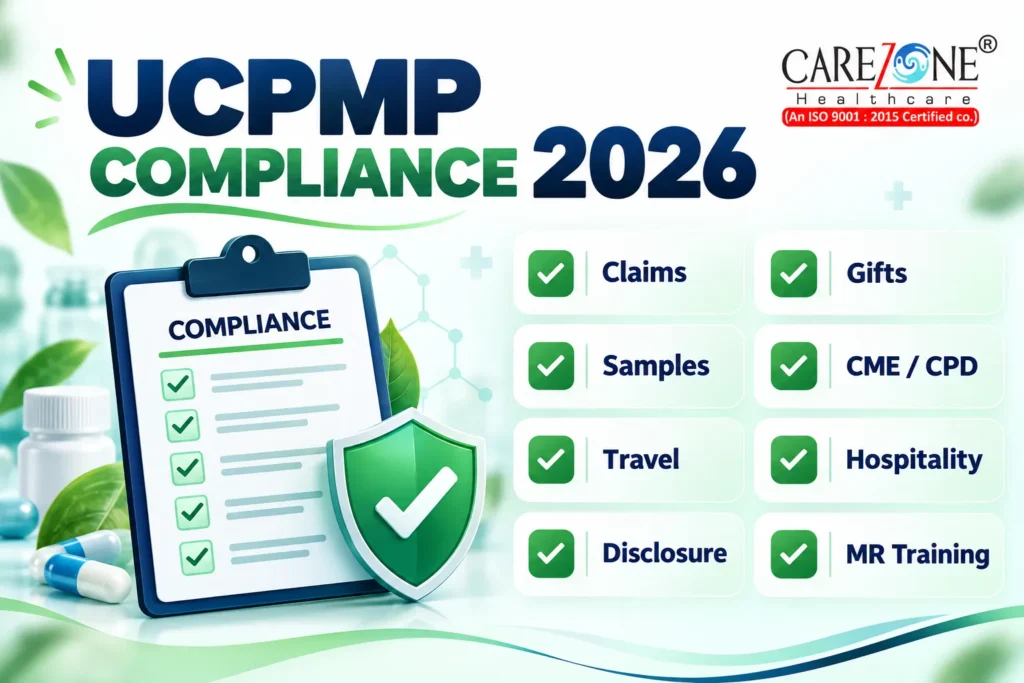
UCPMP covers areas including:
That is an important misconception.
The Code starts much earlier in the marketing process.
For example, medicine promotion must remain consistent with the product’s marketing approval, and promotional information must be balanced, current, verifiable and non-misleading.
For pharma businesses, therefore:
compliance begins with the claim itself — not only with what is given to the doctor.
This is one of the most important questions arising from the Supreme Court proceedings.
The Department of Pharmaceuticals’ official UCPMP portal describes UCPMP 2024 as a mandatory code.
At the same time, the Supreme Court proceedings are examining whether the overall system requires a stronger statutory or regulatory framework with more effective enforcement mechanisms. The Court recorded that UCPMP 2024 would continue to govern pharmaceutical marketing while the new review is undertaken.
Those concepts should not be confused.
A company should therefore avoid either extreme:
Incorrect:
“UCPMP is completely optional, so it can be ignored.”
Also incorrect:
“The Supreme Court has already passed a new pharmaceutical freebies Act.”
The more accurate position as of 9 October 2026 is:
UCPMP 2024 currently governs pharmaceutical marketing, while the Supreme Court-directed process is examining whether the framework should be strengthened through an appropriate statutory and/or regulatory mechanism.
UCPMP requires pharmaceutical promotion to stay aligned with approved product information.
Among other things:
UCPMP also specifically cautions against unqualified claims that a medicine is “safe” or has no side effects or risks.
PCD marketing teams frequently use:
The design may be created by:
But outsourcing the artwork does not automatically remove the need for regulatory accuracy.
Before releasing medicine promotional material, verify:
Carezone Healthcare has already discussed related medicine classification and promotional-risk issues in its regulatory guides.
Internal reading:
Schedule H1 Update 2026 — Carezone Healthcare
Internal reading:
CDSCO Painkiller & Antibiotic Advisory 2026 — Carezone Healthcare
UCPMP 2024 says pharmaceutical companies and their agents should not offer or provide gifts for the personal benefit of healthcare professionals or their family members.
The provision extends to immediate and extended family.
The Code also says no pecuniary advantage or benefit in kind should be offered, supplied or promised to a person qualified to prescribe or supply drugs. Importantly, this provision expressly refers to pharmaceutical-company agents including distributors, wholesalers and retailers.
Depending on the circumstances, problematic items could include things such as:
The key issue is not simply whether the company’s logo appears on an item.
The nature, purpose and value of the item matter.
No.
UCPMP separately permits limited informational and educational brand reminders, subject to specified conditions.
That distinction matters.
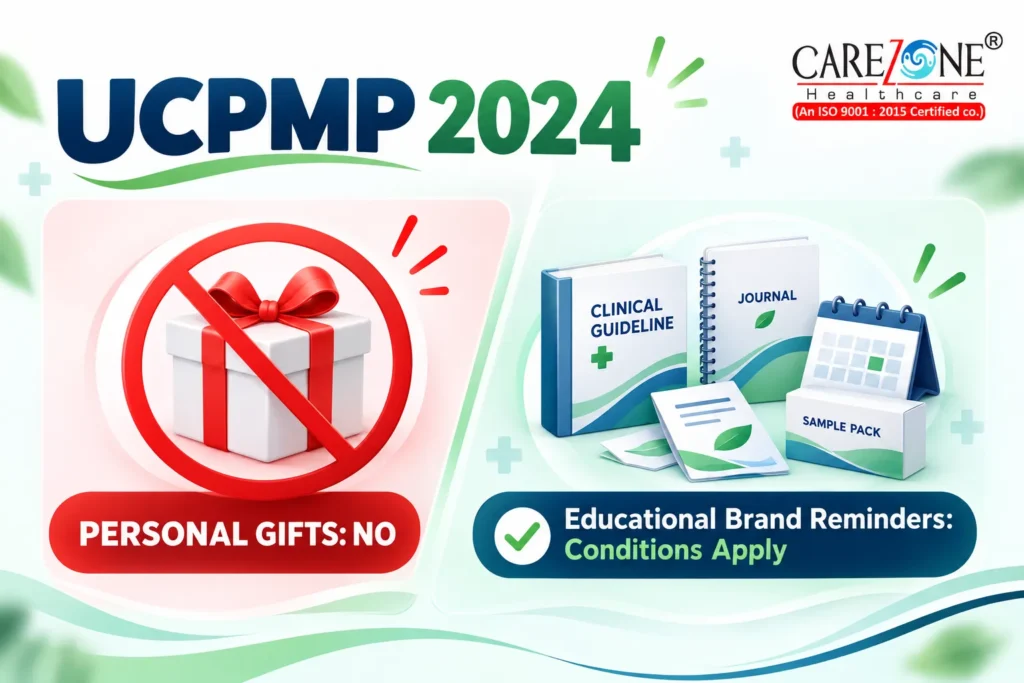
UCPMP recognises two categories of permitted brand reminders:
For informational and educational items, the Code refers to items such as:
The value should not exceed ₹1,000 per item, and the item should not have independent commercial value for the healthcare professional.
This ₹1,000 provision should not be interpreted as:
“Any personal gift below ₹1,000 is allowed.”
That would be an unsafe interpretation.
The category is specifically framed around informational and educational brand reminders, while personal-benefit gifts are addressed separately under the prohibition on gifts.
Yes, UCPMP permits free medical samples, but strict conditions apply.
Free samples should not be treated as unrestricted promotional stock.
The Code provides, among other conditions, that:
UCPMP also states that companies should maintain details including:
The monetary value of free samples distributed should not exceed 2% of the company’s domestic sales per year.
The September 2025 amendment clarified how sample value should be calculated.
For a company’s own manufactured samples, valuation is linked to the per-unit price charged to the stockist or immediate customer for the same dosage form and strength.
Where samples are purchased from another supplier, the purchase price is used for valuation.
A sample-management system should not simply say:
“100 boxes issued for promotion.”
Better records connect:
Product → Sample Pack → Recipient → Quantity → Date → Value → Purpose
That makes internal review much stronger.
UCPMP says pharmaceutical companies, representatives or persons acting on their behalf should generally not provide travel facilities to healthcare professionals or their family members for attending conferences, seminars or workshops.
The provision refers to travel including:
An exception is specified where the healthcare professional is a speaker for a CME or CPD programme.
Whether an expense is compliant depends on:
A doctor being present at a conference is not by itself enough to establish that company-funded travel is permissible.
UCPMP similarly restricts hospitality.
Companies, representatives and persons acting on their behalf should not extend hospitality such as:
to healthcare professionals or their family members unless the person is a speaker for a CME or CPD programme under the relevant provision.
A compliant company should be able to answer:
If the business cannot reconstruct why an expense was legitimate, that itself is a compliance warning sign.
No cash or monetary grant should be paid to healthcare professionals or their immediate or extended family members under any pretext under UCPMP’s healthcare-professional relationship provisions.
This is different from legitimate professional engagements such as bona fide research or advisory services that meet applicable conditions.
UCPMP does not mean the pharmaceutical industry and healthcare professionals can never collaborate.
The Code recognises legitimate research and academic collaboration.
For example, bona fide research should have the required approval from the relevant competent authority where applicable.
Healthcare professionals may also be engaged in consultant-advisory capacity for bona fide research services, supported by a consultancy agreement and appropriate fee or honorarium, subject to applicable legal and ethical requirements.
There is an important difference between:
Payment for genuine, documented professional services
and
a disguised inducement intended to influence prescribing.
Compliance documentation should demonstrate the first.
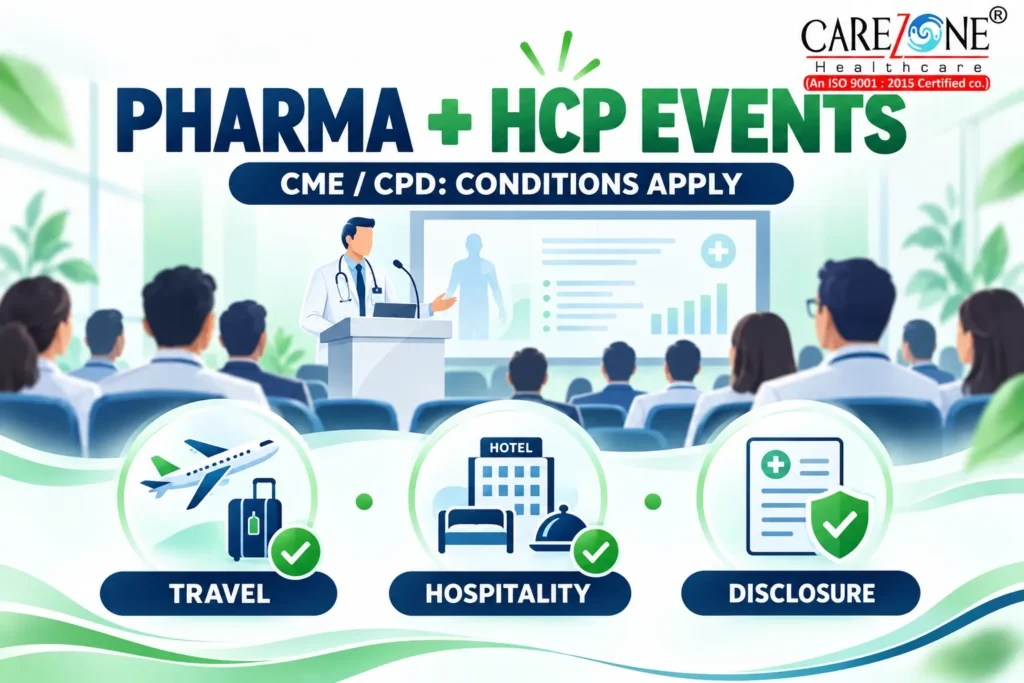
UCPMP permits pharmaceutical-industry engagement in:
But those activities must operate under a transparent and verifiable framework.
The Code states that the conduct of such events in foreign locations is prohibited.
The Code lists eligible organisers including:
Pharma companies are expected to share details of events they conduct, including expenditure, and such information can be subject to independent, random or risk-based audit.
Organisers should also disclose funding sources and expenditure and explain how speakers and participants were selected.
Medical representatives are directly relevant to UCPMP.
The Code defines medical representatives broadly to include sales representatives and other company representatives who call on:
in connection with medicine promotion.
UCPMP states that medical representatives must maintain a high standard of ethical conduct.
They must not use inducement or subterfuge to gain access to a healthcare professional and should not pay under any guise for such access.
The Code states that companies are responsible for the activities of employees, including medical representatives, in relation to compliance.
It also provides for an appropriate UCPMP compliance clause in the employment contract of medical representatives.
A pharmaceutical company should therefore not assume:
“The sales representative did it personally, so the company has no responsibility.”
The company’s:
all matter.
This is particularly important for PCD businesses.
The Department of Pharmaceuticals’ FAQ says pharmaceutical companies, employees, agents and third parties acting on their behalf must comply with UCPMP when marketing medicines in India.
The original Code also expressly refers in relevant provisions to pharmaceutical-company agents such as:
It further states that third parties commissioned to undertake activities covered by the Code should have appropriate working knowledge of UCPMP.
A company should consider compliance across the whole marketing chain:
Pharma Company → Employee / MR → PCD Partner → Distributor / Agent → Promotional Activity
A compliance policy that exists only at head office may be insufficient if field-level conduct contradicts it.
Carezone Healthcare has similarly emphasised supply-chain responsibility in its current regulatory content.
Internal reading:
CDSCO Misbranded Drugs Crackdown 2026 — Carezone Healthcare
Internal reading:
Medical Store CCTV Rules 2026 — Carezone Healthcare
Disclosure is another major UCPMP compliance area.
The Code and subsequent Department of Pharmaceuticals amendments require marketing-expenditure information and compliance declarations.
The 1 September 2025 amendment updated the disclosure framework.
The executive head of the company is responsible for the relevant disclosure, which is to be submitted within the prescribed period following the financial year to the applicable pharmaceutical association, or through the Department portal in specified circumstances where the company is not a member of such an association.
The amended disclosure form includes information concerning:
Free samples
Education programmes organised directly
Education programmes organised through third parties
The form also asks for the methodology adopted to calculate expenditure.
Its expenditure note includes costs such as:
For compliance teams, this means:
marketing expenditure should be auditable, not reconstructed from memory after a complaint arises.
UCPMP establishes Ethics Committees for Pharmaceutical Marketing Practices — ECPMPs — at pharmaceutical-association level.
Complaints normally need to identify:
The original Code provides a complaint timeline linked to the date of the alleged breach and a prescribed complaint fee.
The respondent company can be asked to submit a detailed response and supporting evidence.
The ECPMP is expected to decide complaints within the prescribed process and timeline.
An appeal can go to the Apex Committee for Pharma Marketing Practices — ACPMP, headed at Department of Pharmaceuticals level.
The Department’s dedicated UCPMP portal also provides an appeal mechanism.
Official resource:
Department of Pharmaceuticals UCPMP Portal
UCPMP provides several possible actions after a breach is established.
These can include:
This is precisely where the broader policy debate becomes important.
There is already a compliance structure.
The question now being examined is whether the overall regulatory and statutory framework is sufficiently effective, transparent and enforceable to address unethical pharmaceutical marketing in practice.
This section is essential because breaking-news headlines can create confusion.
No new Parliamentary statute was created on 8 October 2026.
The Court specifically recorded that UCPMP 2024 will continue to govern pharmaceutical marketing practices while the committee process is underway.
Legitimate:
may remain permissible subject to the applicable conditions.
The committee must first:
review → consult → recommend.
Then the Union Government must:
consider → decide → report compliance.
Current UCPMP requirements continue meanwhile.
The committee’s recommendations cannot be predicted with certainty.
However, the Supreme Court has expressly directed the review to consider areas such as:
Potential policy discussions could therefore include stronger mechanisms around:
These should be described as possible areas of reform, not as confirmed future law.
| Stage | Position as of 9 October 2026 |
|---|---|
| Supreme Court order | 8 October 2026 |
| Committee constitution | Within two weeks of order |
| Committee consultation | After constitution |
| Committee recommendations | Within two months from first meeting |
| Union Government decision | After recommendations |
| Compliance affidavit | As directed by Supreme Court |
| Next listed hearing | 29 January 2027 |
The Supreme Court order should not trigger panic.
It should trigger compliance review.
Check:
Separate:
educational/informational items
from:
personal-benefit gifts.
Do not create an internal policy based on the idea that anything below ₹1,000 is automatically acceptable.
Document:
Sales teams should understand:
If franchise partners promote products on behalf of a pharma company, provide clear guidance on:
Marketing agencies, event vendors and field-support agencies working on company activities should not become a route around internal compliance controls.
Do not tell partners:
“Supreme Court has banned all doctor promotion.”
That is inaccurate.
A better summary is:
“The Supreme Court has ordered a review of the regulatory framework while UCPMP 2024 continues to govern pharmaceutical marketing practices.”
Third-party manufacturing does not mean compliance ends once a product leaves the manufacturing facility.
A brand owner should consider:
Carezone Healthcare supports third-party manufacturing enquiries across pharma, nutraceutical and cosmetic categories, including product, packaging and documentation discussion subject to feasibility and applicable requirements.
Carezone internal link:
Explore Third-Party Manufacturing with Carezone Healthcare
The practical lesson is simple:
A product should be compliant not only when manufactured, but also when marketed.
PCD partners often operate close to the market.
They may interact with:
That makes training and promotional discipline important.
PCD businesses should not assume that every promotional method used historically remains suitable under current compliance expectations.
Carezone’s PCD franchise page currently provides territory and product-range enquiry support for pharma entrepreneurs, chemists, distributors and former medical representatives.
Carezone internal link:
Carezone Healthcare PCD Franchise Opportunities
For a broader explanation of the business model:
Carezone internal link:
What Is a PCD Pharma Franchise? Complete 2026 Guide
Distributors should not treat UCPMP as an issue relevant only to pharmaceutical manufacturers.
Certain UCPMP provisions expressly refer to company agents including distributors, wholesalers and retailers.
Carezone Healthcare currently accepts distributor enquiries through its dedicated business contact process.
Carezone internal link:
Carezone Healthcare Distributor & Business Enquiry Desk
A medical representative should be able to discuss a product professionally and scientifically without relying on inappropriate inducements.
In a regulated healthcare industry, a professional MR is also part of the company’s:
scientific communication + reputation + compliance system.
Use this as a practical internal review.
| Compliance Area | Key Question |
|---|---|
| Marketing Approval | Is the promoted indication consistent with approval? |
| Claims | Are claims balanced, current and substantiated? |
| Comparisons | Are comparisons factual and non-misleading? |
| MR Conduct | Are sales representatives trained on UCPMP? |
| Paid Access | Is anyone paying for access to HCPs? |
| Personal Gifts | Are prohibited personal-benefit gifts being avoided? |
| Brand Reminders | Do informational items meet applicable conditions? |
| Free Samples | Are recipient, quantity, date and value recorded? |
| Sample Limits | Are UCPMP quantity/value limits being monitored? |
| CME/CPD | Is the event compliant and transparent? |
| Foreign Event Venue | Has prohibited foreign-location CME/CPD activity been avoided? |
| Travel | Is any HCP travel clearly permitted under the relevant rule? |
| Hospitality | Is hospitality compliant and documented? |
| Cash Grants | Are cash/monetary grants to HCPs prohibited? |
| Research | Is paid professional work bona fide and documented? |
| Third Parties | Are agencies/distributors aware of UCPMP? |
| Marketing Expense | Can expenditure be reconstructed and disclosed? |
| Complaint Process | Is there an internal escalation system? |
| CEO / Executive Oversight | Is senior management aware of disclosure obligations? |
| Regulatory Monitoring | Is the 2026 Supreme Court review being tracked? |
This discussion may appear B2B, but the Supreme Court has connected the issue to a wider public-interest concern.
Pharmaceutical promotion can influence:
The Court therefore considered the issue in the context of the constitutional right to health and the need for ethical, accessible and affordable healthcare.
That does not mean pharmaceutical promotion itself is inherently unethical.
Responsible promotion can:
The issue is whether promotional activity remains scientific, transparent, ethical and compliant.
A pharmaceutical company’s marketing strategy should not be:
Sell first → check compliance later.
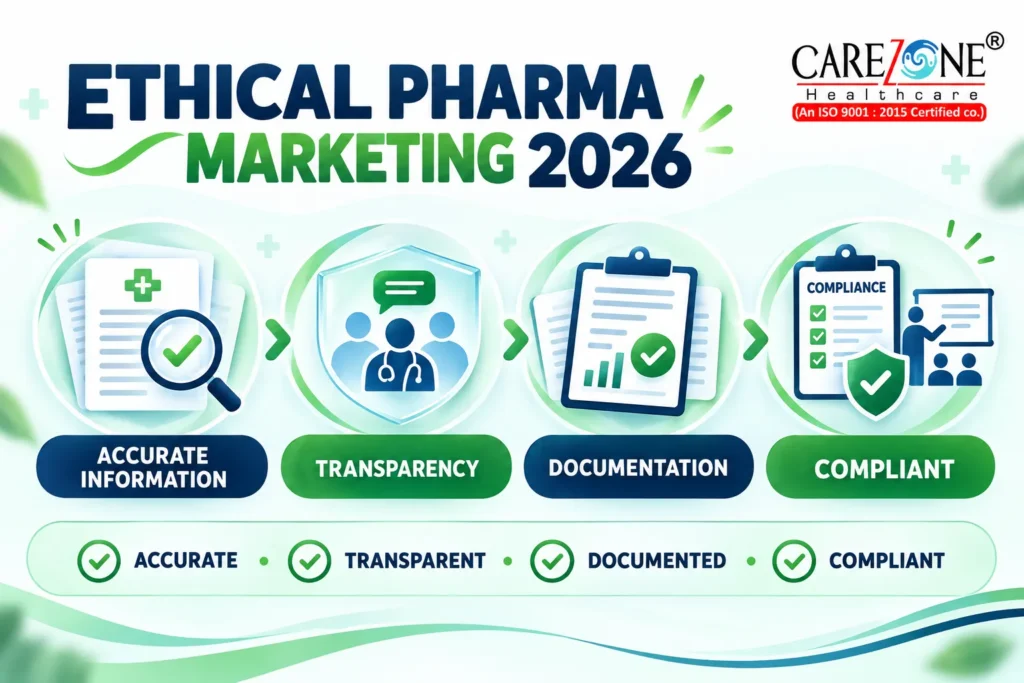
A stronger model is:
Approved Product → Accurate Claim → Compliant Material → Trained Team → Controlled Samples → Documented HCP Engagement → Auditable Expenditure
Carezone Healthcare’s wider regulatory content already follows the same principle across other parts of the pharmaceutical supply chain.
CDSCO Misbranded Drugs Crackdown 2026
Schedule H1 Update 2026: 4 Drugs Proposed
Together, these topics support a wider compliance principle:
Know the product → understand the rule → train the channel → document the activity → verify before promotion.
The 8 October 2026 Supreme Court order is a major regulatory development, but it should be interpreted carefully.
The Court has not created a new pharma-marketing statute overnight.
Instead, it has directed a time-bound expert review of whether India’s current framework is sufficiently effective in:
Meanwhile, UCPMP 2024 continues to govern pharmaceutical marketing practices, and the Department of Pharmaceuticals currently describes it as a mandatory code.
For pharmaceutical businesses, several core rules are already clear:
Personal-benefit gifts: prohibited.
Cash or monetary grants: prohibited.
Travel and hospitality: restricted, with specified CME/CPD speaker exceptions.
Free medicine samples: permitted only within detailed conditions.
Educational brand reminders: permitted within specified limits and conditions.
Medical representatives: must follow ethical promotional standards.
Third parties and agents: cannot be ignored in compliance systems.
Marketing expenditure: increasingly subject to structured disclosure and documentation.
The best response for pharma companies, PCD partners and distributors is therefore not to speculate about the final 2027 framework.
It is to ensure that current marketing practices already withstand compliance scrutiny today.
Pharmaceutical marketing in India is currently governed by several legal and regulatory requirements together with UCPMP 2024. The Department of Pharmaceuticals describes UCPMP 2024 as a mandatory code covering drug promotion, healthcare-professional interaction, gifts, samples, CME/CPD, travel, hospitality, monetary grants, complaints and disclosures.
The Supreme Court directed the Union Government to constitute its proposed committee within two weeks to comprehensively review unethical pharmaceutical marketing practices and the adequacy of the present regulatory framework. The committee is expected to submit recommendations within two months of its first meeting.
The Court did not create a new blanket statutory ban through the October 8 order. It ordered a review of the framework. Existing UCPMP rules relating to gifts, travel, hospitality and monetary benefits continue to govern current practices.
The Department of Pharmaceuticals’ official UCPMP portal describes UCPMP 2024 as a mandatory code. The current Supreme Court process concerns whether the overall framework should receive stronger regulatory or statutory enforcement.
UCPMP says companies and their agents should not provide gifts for the personal benefit of healthcare professionals or their immediate or extended family members.
UCPMP permits specified informational and educational brand reminders such as books, journals and treatment guidelines where the value does not exceed ₹1,000 per item and the item does not have independent commercial value for the healthcare professional. This should not be interpreted as permission for any personal gift below ₹1,000.
Yes, subject to UCPMP conditions. Samples must be provided to qualified prescribers, appropriately marked, documented and kept within applicable quantity and value limits.
UCPMP states that no company should offer more than 12 sample packs per drug to a healthcare practitioner in a year, alongside other conditions relating to sample quantity, pack size and records.
The monetary value of samples distributed by a pharmaceutical company should not exceed 2% of the company’s domestic sales per year under UCPMP.
UCPMP generally prohibits providing travel facilities for healthcare professionals or their families to attend conferences, seminars and workshops, with a specified exception where the HCP is a speaker for a CME or CPD programme.
Hospitality such as hotel or resort accommodation is generally restricted under UCPMP, with a specified exception for speakers at CME or CPD programmes.
UCPMP states that CME/CPD events covered by its framework should not be conducted at foreign locations.
Relevant UCPMP provisions expressly refer to pharmaceutical-company agents including distributors, wholesalers and retailers. The Department’s FAQ also says employees, agents and third parties acting on behalf of companies must comply when marketing medicines in India.
Yes. UCPMP includes specific provisions concerning medical representatives, ethical conduct, access to healthcare professionals and company responsibility for field activity.
The case is listed for 29 January 2027 for consideration of the Union Government’s compliance affidavit.
Regulatory awareness is increasingly important across every part of the pharmaceutical value chain.
Carezone Healthcare, based in Ambala, supports business discussions across:
Carezone’s current website presents a broad pharma, nutraceutical and cosmetic product portfolio together with dedicated business enquiry paths for franchise, manufacturing and distribution requirements.
Explore Carezone PCD Pharma Franchise
Discuss Third-Party Manufacturing
Explore Carezone Healthcare Products
Business enquiries remain subject to product availability, documentation, licensing, regulatory feasibility and final commercial discussion.
This article is for general educational and pharmaceutical-regulatory awareness only.
It is not legal advice and should not be treated as a substitute for advice from:
UCPMP provisions, Department of Pharmaceuticals circulars, professional-conduct rules, tax requirements and other pharmaceutical laws may interact differently depending on the specific activity.
Pharmaceutical companies should verify current Government documents and obtain appropriate professional advice before making a material compliance decision.
Because the Supreme Court-directed committee process is ongoing, future recommendations or Government decisions may change the regulatory position after this article’s review date.
Federation of Medical & Sales Representatives Association of India & Ors. v. Union of India & Ors., 2026 INSC 1097
Read the Supreme Court order text
Official UCPMP 2024 Policy Page
Department of Pharmaceuticals UCPMP Portal
UCPMP Frequently Asked Questions
UCPMP 2024 as amended through 1 September 2025
These official sources should be linked contextually inside the article rather than collected only at the bottom.
View all


May 21, 2025 | by Carezone Healthcare

May 29, 2025 | by Carezone Healthcare