September 25, 2026 | by Carezone Healthcare
Last Regulatory Review: 25 September 2026
Regulatory Context: CDSCO circular listed on 22 September 2026 on indiscriminate use of NSAIDs, antibiotics and associated Chronic Kidney Disease risk
Latest Trade Update: RDCA compliance advisory reported 25 September 2026
Primary Audience: Pharmacists, retail chemists, pharma distributors, wholesalers, stockists, PCD franchise partners, pharmaceutical marketers, manufacturers and healthcare business owners
The CDSCO Painkiller Antibiotic Advisory 2026 has placed renewed attention on self-medication, prescription-only medicine sales, kidney safety and antimicrobial resistance in India.
CDSCO’s official Circulars page currently lists “Indiscriminate use of painkillers (NSAIDs), antibiotics and associated risk of Chronic Kidney Disease” with a release date of 22 September 2026. Contemporary reporting describes the underlying circular as dated 21 September. CDSCO has advised the public, healthcare professionals, pharmacists, retailers, distributors and healthcare institutions to promote the rational and responsible use of non-steroidal anti-inflammatory drugs (NSAIDs) and antibiotics.
The regulator’s message is particularly important because inappropriate NSAID use can increase the risk of kidney injury, while unnecessary or inappropriate antibiotic use contributes to antimicrobial resistance (AMR). WHO identifies misuse and overuse of antimicrobials as major drivers of resistant pathogens.
But there is an equally important regulatory point:
The CDSCO advisory should not be misrepresented as a completely new ban on painkillers or antibiotics. It reinforces rational medicine use and existing prescription, labelling and sale requirements that apply according to the drug’s regulatory classification.
On 25 September 2026, the Retail Distribution Chemist Alliance (RDCA) issued a trade compliance advisory stating that the CDSCO circular does not itself introduce a new retail-drug-licence format, new stock limits, a new mandatory CCTV requirement or a new digital sales-reporting system. Those statements are the trade body’s interpretation of the circular and should be distinguished from formal Government rules.
For Carezone Healthcare’s business audience, the practical question is therefore:
What has CDSCO actually advised, what prescription rules already exist, and what should pharmacists, PCD partners, distributors and manufacturers do differently in day-to-day business?
This guide explains the kidney-risk warning, antimicrobial resistance angle, Schedule H/H1 requirements, pharmacist and distributor responsibilities, and the practical compliance steps pharma businesses should follow without exaggerating the advisory.
The CDSCO Painkiller Antibiotic Advisory 2026 is a regulatory/public-health advisory focused on the indiscriminate use of NSAID painkillers and antibiotics and the associated risks, including kidney complications and antimicrobial resistance.
CDSCO’s official Circulars page lists the advisory as its latest circular with a release date of 22 September 2026.
Government news reporting says CDSCO has called for:
The CDSCO advisory is a medicine-safety and responsible-use intervention. It warns against indiscriminate NSAID and antibiotic use and reinforces compliance with existing prescription-drug requirements rather than creating a blanket new prohibition on every painkiller or antibiotic.
That distinction matters for:
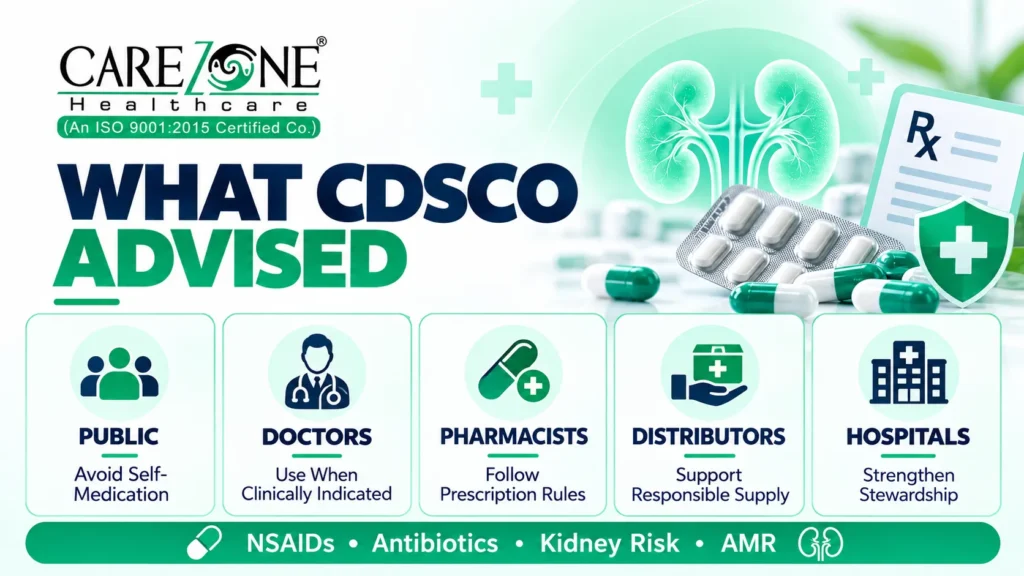
CDSCO’s message applies to several parts of the healthcare system.
Avoid:
Government reporting specifically notes that antibiotics should not be self-used for conditions such as most uncomplicated viral infections.
CDSCO has advised prescribers to consider factors such as:
Pharmacists should not encourage or facilitate self-medication with:
They should follow the statutory sale conditions applicable to the specific product.
The circular reinforces awareness of:
The advisory supports:
The kidneys play an important role in filtering waste, maintaining fluid balance and handling many medicines or their metabolites.
Some medicines can increase kidney risk when:
CDSCO’s advisory specifically highlights concern over indiscriminate NSAID and antibiotic use and its association with avoidable renal complications and Chronic Kidney Disease.
This does not mean:
“Painkillers cause kidney failure in everyone.”
Nor does it mean:
“Antibiotics should never be used in people with kidney disease.”
The correct message is that medicine choice, dose, duration and renal function can matter, and treatment decisions should be made according to the patient’s clinical situation.
Non-steroidal anti-inflammatory drugs are commonly used medicines for pain and inflammation.
The National Kidney Foundation explains that NSAIDs can reduce the amount of blood flowing through the kidneys. This can contribute to acute kidney injury or worsening of Chronic Kidney Disease, particularly with higher doses or longer-term use.
Risk can be greater in people with factors such as:
NSAIDs are not automatically unsafe for every patient, but repeated, high-dose or prolonged use without appropriate medical supervision may increase kidney risk, particularly in susceptible individuals.
The National Kidney Foundation recommends that NSAIDs, when medically appropriate, be used according to professional advice and with attention to the lowest necessary dose and shortest appropriate duration.
National Kidney Foundation — Pain Medicines and Kidney Disease
A responsible pharma article should not say:
The risk depends on the medicine, patient, dose, duration and medical context.
Antimicrobial resistance occurs when microorganisms no longer respond adequately to medicines designed to treat them.
WHO states that misuse and overuse of antimicrobials are major drivers of the development and spread of resistant pathogens.
When antibiotics are used:
they can contribute to resistance pressure.
Drug-resistant infections can become:
WHO reported in July 2026 that approximately one in six laboratory-confirmed bacterial infections worldwide in 2023 was resistant to antibiotics, underlining the global significance of AMR.
Antibiotics target bacterial infections; they are not a general treatment for viral illnesses.
CDSCO specifically cautioned against antibiotic self-medication where antibiotic treatment is not clinically indicated, including many uncomplicated viral infections.
WHO — Antimicrobial Resistance Fact Sheet
The September CDSCO circular primarily reinforces rational use and compliance with the existing regulatory framework; it should not automatically be described as creating a new retail-drug licence, stock limit, CCTV mandate or digital sales-reporting rule.
This point became particularly important on 25 September 2026, when RDCA issued a compliance advisory to chemists and trade distributors.
According to Pharmabiz, RDCA told its members that the CDSCO circular reiterates existing statutory requirements relating to prescription-only medicines and does not itself create:
That clarification is RDCA’s trade/legal interpretation, not a substitute for an official Government notification.
If CDSCO, MoHFW or State Drugs Control authorities subsequently issue a formal statutory change, the formal notification takes precedence.
RDCA compliance advisory reported by Pharmabiz — 25 September 2026
One of the biggest mistakes a pharma business can make is assuming:
Every antibiotic = Schedule H1
or:
Every NSAID = same schedule and same sale conditions
Drug classification is product-specific.
CDSCO’s September circular notes that, depending on applicability and risk, medicines including NSAIDs and antibiotics may fall under Schedules such as G, H, H1 and X, with applicable warnings and conditions of sale.
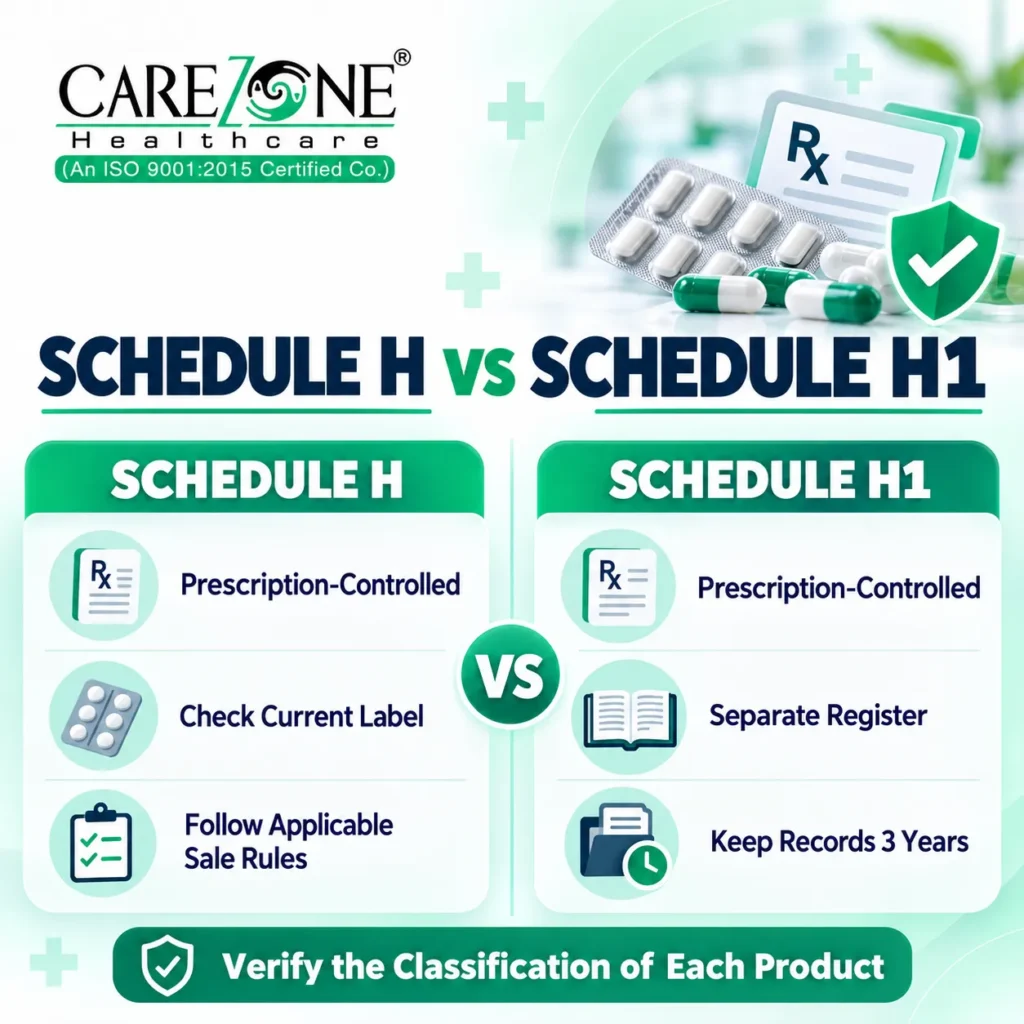
Schedule H generally contains prescription medicines that are subject to applicable prescription-sale requirements.
Schedule H1 was introduced with enhanced controls for specified medicines, including certain antibiotics and other higher-risk categories.
The Government’s official explanation of Schedule H1 states that the supply of an H1 medicine must be recorded in a separate register and that the product carries a specific Schedule H1 warning.
Always verify the actual product classification from the current applicable rules and approved label.
Do not classify a medicine only because it is:
The safest regulatory answer is:
Antibiotic sale conditions depend on the specific product’s classification under the Drugs Rules, but antibiotics falling under prescription schedules such as Schedule H or H1 should not be treated as ordinary OTC products.
For Schedule H1 medicines specifically, Government guidance confirms that retail sale is subject to a prescription and additional register requirements.
Do not write:
“Every antibiotic in India is Schedule H1.”
That would be inaccurate.
Instead:
“Many regulated antibiotics fall under prescription schedules, including Schedule H and H1 depending on the medicine, and businesses should verify the current classification of each product.”
The CDSCO Painkiller Antibiotic Advisory 2026 puts pharmacists and retailers in an important patient-safety position.
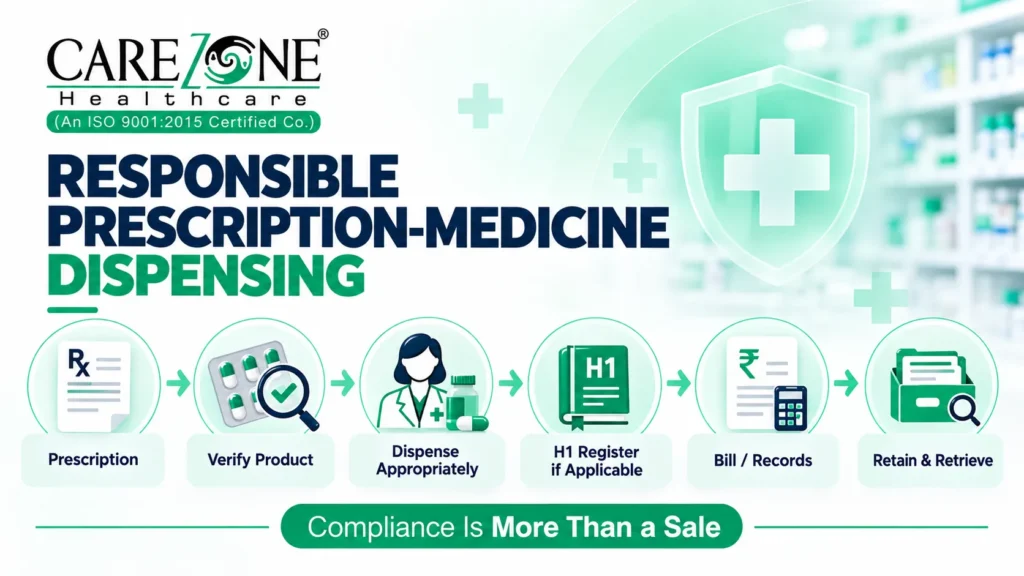
Where a medicine requires prescription sale, follow the applicable requirement.
Do not determine the legal sale status from:
Check the applicable schedule and label.
For Schedule H1 products, maintain the separate statutory register.
Prescription and schedule warnings are not decorative packaging elements.
Staff should understand:
A pharmacy should not encourage unnecessary prescription-medicine consumption to increase sales.
Persistent symptoms require clinical assessment rather than repeated unsupervised medicine purchase.
Government guidance states that supply of a Schedule H1 drug must be recorded in a separate register at the time of supply.
The register includes:
The Schedule H1 register is a statutory retail record designed to improve traceability and oversight of specified higher-control prescription medicines.
It is separate from the idea of merely issuing a cash bill.
A bill and an H1 register serve different compliance functions.
Three years.
Government guidance states that Schedule H1 register records must be preserved for three years and be open for inspection.
This three-year period should not be confused with:
A medical store handling H1 medicines should ask:
Distributors are not the final prescribers or clinicians, but they are an important link in the medicine supply chain.
A strong distribution system should be able to connect:
Manufacturer → Purchase Invoice → Batch → Distributor → Sales Invoice → Retailer / Institution
A distributor should not promote a prescription product as though:
For example:
Wrong:
“CDSCO has banned all painkillers without prescription.”
Better:
“CDSCO has advised rational use of NSAIDs and antibiotics and reinforced compliance with applicable prescription-drug requirements.”
Carezone Healthcare has already covered the importance of source, invoice and batch verification in its regulatory guide on misbranded drugs.
Read: CDSCO Misbranded Drugs Crackdown 2026
PCD partners operate close to doctors, chemists, distributors and local markets, so communication quality matters.
Do not assume classification based only on:
Check the current product information.
PCD promotion should not undermine prescription requirements.
Avoid messaging that suggests:
PCD field teams should understand the difference between:
Carezone Healthcare’s current product catalogue allows B2B partners to review dosage forms, compositions and category information for business discussions.
Explore Carezone Healthcare PCD Pharma Franchise
Read: What Is a PCD Pharma Franchise? Complete 2026 Guide
Manufacturers and marketing companies have an important role in preventing confusion.
Partners should have access to accurate:
Warnings should remain accurate and visible.
Sales teams should know:
Do not tell partners:
“Every antibiotic is now newly banned OTC.”
Instead communicate the actual regulatory position.
If promotional material encourages inappropriate duration, self-medication or consumer-directed use of prescription products, review it.
Businesses planning their own product brands can discuss product category, dosage form, packaging and documentation with Carezone Healthcare’s manufacturing desk.
Carezone Healthcare Third-Party Manufacturing
No new nationwide CCTV requirement is created by this NSAID/antibiotic advisory itself.
RDCA specifically highlighted this in its 25 September trade advisory, saying the circular should not be confused with a new CCTV mandate.
CCTV surveillance at pharmacies is a separate regulatory proposal that Carezone Healthcare has already covered.
A pharmacy receiving both news stories may wrongly combine them:
Painkiller advisory + CCTV draft = “CDSCO ordered CCTV because of painkillers.”
That would be misleading.
The two developments are separate.
Read: Medical Store CCTV Rules 2026
The two developments relate to pharmacy compliance but have different legal functions.
| Development | Main Purpose | Status |
|---|---|---|
| NSAID & Antibiotic Advisory | Rational use, kidney-risk awareness, prescription compliance | CDSCO advisory |
| Medical Store CCTV Proposal | Proposed visual verification of prescription-drug dispensing | Draft proposal |
| Schedule H1 Register | Statutory records for specified H1 medicines | Existing requirement |
| Schedule H2 QR Expansion | Product identification and traceability for specified categories | Separate regulatory framework |
This is a good example of why pharmacies and pharma businesses should maintain a regulatory calendar rather than treating every headline as the same rule.
CDSCO’s advisory also addresses institutional medicine use.
Hospitals can support rational use through:
Antimicrobial stewardship aims to improve how antimicrobial medicines are selected and used.
The goal is not:
“Use fewer antibiotics under all circumstances.”
The goal is:
Use the right antimicrobial, for the right patient, when clinically indicated, using an appropriate regimen.
WHO identifies responsible antimicrobial use as an important element in combating AMR.
The public-health part of the advisory is straightforward.
A previous prescription does not prove the same medicine is appropriate for a new illness.
Many uncomplicated viral illnesses do not require antibiotics.
People with:
may need additional medical consideration before using certain pain medicines.
If a doctor has prescribed an antibiotic or NSAID, do not independently stop, replace or alter it because of a news headline.
Discuss concerns with the treating healthcare professional.
Taking leftover medicine without a clinical assessment may result in:
The advisory does not establish such a blanket new ban.
Classification is medicine-specific.
It has not done so through this advisory.
The CCTV development is separate.
Risk depends on clinical context, dose, duration and patient factors.
Certain antibiotics may require renal consideration, but antibiotics remain essential medicines when appropriately prescribed.
Medicine choice is a clinical decision.
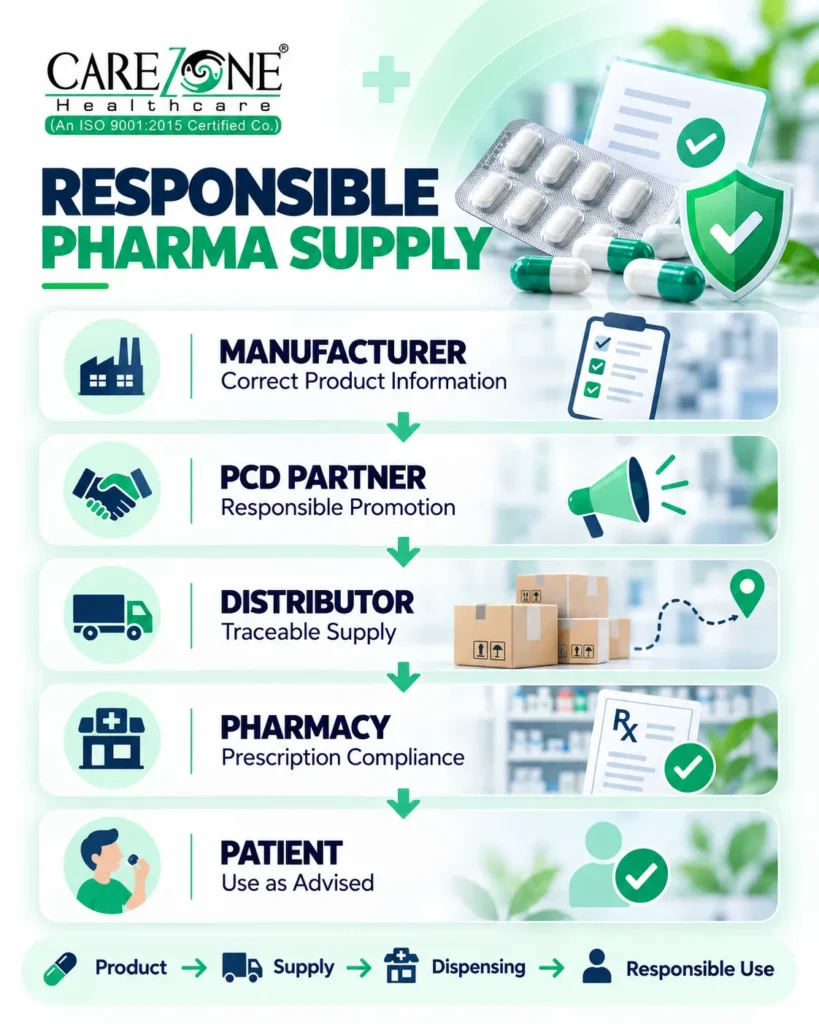
The CDSCO Painkiller Antibiotic Advisory 2026 shows that pharmaceutical responsibility does not end when a product leaves the manufacturer.
A medicine may move through:
Manufacturer → Marketing Company → PCD Partner → Distributor → Medical Store → Patient
Each stage has a role.
Provide accurate product and regulatory information.
Promote responsibly.
Maintain legitimate and traceable supply.
Follow applicable prescription and record requirements.
Prescribe according to clinical need.
Use medicines according to appropriate professional guidance.
Carezone Healthcare is based in Ambala, Haryana and currently presents a broad pharmaceutical, nutraceutical and cosmetic product portfolio for PCD, distributor and manufacturing business discussions. Its current product page lists multiple dosage forms, including tablets, capsules, syrups, suspensions, dry syrups and injections.
The correct business lesson is not:
“Push fewer products.”
It is:
“Promote and distribute medicines responsibly according to their regulatory status and appropriate use.”
Schedule H1 Update 2026: 4 Drugs Proposed
CDSCO Misbranded Drugs Crackdown 2026
Counterfeit Cancer Drugs India 2026
Unauthorised Cosmetics India 2026
Together, these articles create a broader Carezone content cluster around:
Use this checklist according to the actual product and applicable regulatory requirements.
| Verification Area | What to Check |
|---|---|
| Product Name | Exact current product |
| Composition | Active ingredient(s) and strength |
| Dosage Form | Tablet, capsule, liquid, injection etc. |
| Schedule Classification | H / H1 / other applicable schedule |
| Prescription Status | Current sale conditions |
| Label Warning | Applicable statutory warning |
| Manufacturer | Legitimate manufacturing source |
| Batch | Current identifiable batch |
| Expiry | Clear and current |
| Invoice | Proper commercial supply trail |
| Supplier Licence | Applicable legal authorisation |
| Retail Prescription | Where required |
| H1 Register | Where product falls under H1 |
| H1 Record Retention | Three years |
| Promotion | No encouragement of self-medication |
| Sales-Team Training | Current schedule and warning awareness |
| Distributor Communication | Accurate regulatory messaging |
| Complaint / ADR Route | Defined escalation process |
| Regulatory Monitoring | CDSCO / State updates |
| Patient Safety | No inappropriate OTC encouragement |
The checklist should not be treated as a substitute for current Drugs Rules or regulatory advice.
The CDSCO Painkiller Antibiotic Advisory 2026 is a regulatory and public-health advisory warning against indiscriminate use of NSAID painkillers and antibiotics. CDSCO has highlighted kidney-risk concerns, antibiotic self-medication and responsible prescription/dispensing practices. Its official Circulars page lists the circular with a release date of 22 September 2026.
No blanket new ban on painkillers has been created by this advisory. CDSCO has warned against indiscriminate, repeated or prolonged NSAID use without appropriate medical supervision and has reinforced compliance with applicable prescription-sale requirements.
The circular reinforces existing prescription-drug requirements and advises against antibiotic self-medication. Whether a particular antibiotic is Schedule H, H1 or subject to another applicable classification should be verified product by product. Schedule H1 medicines specifically are subject to prescription and register requirements.
NSAIDs can reduce blood flow through the kidneys and may increase the risk of acute kidney injury or worsening Chronic Kidney Disease, particularly at higher doses, with longer use or in susceptible patients. Medicine use should therefore reflect the individual clinical situation.
Unnecessary or inappropriate antibiotic use creates selection pressure that helps resistant microorganisms survive and spread. WHO identifies misuse and overuse of antimicrobial medicines as major drivers of antimicrobial resistance.
No. Businesses should not assume every antibiotic is automatically Schedule H1. Drug classification depends on the specific medicine and applicable Drugs Rules. Certain antibiotics are included in Schedule H1 and are subject to enhanced retail record requirements.
Government guidance says the separate register should record the name and address of the prescriber, patient name, drug name and quantity supplied.
Schedule H1 records must be preserved for three years and be available for inspection.
No. This advisory itself does not create a new CCTV requirement. CCTV at medical stores is part of a separate regulatory proposal. RDCA also highlighted this distinction in its 25 September trade advisory.
They should verify product schedule classification, maintain accurate product information, avoid promotional messages that facilitate self-medication, support legitimate invoiced distribution and ensure retail partners receive correct regulatory information. Product-specific requirements should always be verified under current rules.
The CDSCO Painkiller Antibiotic Advisory 2026 should not be reduced to a headline such as:
“Painkillers and antibiotics banned.”
The actual message is more useful.
CDSCO is reinforcing:
Appropriate Clinical Use → Correct Prescription Practice → Responsible Dispensing → Required Records → Responsible Distribution → Patient Awareness
For pharmacists, this means respecting prescription and record requirements.
For distributors, it means accurate supply and regulatory communication.
For PCD partners, it means promoting prescription medicines responsibly.
For manufacturers and marketing companies, it means ensuring that schedule classification, labels, warnings and partner education remain accurate.
For patients, it means avoiding casual, repeated or prolonged self-medication.
The kidney-risk and AMR concerns are serious, but the response should be accurate compliance and rational medicine use—not fear or misinformation.
Carezone Healthcare’s practical conclusion is:
Responsible pharma partnerships are built not only on product availability, but also on correct information, traceable distribution and appropriate medicine use.

Carezone Healthcare supports B2B pharmaceutical business enquiries from Ambala, Haryana, including:
Carezone Healthcare’s current website presents a broad product portfolio across multiple dosage forms and supports dedicated enquiry pathways for PCD, distribution and manufacturing discussions.
Prepare:
Explore Carezone Healthcare PCD Pharma Franchise
For manufacturing discussions, share:
Carezone’s current manufacturing page notes that MOQ, lead time and feasibility depend on product category, formulation and packaging.
Discuss Third-Party Manufacturing With Carezone Healthcare
Share:
Contact Carezone Healthcare Business Desk
Explore Carezone Healthcare Product Range
Call / WhatsApp: +91 7488834800
Email: info@carezonehealthcare.com
Hello Carezone Healthcare, I would like to discuss your PCD franchise / distribution / third-party manufacturing services. My location is ______ and I am interested in ______ product category. Please share the relevant product and business details.
Carezone Healthcare
Trusted Healthcare. Stronger Pharma Partnerships.
This article is provided for general pharmaceutical-industry, regulatory and health education only.
It is not a substitute for:
The CDSCO advisory discussed here should not be interpreted as a universal ban on all NSAIDs or antibiotics.
Drug classification and prescription requirements depend on the specific product and applicable regulatory provisions.
Patients should not start, stop, replace, repeat or alter:
on the basis of this article.
Medicine choice, dosage and treatment duration should be determined by an appropriately qualified healthcare professional.
The RDCA clarification discussed in this article is an industry/trade advisory, not a Government statutory notification.
PCD franchise, distribution and manufacturing results vary according to products, territory, market conditions, regulatory requirements and commercial execution. Carezone Healthcare does not guarantee business returns or monopoly allocation.
Regulatory and medical content last reviewed: 25 September 2026. This article should be refreshed if CDSCO, MoHFW or relevant State Drugs Control authorities issue material new guidance concerning NSAIDs, antibiotics, AMR or prescription-drug dispensing.
View all


April 26, 2025 | by Carezone Healthcare
May 16, 2025 | by Carezone Healthcare

April 25, 2025 | by Carezone Healthcare