September 11, 2026 | by admindefault
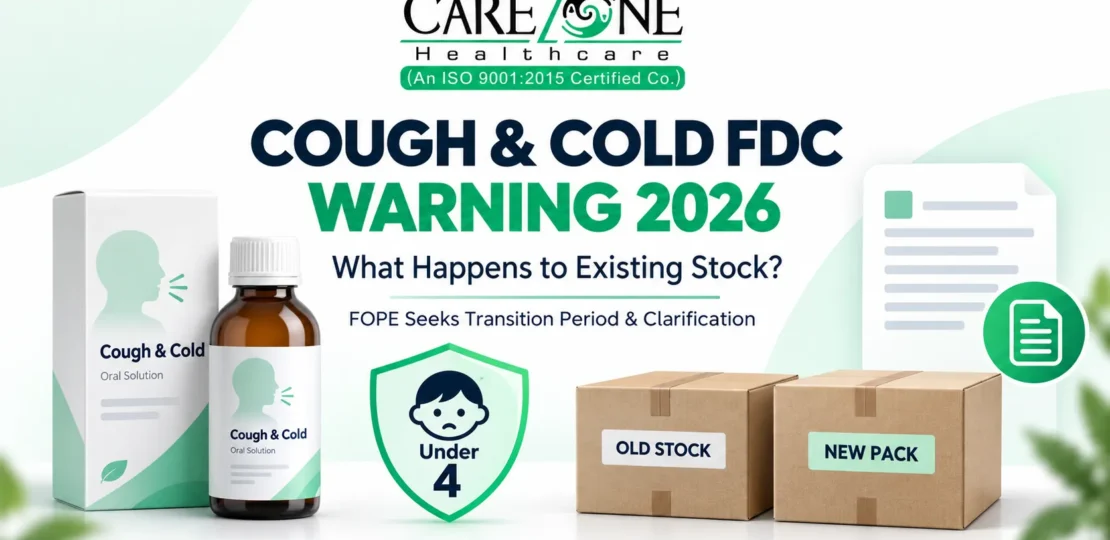
Regulatory Reference: S.O. 4595(E), dated 18 August 2026
Latest Industry Development: FOPE representation reported on 10 September 2026
Primary Audience: Pharmaceutical manufacturers, PCD franchise partners, distributors, stockists, wholesalers, marketing companies and third-party brand owners
India’s Cough & Cold FDC Warning 2026 has moved from a straightforward labelling update into a practical supply-chain question: what should happen to products manufactured and distributed before the new warning requirement came into force?
Through S.O. 4595(E), dated 18 August 2026, the Government restricted the manufacture, sale or distribution of all formulations of fixed-dose combinations containing Chlorpheniramine Maleate and Phenylephrine Hydrochloride, subject to manufacturers carrying the warning:
“Fixed dose combination shall not be used in children below four years of age.”
The warning is required on the label and package insert or promotional literature, and the notification states that it comes into force from the date of publication in the Official Gazette. CDSCO lists S.O. 4595(E) on its Gazette Notifications page, while the Ministry of Health and Family Welfare has separately explained that the 2026 action extends the warning requirement to all applicable FDC formulations containing these two ingredients.
A fresh development on 10 September 2026 has now added an important industry dimension. The Federation of Pharma Entrepreneurs (FOPE) has asked the Government for a reasonable transition period and clarification on existing inventory, retrospective enforcement, dosage-form scope and whether warning stickers or stamps could be permitted for stock already in the supply chain.
For pharmaceutical businesses, the key point is simple:
The Government notification is already operative. FOPE’s transition-period and stickering requests are industry proposals—not permissions that manufacturers, distributors or PCD partners should assume have already been granted.
This Carezone Healthcare guide explains the confirmed rule, the FOPE requests, the unresolved existing-stock questions and the practical verification steps relevant to manufacturers, PCD partners, distributors and third-party brand owners.
S.O. 4595(E) restricts the manufacture, sale or distribution of all formulations of fixed-dose combinations containing Chlorpheniramine Maleate and Phenylephrine Hydrochloride unless manufacturers carry the prescribed warning concerning use in children below four years.
The notification was issued by the Ministry of Health and Family Welfare on 18 August 2026 under Section 26A of the Drugs and Cosmetics Act, 1940. CDSCO’s Gazette Notifications page describes it as the prohibition/restriction concerning all formulations of FDCs containing Chlorpheniramine Maleate and Phenylephrine HCl in children below four years.
The notification requires manufacturers to mention:
“fixed dose combination shall not be used in children below four years of age”
on the label and package insert or promotional literature of the drug. The notification states that it comes into force from the date of publication in the Official Gazette.
The Government’s PIB explanation further states that the 2026 notification extends the age-specific warning requirement across all applicable FDC formulations containing the two ingredients.
The 2026 change is a use restriction combined with a mandatory warning requirement. It should not be described as a universal ban on every medicine containing Chlorpheniramine Maleate or every medicine containing Phenylephrine Hydrochloride individually.
The regulatory focus is on fixed-dose combinations containing both ingredients within the scope of S.O. 4595(E).
No. S.O. 4595(E) does not amount to a blanket prohibition of these ingredients for every age group and every use.
The Government has restricted the manufacture, sale and distribution of the affected FDCs subject to the condition that manufacturers carry the warning that the fixed-dose combination shall not be used in children below four years.
That distinction is important for:
Avoid headlines such as:
“Government bans Chlorpheniramine and Phenylephrine medicines.”
That wording is too broad.
A more accurate description is:
“Government requires an under-four warning and restricts affected Chlorpheniramine Maleate + Phenylephrine Hydrochloride FDCs accordingly.”
For B2B teams, precise regulatory language matters because an inaccurate “complete ban” message can create:
The current rule did not appear without regulatory history.
On 18 December 2023, CDSCO wrote to State/UT Drugs Controllers concerning a specific FDC of Chlorpheniramine Maleate IP 2 mg + Phenylephrine HCl IP 5 mg drop/ml.
CDSCO stated that concerns had been raised regarding promotion of an anti-cold formulation for infants and that the Subject Expert Committee recommended that the FDC should not be used in children below four years. The authority asked that the warning be mentioned on the label and package insert/promotional literature.
The Government subsequently issued S.O. 1717(E), dated 15 April 2025.
That notification restricted manufacture, sale or distribution of all formulations of the fixed-dose combination of Chlorpheniramine Maleate + Phenylephrine Hydrochloride, subject to the same under-four warning condition.
The notification followed recommendations from the Subject Expert Committee and the Drugs Technical Advisory Board.
The 2026 notification went further by addressing other fixed-dose combinations containing Chlorpheniramine Maleate and Phenylephrine Hydrochloride, following Expert Committee and DTAB consideration.
The Government’s explanatory release states that the latest notification extends the requirement to all formulations containing these two ingredients.
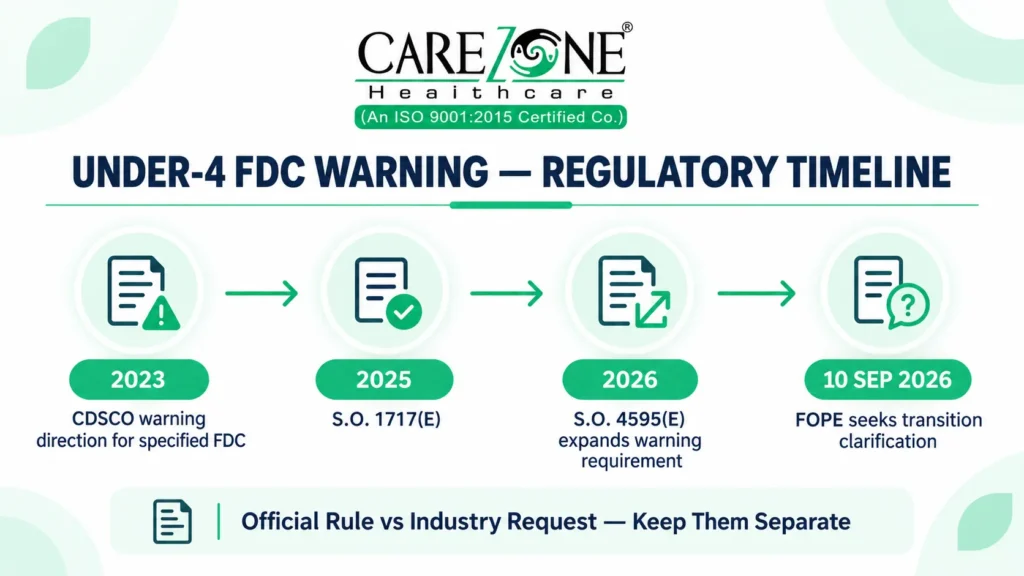
FOPE’s concern is primarily operational.
By the time a regulatory notification comes into force, pharmaceutical stock may already exist at multiple stages of the supply chain.
FOPE pointed out that pre-notification products may already be held by:
This creates practical questions.
A product may have been:
FOPE therefore asked the Government for:
FOPE also proposed an authorised mechanism for adding the warning to existing stock through stickers, stamps or modified package inserts where appropriate.
These are FOPE requests. They should not be presented as Government-approved transition rules unless the competent authority formally accepts or clarifies them.
That distinction is central to this article.
| Issue | Position as of 11 September 2026 |
|---|---|
| S.O. 4595(E) issued | Confirmed |
| Notification date | 18 August 2026 |
| Effective from publication | Confirmed |
| Under-four warning required | Confirmed |
| Applies to affected FDC formulations containing both ingredients | Confirmed |
| Warning on label | Confirmed |
| Warning in package insert or promotional literature | Confirmed |
| FOPE requested transition period | Confirmed as industry request |
| FOPE requested prospective treatment of pre-notification stock | Confirmed as industry request |
| FOPE proposed stickers/stamps | Confirmed as industry proposal |
| Automatic permission for distributors to sticker products | Not established by FOPE request |
| General sell-through period for all old stock | Needs authoritative clarification/product-specific guidance |
| Automatic recall of all pre-notification stock | Should not be assumed from FOPE’s representation |
| Scope across unusual dosage forms | FOPE has requested further clarification |
This table is particularly important because regulatory articles can easily blur three different things:
Law → Industry Request → Business Interpretation
They are not the same.
This is currently the most commercially important question.
The notification itself is already effective, but FOPE has specifically sought clarification on stock manufactured and distributed before the notification. Businesses should not independently assume that all pre-notification stock may automatically continue unchanged—or that it must automatically be recalled or destroyed.
Instead, manufacturers and downstream partners should identify affected inventory and obtain appropriate written guidance.
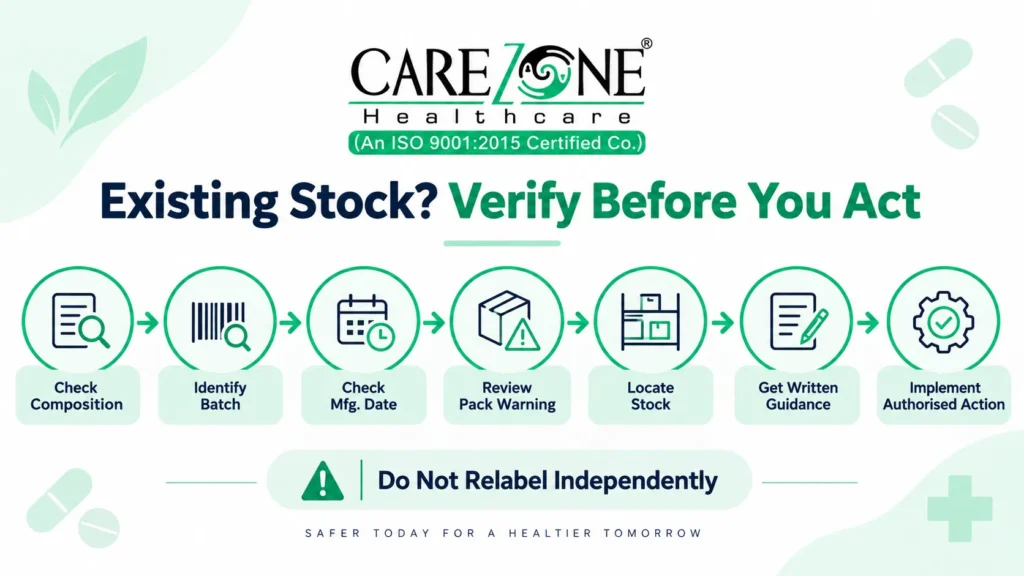
The first step is to separate stock into clearly identifiable categories:
Record:
For post-notification manufacturing, companies should ensure the applicable warning and regulatory requirements are incorporated in the controlled artwork and packaging process.
Identify whether the stock is with:
Regulatory, production and artwork teams should determine what version is being used and whether the batch falls under current requirements.
A distributor should not make its own product-label modification decision.
Instead:
This approach reduces both regulatory risk and unnecessary commercial disruption.
Not merely because FOPE has requested it.
FOPE proposed using a mechanism under Rule 104A of the Drugs and Cosmetics Rules, 1945 to permit warning stickers or stamps on existing inventory.
However, Rule 104A itself generally states that no person shall alter, obliterate or deface a manufacturer’s inscription or mark on a drug container, label or wrapper, subject to an exception where alteration is made at the instance, direction or with the permission of the Licensing Authority.
This means:
Rule 104A should not be interpreted as a blanket right for a distributor, PCD partner, retailer or brand owner to start applying stickers independently.
CDSCO has previously issued specific clarifications under Rule 104A in other contexts. For example, a May 2025 CDSCO Office Memorandum regarding imported drugs described controlled overprinting/stickering conditions and licensing requirements for that particular situation.
That example reinforces the core principle:
Authorised relabelling is a controlled regulatory activity—not an informal packaging correction.
Before adding any warning sticker, stamp or overprint:
The Government notification uses broad wording covering all formulations of fixed-dose combinations containing Chlorpheniramine Maleate and Phenylephrine Hydrochloride.
FOPE has nevertheless requested clarification because the expression “FDC” could theoretically reach dosage forms that industry believes may not match the policy context, including examples such as eye drops or injectables.
Manufacturers should not decide scope merely from marketing assumptions such as “this is not a cough syrup.” The exact composition and formulation should be reviewed against the notification, product permission and any subsequent regulatory clarification.
The practical trigger is not simply whether a product looks like a typical cough syrup.
Businesses should ask:
Until more detailed guidance is issued, manufacturers should involve their regulatory teams rather than make broad assumptions.
Manufacturers sit at the centre of the implementation process because the notification specifically places the warning requirement on manufacturers of affected drugs.
Search every active and planned SKU containing:
Chlorpheniramine Maleate + Phenylephrine Hydrochloride
Do not search only by brand name.
A multi-ingredient cold formulation may contain the two ingredients along with additional actives.
Record:
Check all relevant:
Do not paraphrase the Government warning casually.
Use controlled regulatory artwork based on the exact applicable requirement.
The regulatory team should ensure that superseded packaging files cannot be mistakenly released for new production.
Count:
This matters for both compliance planning and commercial impact.
Separate stock by:
One approved communication should explain:
Do not allow warehouses, distributors or field teams to alter labels independently.
Because FOPE has now formally raised existing-stock and implementation concerns, regulatory teams should monitor CDSCO/MoHFW and State Licensing Authority communications closely.
PCD partners usually do not control manufacturing artwork, but they may hold or market affected inventory.
That creates a different responsibility.
Do not assume every cough/cold product is affected.
Equally, do not assume a product is outside the notification because its brand name does not mention either ingredient.
Verify the current composition from:
Ask:
If a brochure, visual aid, digital creative or product card covers an affected formulation, request the latest approved version.
Do not keep circulating outdated pediatric-use messaging.
PCD sales teams should not tell retailers or prescribers that an affected FDC can be used in children below four contrary to the prescribed warning.
Maintain:
This becomes particularly important if the manufacturer later issues transition or replacement instructions.
For businesses evaluating a franchise opportunity, Carezone Healthcare’s current PCD page explains its product-category and territory discussion process.
Explore Carezone Healthcare PCD Pharma Franchise
Carezone has also published a detailed guide explaining the PCD model and product-selection considerations.
What Is a PCD Pharma Franchise? Complete 2026 Guide
Distributors are likely to be among the stakeholders most affected by ambiguity around existing stock.
FOPE specifically highlighted inventory already held by distributors and stockists when asking for a transition period.
A distributor should therefore create a targeted inventory review.
Search by composition, not only brand.
For each affected SKU, record:
Keep a clear record of the warning status and packaging version.
Ask for written instructions from the:
The FOPE representation does not itself authorise distributors to modify labels.
If guidance later affects particular batches, the distributor should know which customers received them.
Retain manufacturer circulars and regulatory instructions together with batch records.
Affected products should be flagged internally so that warehouse staff do not mix pack versions without awareness.
The issue is especially relevant for businesses using third-party pharma manufacturing.
When a brand owner outsources manufacturing, the regulatory requirement still affects the product sold under that brand.
A practical workflow is:
Brand Owner → Manufacturer → Regulatory Review → Artwork → Packaging Vendor → Manufacturing → Dispatch → Distribution
Do not rely only on the product name.
Check the full approved composition.
Clarify whether artwork sign-off sits with:
Determine whether old cartons, labels or inserts remain in stock.
A visually approved carton is not automatically a regulatorily current carton.
If finished products were manufactured before the notification, obtain written advice on how the manufacturer is handling affected stock.
If relabelling is being considered, regulatory/licensing-authority requirements must be addressed.
Carezone Healthcare currently accepts third-party manufacturing discussions for pharma, nutraceutical and cosmetic categories. Its website notes that final MOQ, lead time, feasibility and documentation depend on formulation, dosage form, packaging, approvals and internal review.
Discuss Third-Party Manufacturing with Carezone Healthcare
For an affected formulation, manufacturers and brand owners should review more than the outer carton.
| Material / Control Point | What to Review |
|---|---|
| Primary Label | Applicable under-four warning |
| Outer Carton | Current controlled artwork |
| Package Insert | Warning and product information |
| Promotional Literature | No outdated pediatric-use message |
| Visual Aid | Current approved regulatory wording |
| Product Card | Composition and warning consistency |
| Digital Product PDF | Replace outdated files |
| Website Product Information | Review applicable product wording |
| Sales-Team Material | Remove superseded versions |
| Packaging Inventory | Quantity of old printed material |
| Artwork Version Number | Current vs obsolete |
| Finished Goods | Batch and packaging version |
| Distributor Circular | Written implementation instructions |
The notification’s exact wording should guide regulatory artwork.
Do not shorten the warning into an ambiguous advertising phrase such as:
“Not recommended for kids.”
Regulatory warnings are not marketing copy.
| Stock Situation | Recommended Business Action |
|---|---|
| Manufactured after S.O. 4595(E) | Ensure current regulatory requirements are incorporated before release |
| Manufactured before notification, still at manufacturer | Identify batch and seek regulatory/compliance decision |
| Pre-notification stock at C&F | Record quantity and await/implement written authorised instruction |
| Pre-notification stock with distributor | Identify batches; obtain supplier/manufacturer guidance |
| Stock already at retailer | Maintain traceability and follow competent instructions |
| Old promotional literature | Review and replace where outdated |
| Packaging material not yet used | Regulatory team should assess whether it requires revision |
| Pack missing new warning | Do not independently add sticker without appropriate authorisation |
| Product composition unclear | Verify composition before classifying |
| Product appears outside typical cough/cold dosage form | Regulatory review required; do not assume exemption |
This is a practical risk-management table, not an official CDSCO transition protocol.
FOPE has specifically requested clarification on this issue.
That means businesses should seek authoritative/product-specific guidance rather than create their own universal rule.
The notification does not mean a distributor should spontaneously destroy inventory without appropriate instructions.
FOPE has requested one.
A request is not an approval.
Rule 104A involves regulatory control over alterations to labels and packs.
The notification uses broad FDC/formulation wording.
Coverage depends on composition and regulatory status.
The focus here is the relevant FDCs containing both Chlorpheniramine Maleate and Phenylephrine Hydrochloride.
Regulatory compliance and medically responsible communication should remain separate from sales pressure.
For a pharma business, the most useful way to manage the Cough & Cold FDC Warning 2026 is not through a general message such as:
“Change all cough products.”
The correct operational approach is more precise:
Notification → Composition Search → Affected SKU → Batch → Artwork Version → Stock Location → Partner Communication
This reduces two opposite risks:
Carezone Healthcare’s current website lists products across 12 dosage-form categories, including syrups/oral liquids, suspensions, drops and dry syrups, and its PCD page includes a Pediatric range for business discussion.
However, this article does not state or imply that a particular Carezone Healthcare product contains the ingredients covered by S.O. 4595(E).
For example, Carezone’s current catalogue lists CARECOLD TAB but states that composition is available on request; therefore its regulatory status should not be inferred from the brand name alone.
That is exactly the principle pharmaceutical partners should apply across the industry:
Verify composition first. Classify second. Communicate third.
For related regulatory reading:
Schedule H1 Update 2026: 4 More Drugs Proposed
CDSCO Misbranded Drugs Crackdown 2026
These articles build a broader Carezone Healthcare knowledge cluster around pharma compliance, supply-chain verification and B2B regulatory awareness.
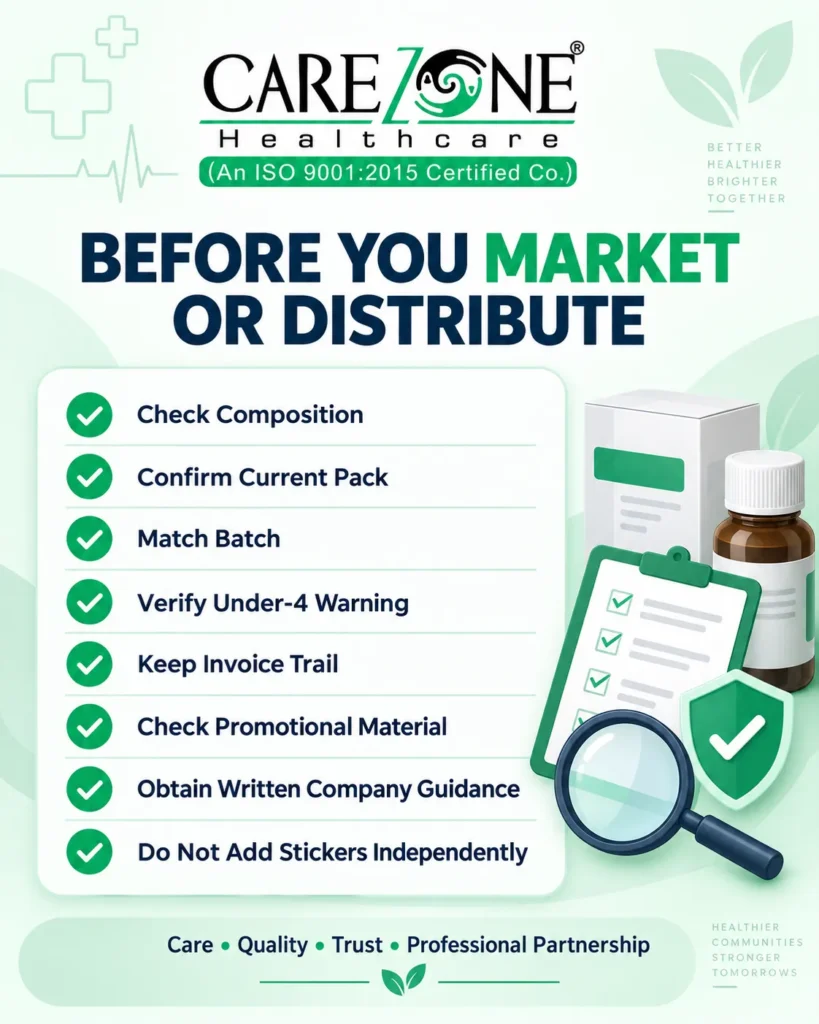
Before manufacturing, buying, stocking or promoting a cough/cold or pediatric formulation, verify the details relevant to the transaction.
| Verification Area | What to Check |
|---|---|
| Product Name | Exact current brand/product |
| Composition | Every active ingredient |
| Strength | Exact strength per dosage unit |
| Dosage Form | Syrup, drops, tablet, suspension etc. |
| Regulatory Status | Current applicable notification/rule |
| Product Permission | Relevant permission where applicable |
| Manufacturer | Actual manufacturing source |
| Marketing Company | Correct marketer details |
| Artwork Version | Current approved version |
| Warning | Applicable statutory/regulatory warning |
| Package Insert | Current approved content |
| Promotional Literature | No outdated age/use statements |
| Batch Number | Batch-level identification |
| Manufacturing Date | Pre/post-notification relevance |
| Expiry | Current and legible |
| Existing Stock | Location and quantity |
| Invoice Trail | Supplier and downstream traceability |
| Distributor Communication | Written company instruction |
| Complaint Contact | Defined escalation route |
| Regulatory Updates | Monitor CDSCO/MoHFW/SLA guidance |
A checklist does not replace professional regulatory review, but it reduces the risk of decisions based only on product names or informal messages.
The Government’s warning is clear: affected fixed-dose combinations containing Chlorpheniramine Maleate and Phenylephrine Hydrochloride should not be used in children below four years of age.
Parents should not use this article to:
For a child with cough, cold, breathing difficulty, fever or persistent symptoms, medicine selection should be discussed with an appropriately qualified healthcare professional.
The article’s primary purpose is to explain the regulatory and pharmaceutical supply-chain implications, not to provide personalised treatment advice.
The Cough & Cold FDC Warning 2026 refers to S.O. 4595(E), dated 18 August 2026, which restricts manufacture, sale or distribution of affected FDC formulations containing Chlorpheniramine Maleate and Phenylephrine Hydrochloride subject to an under-four warning. The notification is final and states that it comes into force from its Gazette publication date.
The Government requires manufacturers of affected FDCs to state that the fixed-dose combination shall not be used in children below four years of age. The requirement applies to the label and package insert or promotional literature according to the notification wording.
No. The notification is not a universal ban on the individual ingredients for every patient or age group. It restricts manufacture, sale and distribution of the relevant fixed-dose combinations subject to the mandatory under-four warning and prohibits use of the affected FDCs in children below four years.
FOPE has specifically asked the Government for a transition period and prospective treatment of compliant pre-notification stock already present in the supply chain. Businesses should therefore identify old inventory and follow written manufacturer/regulatory guidance rather than independently assume universal sell-through, recall or destruction.
FOPE’s reported representation requests a transition period, prospective treatment and uniform implementation guidance. The representation itself is not a Government approval. Pharma businesses should monitor CDSCO, MoHFW and relevant Licensing Authority communications for authoritative clarification.
They should not assume they can do so independently. FOPE has proposed a mechanism involving stickers or stamps, but Rule 104A generally restricts alteration of manufacturer inscriptions except at the instance, direction or with permission of the Licensing Authority. Any relabelling should therefore follow authorised regulatory/manufacturer instructions.
The notification refers broadly to all formulations of fixed-dose combinations containing Chlorpheniramine Maleate and Phenylephrine Hydrochloride. FOPE has asked for further clarification concerning scope across different dosage forms. Manufacturers should review exact compositions, product permissions and subsequent regulatory guidance rather than assume the rule applies only to syrup.
A PCD partner should identify the product and batch, verify the composition, check the pack-warning status, preserve invoices and obtain written guidance from the manufacturer or marketing company. The partner should not alter product labels or issue independent medical-use claims.
Ask for the affected SKU list, regulatory interpretation, artwork status, batch status, packaging-material position, finished-stock instructions and documentation needed for future production. Any stickering or relabelling proposal should be handled through the appropriate authorised process.
The strongest starting points are CDSCO Gazette Notifications, Ministry of Health & Family Welfare / PIB releases, the Official Gazette and relevant State Licensing Authorities. Industry bodies and trade publications can identify implementation concerns, but they do not replace Government clarification.
The Cough & Cold FDC Warning 2026 is no longer only a packaging-news story.
For manufacturers and brand owners, it is an artwork, packaging and finished-stock control issue.
For distributors and stockists, it is an inventory and batch-traceability issue.
For PCD partners, it is a product-verification and communication issue.
And for healthcare communication, it is a child-safety and responsible-use issue.
Three facts should remain separate:
1. S.O. 4595(E) is already a final notification.
2. The under-four warning requirement is confirmed.
3. FOPE’s requests for a transition period, prospective handling and a sticker/stamp mechanism are requests for clarification—not rules that businesses should implement independently.
The most practical approach is:
Verify Composition → Map Affected SKU → Identify Batch → Review Artwork → Locate Existing Stock → Obtain Written Guidance → Implement Authorised Changes → Communicate Downstream
Pharma businesses should avoid both extremes:
Ignoring the regulation and overreacting without clarification.
Carezone Healthcare’s perspective is that regulatory changes are managed most effectively when businesses combine current official information with disciplined documentation, batch traceability and controlled partner communication.

Carezone Healthcare is based in Ambala, Haryana and supports B2B enquiries across:
Carezone Healthcare’s current website states that the company has operated since 2012 and presents a broad 600+ product portfolio.
Share:
Explore Carezone Healthcare PCD Pharma Franchise
Product availability, franchise territory and commercial terms depend on current company policy and individual business review.
For third-party manufacturing enquiries, share:
Discuss Carezone Healthcare Third-Party Manufacturing
MOQ, lead time, pricing, documentation and feasibility vary according to product, formulation, packaging, raw materials, approvals and final internal review.
Distributors can share:
Contact Carezone Healthcare Business Desk
Carezone’s current product page includes tablets, capsules, syrups/oral liquids, suspensions, dry syrups, drops, injections and topical product categories for B2B discussion.
View Carezone Healthcare Product Range
Call / WhatsApp: +91 7488834800
Email: info@carezonehealthcare.com
Hello Carezone Healthcare, I would like to discuss your PCD franchise / distribution / third-party manufacturing services. My location is ______ and I am interested in ______ product category. Please share the relevant product and business details.
Carezone Healthcare
Trusted Healthcare. Stronger Pharma Partnerships.
This article is provided for general pharmaceutical-industry, regulatory and educational information.
It is not a substitute for:
FOPE’s transition-period, prospective-treatment and stickering proposals discussed in this article are industry requests. They should not be treated as Government permissions unless formally accepted or clarified by the competent authority.
Manufacturers, marketers, brand owners, PCD partners, distributors, stockists and retailers should verify product-specific obligations with their regulatory teams, manufacturer, applicable Licensing Authority and official Government sources before modifying stock, packaging or promotional material.
Parents and caregivers should not use this article to select or dose medicines for children. Medicine use for a child should follow appropriate professional medical advice.
Business availability, territory allocation, MOQ, manufacturing feasibility, pricing and commercial results vary. Carezone Healthcare does not guarantee franchise income, monopoly availability or business returns.
Regulatory content last reviewed: 11 September 2026. This article should be updated promptly if CDSCO, MoHFW or a competent Licensing Authority issues new clarification regarding S.O. 4595(E), existing inventory, transition periods or relabelling.
View all


June 14, 2025 | by Carezone Healthcare

June 7, 2025 | by Carezone Healthcare

June 2, 2025 | by Carezone Healthcare